

BPS Solitons, Walls, Strings, Vortices, and Junctions
BPS solitons are finite-energy or finite-tension field configurations whose topological or extended central charge saturates a supersymmetry bound. Completing the energy into nonnegative squares gives first-order equations; setting the same combination of fermion variations to zero gives the preserved-supercharge projector. Agreement of the two derivations is a powerful normalization and sign check, but neither derivation guarantees that a solution with the requested boundary data exists.
Required background. BPS particles and central charges supplies shortening logic, and gauge-matter F- and D-term potentials fixes the component conventions. Helpful background. Bogomolny bounds develops the general square-completion method, while zero modes and collective coordinates treats fluctuations about a solution.
The common BPS construction
Section titled “The common BPS construction”For static fields in a fixed topological sector, seek a decomposition
where depends only on asymptotic or defect data. Positivity gives after choosing the orientation that makes the boundary term nonnegative. Saturation requires
for every square. Independently, vary the fermions and demand
for a nonzero supersymmetry parameter . The resulting projector selects the same phase and orientation as the boundary charge. The square-completion method and its topological boundary term originate in Bogomolny 1976, pp. 449–454, INSPIRE record.
A complete BPS statement specifies:
- the vacuum approached in every asymptotic direction;
- the topological sector, charge normalization, and orientation;
- the first-order equations and preserved supercharges;
- the boundary term and hence the tension or mass;
- existence, moduli, normalizability, and stability separately;
- the regime in which gravity, higher derivatives, and quantum corrections are neglected.
Domain walls from a superpotential
Section titled “Domain walls from a superpotential”Consider a four-dimensional Wess–Zumino model with canonical kinetic term and a static configuration interpolating between supersymmetric vacua and . Its tension is
For any constant phase ,
Choose . Then
Along a solution,
Thus the image of a BPS wall is a straight segment in the appropriately rotated -plane, traversed monotonically. This is a useful necessary condition for existence. It is not sufficient: the corresponding gradient-flow trajectory must actually connect the two critical points.
For several chiral fields with Kähler metric , the equation becomes
The tension remains in the stated normalization. Reversing the wall orientation sends and therefore (equivalently, it reverses the unit normal). The projector below acquires the corresponding minus sign and selects the complementary half of supersymmetry; the oriented boundary term reverses before the absolute value is taken.
The canonical-flat-Kähler flow, orientation reversal, and tension normalization above agree with Shifman and Voloshin 1998, § 1, manuscript pp. 2–3, eqs. (2) and (5), PDF. That source assumes canonical kinetic terms: it is not the source of the curved-Kähler inverse-metric generalization displayed above, which follows by the same square completion with retained.
The fermion variation fixes that projector without an extra convention choice. In the component convention of the preceding chapter,
On the BPS branch , this becomes
Thus a wall of the displayed orientation preserves precisely the parameters obeying
together with the Hermitian-conjugate relation. This real projector leaves two of the four real supercharges. It also shows directly why the phase in the square completion and the phase of the preserved supersymmetry cannot be chosen independently.
For a four-component explicit-model cross-check of the complementary wall projectors, see Dvali and Shifman 1997, § 2.1, manuscript pp. 3–5, eqs. (4)–(9), PDF. Their gamma-matrix convention differs from the two-component convention used here, so the comparison is structural rather than a componentwise identity.
The translational collective coordinate also passes an explicit norm check. For a centered profile , a slowly varying displacement gives
The equality uses the BPS equation and the displayed tension functional. Consequently the wall worldvolume action contains
Finite tension therefore makes the translation mode normalizable per unit wall area. A formal deformation with divergent kinetic norm would instead change boundary data and would not be a collective coordinate.
In the same explicit model, the normalized translation profile and its goldstino partner are exhibited in Dvali and Shifman 1997, § 2.1, manuscript pp. 5–6, eqs. (10)–(12), PDF, again as a profile and gamma-convention cross-check rather than a replacement for the normalization derived above.
Abelian BPS vortices
Section titled “Abelian BPS vortices”Take a theory in the transverse plane with a charge- scalar , covariant derivative , magnetic field , and geometric moment-map level
Thus in the convention inherited from the gauge–matter page. The corresponding energy per unit length is
The displayed one-scalar model is a classical Abelian-Higgs fixture for the local D-term and BPS equations. A four-dimensional quantum theory with only this charge- chiral multiplet has a gauge anomaly, so no standalone quantum theory is being claimed here. A supersymmetric quantum application must place this sector in an anomaly-free matter completion while preserving the displayed vacuum and low-energy equations.
Using
and finite-energy boundary conditions, the tension can be written
At spatial infinity and , so
Choosing the sign appropriate to yields
For , one consistent orientation is
with both signs reversed for an antivortex. The coupling cancels from the topological tension because it appears both in the covariant derivative and in flux quantization. A different convention that places in front of the gauge kinetic term reallocates factors of ; the physical tension is unchanged after parameters are translated consistently.
The vector and chiral variations reproduce both first-order equations. On this bosonic background and , so the equation gives . With in the site’s sigma-matrix convention,
The gaugino variation vanishes for
The Hermitian-conjugate projector implies for the upper dotted spinor. Hence
where the first term vanishes by and the second by the spinor projector. Thus the supersymmetry variations reproduce the same orientation as the energy bound and preserve two real supercharges. For , the equations are , , and .
An explicit FI-string realization of the first-order equations, half-BPS projector, and fermion modes appears in Davis, Davis, and Trodden 1997, § IV, manuscript pp. 10–11, eqs. (4.1)–(4.10), PDF. Their covariant derivative, FI parameter, and gauge-coupling normalizations differ from those used here, so individual factors should be compared only after translating the complete convention package.
The equations imply the bound, but existence is a separate boundary-value theorem. On the critically coupled plane, set . For every unordered -tuple of points, with repetitions allowed, there is a unique solution modulo gauge whose Higgs zeros occur at precisely those points with the prescribed multiplicities Taubes 1980, § III, Theorem 1, printed p. 281. The position moduli space is therefore : the isomorphism sends the unordered roots to the coefficients of their monic polynomial. It is smooth and has real dimensions, so coincident vortices are not orbifold singularities of this coarse moduli space. In particular, a localized unit vortex has two gauge-compensated translational zero modes with finite transverse norm. Additional size or orientational modes depend on the matter content and flavor symmetry.
Monopoles and strings
Section titled “Monopoles and strings”For an adjoint Higgs field in a Yang–Mills theory, the static energy in the Prasad–Sommerfield limit has the schematic completion
This is the canonical-field normalization . The frequently used completion with an overall instead belongs to holomorphic fields and a consistently rescaled vector-multiplet scalar; the connection, scalar, field strength, and prefactor must be translated together. The BPS equation is . The surface term pairs the asymptotic scalar with the magnetic charge and matches the particle central charge in an extended-supersymmetry embedding. Its coefficient still depends on generator and trace normalization, so a monopole mass formula should never be copied without those conventions. The explicit regular monopole in this limit is the Prasad–Sommerfield 1975, pp. 760–762 solution.
Vortex strings instead carry a two-form or string charge in the extended supersymmetry algebra. Domain walls carry tensorial charges appropriate to codimension one. These are not Lorentz-scalar central charges of an isolated particle algebra; they commute only with the unbroken worldvolume symmetry. The term “BPS” covers all of them because positivity and shortening work after adapting the algebra to the extended object. Particle-like scalar topological charges are explained in Witten and Olive 1978, pp. 97–101. The distinct four-dimensional string and wall extensions, including their vector and rank-two tensor charges, are given in Ferrara and Porrati 1998, § 2, manuscript pp. 2–4, Eqs. (3), (7), and (8).
The upper bands of the next figure make this algebraic boundary explicit. Inspect them before following the lower chamber flow: that flow is a particle fixture and its KS factors do not contain the tensorial charges of the wall or string sector.
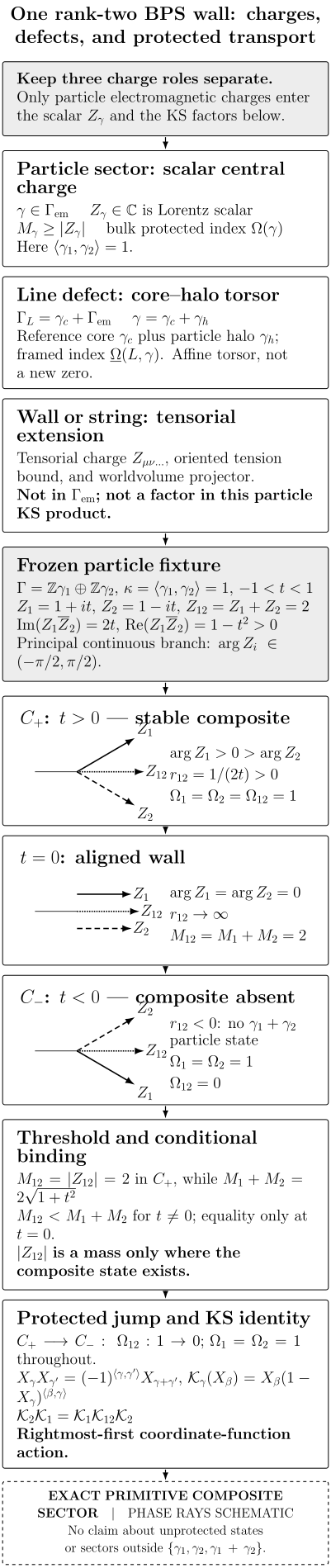
Particle charges enter a Lorentz-scalar and the displayed KS product; wall and string charges are tensorial extensions with oriented tension bounds and worldvolume projectors. The lower rank-two example is exact only for its primitive particle composite sector, where the seed states remain as changes from one to zero. Phase-ray angles are schematic. The structured fixture and charge-role table records the equations, hypotheses, source locators, and independent checks.
Junctions and compatible phases
Section titled “Junctions and compatible phases”A wall junction in two transverse dimensions must balance tension vectors. If wall has complex charge proportional to , a static three-wall junction requires
The spatial orientation of each wall is tied to the phase of its charge by its supersymmetry projector. A set of walls preserves a common supercharge only when those projectors have a nonzero common solution. Force balance is necessary but not sufficient: the coupled first-order PDE and boundary conditions still need a solution.
Analogous compatibility conditions govern confined monopoles on vortices and endpoints of strings on walls. Charge conservation, projector intersection, and boundary conditions are three separate checks.
Quantum meaning of a classical BPS solution
Section titled “Quantum meaning of a classical BPS solution”Classical saturation often protects the central-charge relation, but the soliton’s quantum interpretation requires more work. One must quantize normalizable bosonic and fermionic zero modes, determine the resulting supermultiplet, and check whether it can pair into a long multiplet. Non-normalizable modes change boundary conditions rather than label states. A protected index may survive deformations even when the detailed spectrum does not.
Higher-derivative corrections can modify the first-order field profile while leaving an exact central charge fixed. Conversely, an anomaly or quantum correction can alter the relation between a microscopic parameter and the exact central charge. The safe statement names the exact charge and the approximations used to construct the profile.
Common pitfalls
Section titled “Common pitfalls”Choosing an absolute value too early. The square completion has an oriented boundary term. Choose the projector and orientation first; take the absolute value only when stating the unoriented energy bound.
Inferring existence from saturation equations. First-order equations are necessary for a BPS configuration, but boundary data may admit no solution. Gradient-flow intersections, topological theorems, or explicit construction supply existence.
Counting every formal zero mode. Only normalizable fluctuations are collective coordinates of a finite-energy object. Gauge transformations and changes of boundary conditions must be removed.
Exercises
Section titled “Exercises”Let with real positive , and restrict to a real wall from to .
- Write the BPS equation for the orientation in which increases with .
- Solve it.
- Compute the wall tension from .
Solution
Here . Since , choose . The equation is , whose centered solution is . Finally,
Translating the center gives the normalizable zero mode associated with broken translations.
For the vortex, reproduce the preserved supersymmetry rather than starting from the answer:
- Insert into and derive the projector on .
- Use its Hermitian conjugate and to show .
- State the three sign changes for an antivortex.
Solution
For ,
so . Its conjugate gives . In the decomposition of displayed above, the first term vanishes by the vortex equation and the second by this spinor projection. For , the consistent package is
Changing only one of these signs would make the energy and supersymmetry derivations disagree.
References
Section titled “References”- Bogomolny, E. B. “Stability of Classical Solutions.” Soviet Journal of Nuclear Physics 24 (1976): 449–454. INSPIRE record.
- Davis, Stephen C., Anne-Christine Davis, and Mark Trodden. “N=1 Supersymmetric Cosmic Strings.” Physics Letters B 405 (1997): 257–264. doi:10.1016/S0370-2693(97)00642-4. arXiv:hep-ph/9702360.
- Dvali, Gia, and Mikhail Shifman. “Dynamical Compactification as a Mechanism of Spontaneous Supersymmetry Breaking.” Nuclear Physics B 504 (1997): 127–146. doi:10.1016/S0550-3213(97)00420-3. arXiv:hep-th/9611213.
- Ferrara, Sergio, and Massimo Porrati. “Central Extensions of Supersymmetry in Four and Three Dimensions.” Physics Letters B 423 (1998): 255–260. doi:10.1016/S0370-2693(97)01586-4. arXiv:hep-th/9711116.
- Prasad, M. K., and Charles M. Sommerfield. “Exact Classical Solution for the ’t Hooft Monopole and the Julia–Zee Dyon.” Physical Review Letters 35 (1975): 760–762. doi:10.1103/PhysRevLett.35.760.
- Shifman, Mikhail A., and Mikhail B. Voloshin. “Degenerate Domain Wall Solutions in Supersymmetric Theories.” Physical Review D 57 (1998): 2590–2598. doi:10.1103/PhysRevD.57.2590. arXiv:hep-th/9709137.
- Taubes, Clifford Henry. “Arbitrary -Vortex Solutions to the First Order Ginzburg–Landau Equations.” Communications in Mathematical Physics 72 (1980): 277–292. doi:10.1007/BF01197552.
- Witten, Edward, and David Olive. “Supersymmetry Algebras That Include Topological Charges.” Physics Letters B 78 (1978): 97–101. doi:10.1016/0370-2693(78)90357-X.
Original QFT.org content:CC BY 4.0, unless an item supplies different terms. Third-party material retains its own terms.