

Factorization, Holomorphic Blocks, and Gluing
For the three-dimensional theories treated here, a holomorphic block is a solid-torus wavefunction attached to an isolated massive vacuum and a relative integration cycle. A compact partition function factorizes only when those cycles form the required basis, the two solid tori are paired by a specified gluing map, and anomaly, contact-term, flux, and convergence data are complete. Verified examples support this construction strongly, but there is no dimension-independent theorem that every supersymmetric partition function admits a finite block decomposition.
Required background. Use a concrete sphere matrix model and import its cycles and kernels from boundary gluing and residues.
Helpful background. Twisted indices and elliptic genera exhibit the same chamber-dependent residue structures.
Blocks in a fixed chamber
Section titled “Blocks in a fixed chamber”Consider a three-dimensional theory whose generic real-mass and FI deformations leave finitely many massive vacua on . A holomorphic block is the supersymmetric path integral on the cigar with vacuum selected at the asymptotic torus. In a UV gauge description, localization gives an integral of the form
Here is the gauge rank, are exponentiated complexified gauge scalars, denotes exponentiated masses and FI parameters, and is the rotation fugacity. The integrand contains one-loop -special functions and the chosen Chern–Simons contact terms. The cycle is a middle-dimensional class in the relative homology appropriate to the poles and asymptotic decay of this particular integrand. Thus the same meromorphic form integrated over a different cycle is a different block.
The useful analytic domains are and , with roots of unity excluded. The two domains define paired analytic functions; one must not obtain the second by evaluating a divergent product on . The vacuum, contour, and integral construction is developed in Beem, Dimofte, and Pasquetti 2014, §§2–4, especially §§3.2 and 4.5.
Supersymmetric line operators act as -difference operators. If multiplies by and shifts , then
and the blocks solve a common system
Different vacuum cycles give solutions of the same equations in a chamber. The converse is weaker: a difference equation alone does not choose a cycle, a Stokes sector, or a normalization.
The tetrahedron block and its two q domains
Section titled “The tetrahedron block and its two q domains”For away from the unit circle, define
The second line equals with the first-line definition applied to . There is no analytic continuation in through roots of unity; the fused answer reaches physical unit-modulus parameters by a separate analytic continuation in the geometric variables Beem, Dimofte, and Pasquetti 2014, §2.5, eqs. (2.56)–(2.59).
The elementary theory is a charge-one chiral together with the background Chern–Simons levels that cancel its parity anomaly; in the convention of the cited paper, the flavor level is . Its block is
It obeys
which is the elementary line-operator equation. Multiplication by a function satisfying leaves it unchanged. To preserve a chosen fusion, must also obey the corresponding modular pairing condition; admissible ratios of theta functions provide the standard elliptic ambiguity Beem, Dimofte, and Pasquetti 2014, §2.6.
Two gluings are two different observables
Section titled “Two gluings are two different observables”The generic notation
means that the two boundary Hilbert spaces are paired by an imported gluing kernel . The subscripts emphasize that one block is defined with and its partner with . The local polynomial records the selected anomaly and contact-term scheme; it cannot be discarded before its quantized and scheme-independent parts are separated.
For the ellipsoid, or -fusion, let be the temporarily complexified squashing parameter and let be the additive complexified mass or FI coordinate in the chosen R-background convention. Any R-charge-dependent imaginary shift is included in this definition of . The massive-vacuum basis is diagonal in the standard examples and
Start with , so and , and analytically continue the fused product to physical real . Identity fusion instead gives an index. In a common flux convention,
Thus -fusion and identity fusion pair the same blocks with different parameter maps and different background data Beem, Dimofte, and Pasquetti 2014, §1, eqs. (1.1)–(1.3), and §2.3. The word “gluing” does not select between them.
For there is one block. Its exact benchmark in the declared contact-term convention is
The right side is the paired -Pochhammer representation of the corresponding noncompact quantum dilogarithm or double-sine determinant. If one changes the bare background Chern–Simons levels or uses a “chiral determinant” with those counterterms stripped off, a fixed quadratic exponential must be restored. Pasquetti’s residue evaluation gives the same perturbative-times-vortex factorization for a broad Abelian class Pasquetti 2012, §§3–4.
Stokes transport of a block basis
Section titled “Stokes transport of a block basis”As masses or FI parameters cross a Stokes wall, an integral basis of the cycles can jump by . For the diagonal fusion pairing, the two analytic bases transform oppositely:
Therefore is unchanged. With a nontrivial kernel, the equivalent statement is . The fixed compact observable is invariant under a basis change only when its full gluing cycle is transported. Crossing a pole or changing the prescribed relative homology class is a different operation and can change the observable. The explicit example in Beem, Dimofte, and Pasquetti 2014, §§5.2–5.5 exhibits both the Stokes matrices and their cancellation after fusion.
This leads to three distinct notions of equality:
- the same formal -series in one chamber;
- analytic continuations of the same block solution;
- two bases related by a Stokes matrix that give the same glued observable.
Only the last statement is basis independent. Publishing a block without its domain, chamber, cycle, and fusion rule leaves these possibilities unresolved.
Hypotheses and proof status
Section titled “Hypotheses and proof status”A finite vacuum sum is justified when:
- generic compactified parameters give isolated massive supersymmetric vacua;
- the associated cycles span the relative homology selected by the original compact path integral;
- the block integrals converge in and , or a named resummation defines them;
- dynamical gauge anomalies cancel and background contact terms are retained in ;
- no continuum or noncompact branch contributes an additional spectral integral;
- the gluing kernel, flux sum, discrete quotient, and global gauge sectors are complete; and
- the deformation that stretches the compact manifold into two cigars preserves the protected observable.
The last item is often the least explicit. For the broad class of three-dimensional theories with enough flavor deformations to gap all vacua, the universal factorization in Beem, Dimofte, and Pasquetti 2014, §1 is presented as a conjecture supported by construction and examples. Specific free and Abelian identities can be proved by special-function manipulations; that does not automatically promote the general path-integral argument to a theorem.
If vacua collide, cycles can become linearly dependent and the difference equations can develop logarithmic solutions. If a Coulomb branch remains noncompact, factorization may require a continuous spectral integral rather than a finite sum. These are changes in the mathematical form of the answer, not small numerical corrections.
The shared exact-observable map shows where block factorization sits relative to the constructions it can reorganize. Follow the optional arrows from a localized path integral or protected trace into blocks, and then check the vacuum basis, paired domains, relative cycles, gluing kernel, contact prefactor, flux sectors, and Stokes transport before treating the fused result as the original compact observable.
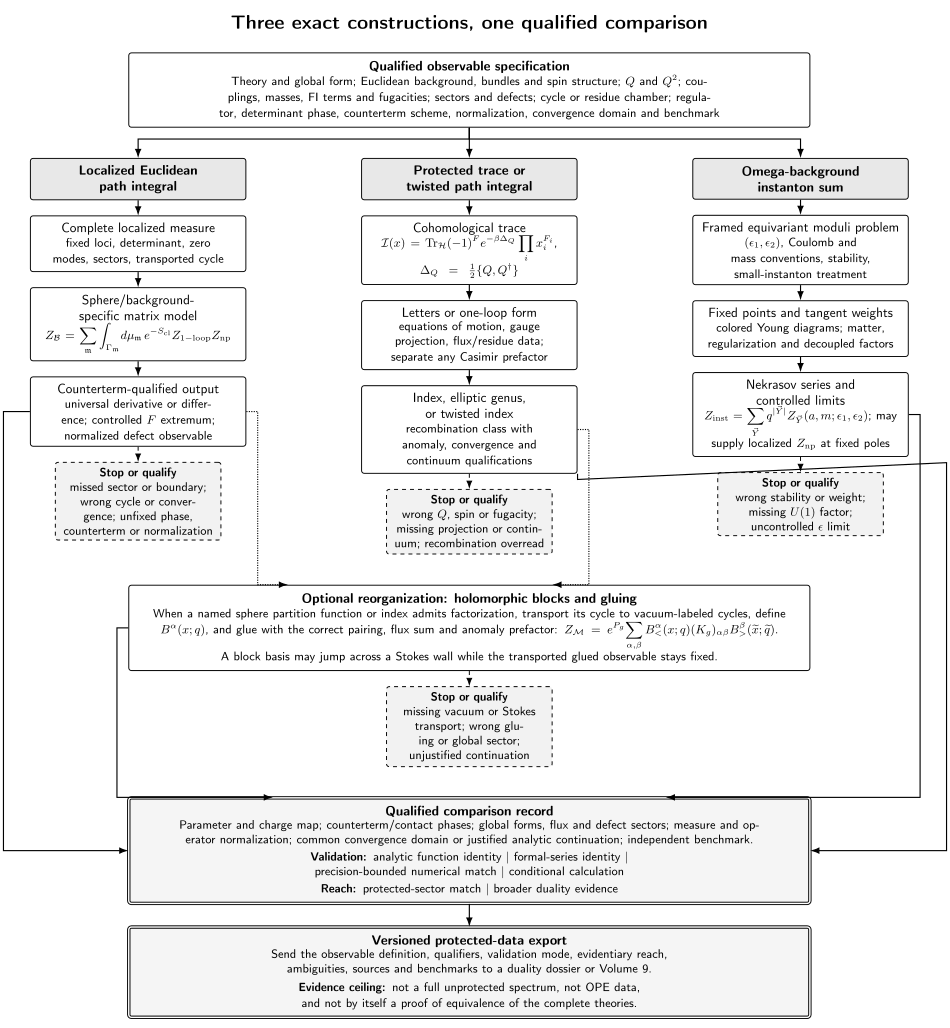
Block factorization is an additional, observable-specific construction available only when its vacuum and cycle hypotheses hold. Dotted arrows mark the optional entry from the localized-integral and protected-trace branches; solid bypasses carry either observable directly to comparison without factorization. When the block route is selected, the compact observable is recovered only with the correct pairing, prefactor, flux and global sectors, and contragredient Stokes transport. The dashed exit records colliding vacua, a continuum, an incomplete cycle basis, a missing gluing sector, or an uncontrolled analytic continuation; it is not a claim that every exact observable factorizes. The map is schematic and not to scale.
The reflowing text equivalent of the exact-observable map preserves every branch, factorization condition, failure exit, comparison field, and evidence limit for narrow-screen and print reading.
Reconstruction limits
Section titled “Reconstruction limits”Knowing does not uniquely recover the individual blocks. A basis change
leaves the bilinear pairing invariant. Elliptic prefactors that fuse to one and quantized contact-term changes add further ambiguity. A compact partition function therefore does not determine a preferred block basis; one also needs line-operator equations, asymptotics, cycles, and a chamber.
Failure modes
Section titled “Failure modes”Calling every residue a vacuum block. A pole prescription must be derived from the imported integration cycle. A convenient residue sum chosen after seeing the integrand can omit a cycle or double count one.
Putting both factors in the same domain. In - and identity fusion, one partner lies outside the unit circle when the other lies inside. Two copies of the same convergent product generally do not reconstruct the compact determinant.
Ignoring background contact terms. A half-integer parity-anomaly counterterm is part of the definition of . Removing it without restoring the corresponding quadratic factor compares different background experiments.
Treating a Stokes jump as a discontinuity of the compact answer. A basis jump cancels under contragredient transport. A genuine change requires a pole crossing, a changed relative cycle, or another failure of analytic continuation.
Assuming a finite vacuum sum. Colliding vacua, a continuum, or an unlifted noncompact branch can require logarithmic blocks or an integral over blocks.
Confusing a formal series with an analytic function. State the domain, convergence region in , and any resummation or analytic-continuation path.
Exercises
Section titled “Exercises”1. Verify the tetrahedron difference equation
Section titled “1. Verify the tetrahedron difference equation”Show that in both domains.
Solution
For , use :
For , the definition gives
and applying this definition to both factors gives the explicit cancellation
so again . Thus the line-operator equation is common to the two analytic domains even though their infinite products differ.
2. Check Stokes invariance of a two-vacuum fusion
Section titled “2. Check Stokes invariance of a two-vacuum fusion”Let be two-component column vectors and set
Show that the diagonal pairing is unchanged by and .
Solution
The transformed pairing is
Transforming both vectors by instead would insert and generally change the result. The inverse transpose is therefore scientific data, not a presentational choice.
References
Section titled “References”Original QFT.org content:CC BY 4.0, unless an item supplies different terms. Third-party material retains its own terms.