

Supercurrent Multiplets and Rigid-Background Compatibility
A curved supersymmetric background can source only a current multiplet that exists as a global operator multiplet of the quantum field theory. In four-dimensional language, the -multiplet is the general starting point. A globally valid improvement may reduce it to the Ferrara–Zumino or R multiplet, and that reduction determines which off-shell supergravity sources can be frozen. Thus the current multiplet is not bookkeeping performed after choosing a geometry: it is the compatibility test that comes first.
Required background. Supercurrent multiplets and improvements supplies the superspace conservation equations. Current sources and generating functionals supplies the source–operator pairing and its contact terms.
Helpful background. What is an anomaly? distinguishes a genuine obstruction to gauging a background symmetry from a removable local contact term.
Current equations determine admissible sources
Section titled “Current equations determine admissible sources”Work first in flat four-dimensional superspace, where the operator equations are easiest to identify. In the normalization used by Komargodski and Seiberg, the real superfield obeys
together with . Its components include , the supersymmetry current, a vector operator, and the closed forms that encode string and domain-wall currents. A linear source coupling has the schematic form
The omitted compensator terms source and . Invariance under the linearized supergravity gauge transformations reproduces the supercurrent conservation equation. This is the supersymmetric version of the pairing : changing the operator multiplet changes the compensator and auxiliary sources, not merely their names. The operator equations, improvements, and linearized supergravity couplings are derived in Komargodski and Seiberg 2010, eqs. (2.1), (2.6), and §5.
For a real superfield , the allowed improvement is
The coefficients change if and are rescaled. More importantly, must be a local, real, gauge-invariant, globally defined operator. A formal nonlocal solution of the improvement equation does not define another current multiplet. With that qualification, the three relevant cases are:
- If can be set to zero, the Ferrara–Zumino (FZ) multiplet exists and couples to old-minimal supergravity.
- If can be set to zero, the R multiplet exists. Its bottom component is a conserved current, and it couples to new-minimal supergravity.
- If neither reduction exists, the full -multiplet is required. Its linearized coupling belongs to a larger supergravity system containing an additional propagating chiral matter multiplet, with a dual linear-multiplet description; it is not merely old- or new-minimal supergravity with renamed auxiliaries. Existence of that source coupling does not by itself establish a nonlinear supergravity completion.
The first two bullets are often summarized as “choose old minimal or new minimal.” The real statement is sharper: the QFT must supply the corresponding global operator equation. It is inconsistent to select the auxiliary fields of one formulation while ignoring the missing improvement.
Why an improvement can fail globally
Section titled “Why an improvement can fail globally”An improvement that works in one coordinate patch may fail as a source coupling. Two standard failures are physical:
A Fayet–Iliopoulos term. For a dynamical Abelian vector multiplet with a constant Fayet–Iliopoulos coupling, the candidate FZ operator is not invariant under the dynamical gauge symmetry. The -multiplet remains well defined, but the proposed FZ multiplet is not a gauge-invariant operator multiplet.
A non-exact Kähler form. In a nonlinear sigma model the local Kähler potential changes by between target-space patches. An improvement built from then changes on overlaps. If the Kähler form has a nonzero cohomology class, there is no global potential and hence no global FZ operator. The Fayet–Iliopoulos and Kähler obstructions are analyzed in Komargodski and Seiberg 2010, §§3–4; the associated string and domain-wall currents and their behavior under improvements are developed in Dumitrescu and Seiberg 2011, §§2–3.
The R-multiplet has a different obstruction: the theory must possess an exact continuous symmetry. A classical charge assignment is insufficient if the superpotential explicitly breaks it or if it has a mixed anomaly with a dynamical gauge group, because then the putative R current is not conserved. By contrast, an ’t Hooft anomaly involving nondynamical background fields need not remove the flat-space current. It instead means that the generating functional is not invariant under background gauge transformations unless the total anomaly is cancelled, for example by additional sectors or by inflow from a bulk that is part of the system. This quantum qualification must accompany any use of the R source.
Compatibility test before freezing the background
Section titled “Compatibility test before freezing the background”Given a proposed rigid background, proceed in this order:
- Name the off-shell formulation. List its metric, R gauge field, tensor or vector sources, scalar auxiliaries, and compensator.
- Match sources to operators. Verify that all of them belong to one conserved supercurrent multiplet.
- Construct the improvement. Check locality, gauge invariance, and patching over both field space and spacetime.
- Check the quantum Ward identity. Separate a dynamical-gauge anomaly, which invalidates the symmetry, from background ’t Hooft anomalies and removable contact terms.
- Check global source data. Specify the background bundles, fluxes, and boundary behavior that the operator coupling requires.
- Only then freeze the sources. The fermionic variations of that same off-shell formulation determine the admissible rigid geometries.
For example, a theory with an exact current but no global FZ multiplet can use a new-minimal source multiplet; absence of the FZ improvement is irrelevant to that construction. Conversely, a theory without a continuous R symmetry cannot borrow the new-minimal Killing-spinor equation. It may use old minimal if its FZ multiplet exists, but the auxiliary fields and admissible geometries are then different. The frozen-supergravity procedure and its old- and new-minimal realizations are developed in Festuccia and Seiberg 2011, §1, §§2 and 6.
The first stage of the chapter-wide chain below is the practical consequence: the admissible background multiplet is selected by a globally defined current multiplet before any Killing-spinor equation is solved. Follow the solid arrow from source compatibility, and notice that each dashed arrow records a reason the construction can stop.
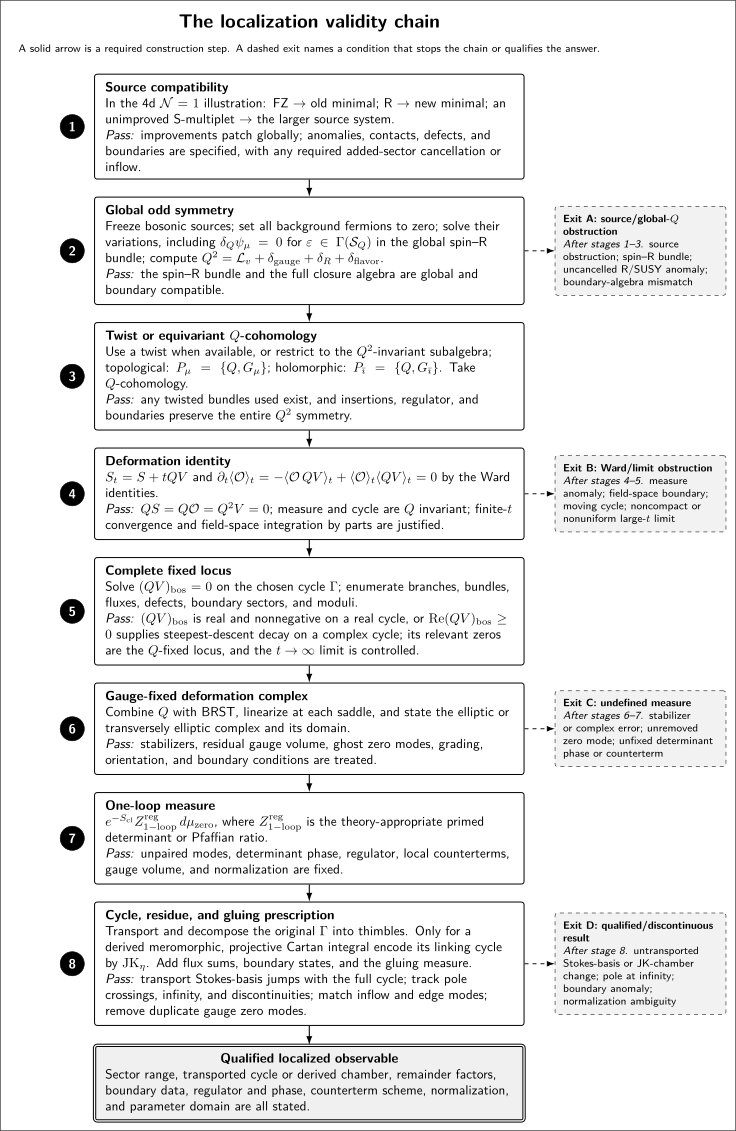
The first stage separates the Ferrara–Zumino multiplet coupled to old-minimal sources, the R-multiplet coupled to new-minimal sources, and the unreduced S-multiplet coupled to a larger source system. It must be passed before the bosonic sources can be frozen and every background-fermion variation set to zero. Dashed exits collect global-improvement, gauge-invariance, anomaly, and boundary failures. The full eight-stage diagram is schematic and not to scale; supercharge and R-charge normalizations are theory dependent.
The reflowing text equivalent of the eight-stage chain preserves every input, construction, pass condition, output, and failure exit for narrow-screen and print reading.
Quantum scope and failure statements
Section titled “Quantum scope and failure statements”The supercurrent equation is an operator statement, while a curved-space generating functional also depends on a renormalization scheme. Local supersymmetric functionals of the background sources can shift contact terms and finite partition functions without changing separated flat-space correlators. Consequently, “this rigid background exists,” “the quantum Ward identity is nonanomalous,” and “the partition function is scheme independent” are three distinct claims. In four-dimensional new minimal supergravity, the available counterterms and the stronger cancellations on backgrounds with two supercharges of opposite chirality are classified in Assel, Cassani, and Martelli 2014, §§3–6.
This page establishes source compatibility only. It does not impose supergravity equations of motion, prove that a global Killing spinor exists, or evaluate an exact observable. Those are separate steps in the chapter.
Exercises
Section titled “Exercises”1. Why does a local Kähler potential not suffice? Let on overlapping target-space charts. Explain why an improvement does not define a global real superfield when the Kähler class is nonzero.
Solution
On an overlap, . Although this is a Kähler transformation of the sigma-model action, it is a nonzero transition for the proposed operator . The improved supercurrent therefore differs from patch to patch. A global improvement would make the Kähler form exact; a nonzero Kähler class forbids it.
2. Choose the formulation. A theory has a gauge-invariant FZ multiplet and an anomaly-free current. Which minimal formulations are available, and is their rigid-background problem identical?
Solution
Both old-minimal and new-minimal couplings are available. They use different compensators and auxiliary fields, so their gravitino variations and allowed frozen backgrounds are not identical. Any comparison must translate the background sources and the improvement relating their current multiplets.
3. Distinguish two anomalies. A candidate R current has no mixed anomaly with the dynamical gauge group but has a nonzero mixed ’t Hooft anomaly with a background flavor symmetry. Does this fact alone eliminate the R multiplet?
Solution
No. With the flavor background switched off, the R current can still be conserved and define an R multiplet. Turning on the flavor background makes the generating functional transform anomalously under background gauge transformations. That anomaly must be recorded; gauging the background symmetry requires cancellation of the total anomaly by added sectors, bulk inflow, or both. A mixed anomaly with a dynamical gauge group would instead spoil conservation of the proposed R current and invalidate the premise.
References
Section titled “References”- Assel, Benjamin, Davide Cassani, and Dario Martelli. “Supersymmetric Counterterms from New Minimal Supergravity.” Journal of High Energy Physics 2014, no. 11 (2014): 135. doi:10.1007/JHEP11(2014)135. Open preprint.
- Dumitrescu, Thomas T., and Nathan Seiberg. “Supercurrents and Brane Currents in Diverse Dimensions.” Journal of High Energy Physics 2011, no. 7 (2011): 095. doi:10.1007/JHEP07(2011)095. Open preprint.
- Festuccia, Guido, and Nathan Seiberg. “Rigid Supersymmetric Theories in Curved Superspace.” Journal of High Energy Physics 2011, no. 6 (2011): 114. doi:10.1007/JHEP06(2011)114. Open preprint.
- Komargodski, Zohar, and Nathan Seiberg. “Comments on Supercurrent Multiplets, Supersymmetric Field Theories and Supergravity.” Journal of High Energy Physics 2010, no. 7 (2010): 017. doi:10.1007/JHEP07(2010)017. Open preprint.
Next step
Section titled “Next step”With the admissible source multiplet fixed, derive rigid supersymmetry from its nondynamical supergravity background.
Original QFT.org content:CC BY 4.0, unless an item supplies different terms. Third-party material retains its own terms.