

BPS Bounds, Shortening, and Multiplet Recombination
A BPS bound is an eigenvalue inequality for a positive supercharge anticommutator. In a four-dimensional massive sector, diagonalizing that matrix gives in the convention used here. At saturation, half of the supercharge combinations become null and disappear from the positive unitary quotient. The resulting short multiplet, the decomposition of a normalized long family at threshold, and the loss of a BPS bound state at a marginal-stability wall are related ideas—but they are not the same operation.
Required background. Extended supersymmetry and central charges fixes and its canonical form. Massive and massless unitary supermultiplets supplies the fermionic-oscillator construction. Hermitian forms and adjoints supplies the positive-null quotient used at saturation.
Helpful background. Characters and conformal multiplet counting supplies character bookkeeping for the later superconformal analogue.
Positive anticommutators give inequalities
Section titled “Positive anticommutators give inequalities”Let collect the complex supercharge components that act in a fixed momentum and charge sector, and let be arbitrary complex coefficients. For
unitarity gives
Thus the Hermitian anticommutator matrix is positive semidefinite. This is the whole logical source of a BPS inequality: every eigenvalue must be nonnegative. The argument assumes the declared adjoint and a positive physical Hilbert space; it must be applied after removing gauge or BRST redundancy.
In a massive rest frame, put the antisymmetric central-charge matrix into unitary skew-normal form. In the normalization used below, a block with singular value produces the full anticommutator eigenvalues
each with little-group multiplicity two. If is odd, there are also unpaired modes with eigenvalue . Positivity gives
Normalization matters. Weinberg’s obeys in his equations (25.5.20)–(25.5.24), so for the block below Weinberg 2000, § 25.5, pp. 52–53. The invariant object is the spectrum of the complete anticommutator matrix, not the letter assigned to its central term.
The four-dimensional N=2 norm matrix
Section titled “The four-dimensional N=2 norm matrix”Take a massive sector with and , and choose
Write . The rest frame identifies dotted and undotted little-group indices, allowing the phase-adapted combination
For each little-group component, the positive block is
Its normalized eigenvectors are
with
The norm gives
The phase has disappeared because a unitary change of supercharge basis diagonalizes the norm matrix—equivalently, an algebra automorphism rotates . This does not require an unbroken physical symmetry inside a fixed nonzero- sector.
At ,
for every state in the irreducible charge sector. Positivity makes and act trivially. Four of the eight real supercharges are preserved, so the representation is half-BPS.
Fixed-charge and CPT-complete counts
Section titled “Fixed-charge and CPT-complete counts”Away from saturation, and supply four complex creation modes. At saturation, the two modes are removed. For a scalar Clifford vacuum the comparison is
| Sector | Fixed- states | CPT-complete states for |
|---|---|---|
| long | ||
| half-BPS short |
The fixed-charge quotient is therefore , not . The latter comparison silently changes conventions by CPT-completing only the short side. Since CPT maps , a local CPT-invariant spectrum generally contains both charge sectors.
For saturated skew blocks in four-dimensional -extended supersymmetry, a scalar Clifford vacuum has
The word “half” refers to annihilating real supercharges, not directly to the ratio of final state counts. Massless representations also shorten, but because loses rank. Superconformal representations shorten when a radial-quantization norm reaches a scaling-dimension bound. One must name the positive matrix and the null direction, not merely call all three examples “short.”
Null quotient and normalized threshold limit
Section titled “Null quotient and normalized threshold limit”Exactly at the bound, is orthogonal to the entire semidefinite module. Quotienting its null submodule produces a cyclic short representation. A negative eigenvalue below the bound cannot be removed in this way; it signals nonunitarity.
There is a second, subtler construction. For , the normalized creator
remains finite in norm but becomes singular as an expression in the original charges. A normalized family of long representations consequently becomes reducible at the threshold and decomposes into several short irreducibles. This direct-sum limit is not the same object as taking the null quotient of one chosen cyclic semidefinite module, which gives a single short multiplet.
Let be the spin- little-group representation with a definite Clifford-vacuum parity, and let inherit that parity. Define
Because the two modes form a spinor doublet,
Therefore
Here reverses the Clifford-vacuum fermion parity; it does not change the charge . For a bosonic scalar vacuum,
Thus the four -Fock basis states organize into three irreducible short summands counting multiplicity, not four independent scalar short multiplets.
For an ordinary spin character, set
Then
For supercharacters defined with a common even Clifford vacuum,
because . Character equality verifies the branching only after the fugacity and parity conventions have been fixed.
The shortening and recombination map
Section titled “The shortening and recombination map”The figure follows the eigenvalue rather than the name of the multiplet. Inspect where positivity permits an active creator, where a zero mode must be quotiented, and where a reverse arrow requires the exact partner representations.
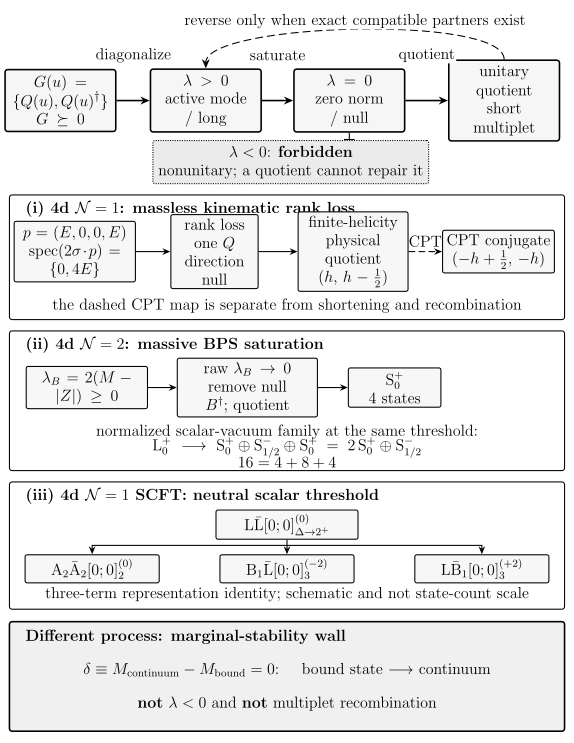
Schematic, not to state-count scale. Positivity permits , saturation at creates a null direction and a short quotient, and is nonunitary. The fixtures distinguish massless kinematic rank loss, massive BPS saturation, superconformal recombination, and a marginal-stability wall where BPS constituents meet a continuum without crossing the positivity bound.
Comparing three shortening mechanisms
Section titled “Comparing three shortening mechanisms”The table keeps the algebra, quotient, count, reverse process, and failure boundary on the same row. Its formulas use the conventions declared on the relevant page; it is a comparison, not a cross-dimensional identification.
| Mechanism and domain | Positive spectrum or allowed branch | Null direction | Short result | Count or protected datum | Reverse process | Distinct caveat | Convention and source |
|---|---|---|---|---|---|---|---|
| 4d finite-helicity massless particle | and on the positive physical quotient | One oscillator gives | 2 states before a separate CPT completion | Moving to a massive orbit changes the little group; it is not BPS recombination | Trivial translations and a prior gauge or BRST quotient are assumed | ; Weinberg 2000, § 25.4, pp. 43–47 | |
| 4d massive BPS sector | , each twice; | and at | The cyclic quotient is | Scalar vacuum: 4 fixed- states, or 8 after CPT completion | when the inequality becomes strict | A marginal-stability wall is a separate bound-state-to-continuum process | ; Ferrara, Savoy, and Zumino 1981, pp. 393–398 |
| 4d superconformal scalar | Chiral branch for ; for , the long branch begins at | ; the endpoint has an additional left null | for ; at the free endpoint | is fixed by the exact superconformal ; is free | above the neutral threshold | Full Dynkin labels, null levels, partners, and normalization are required | ; Córdova, Dumitrescu, and Intriligator 2019, § 2.2.1, pp. 29–32 |
The superconformal handoff supplies the complete scalar branches and labels behind the third row.
Marginal stability is not recombination
Section titled “Marginal stability is not recombination”Suppose a BPS charge can split as . The triangle inequality gives
with equality when the nonzero constituent central charges have aligned phases. On a marginal-stability wall, the parent and constituents may all remain BPS,
while the one-particle bound state reaches the multiparticle threshold and can disappear into the continuum. No state passes into the forbidden region , and no long–short recombination is required. Seiberg and Witten analyze this mechanism under “Stability of BPS-Saturated States” Seiberg and Witten 1994, arXiv PDF pp. 19–21.
What the algebra does not prove
Section titled “What the algebra does not prove”The inequality is conditional: if a state with the specified momentum, central charge, adjoint, and positive norm exists, its mass obeys the bound. Saturation fixes its representation, but the algebra alone does not establish
- existence or normalizability of a classical solution or quantum state;
- stability against decay into states carrying the same total charge;
- which side of a marginal-stability wall contains a bound state;
- absence of anomalies or quantum corrections in the map from physical charges to ; or
- protection when compatible recombination partners are present.
The dynamics of central charges and stability chambers is developed in BPS particles and central charges. Witten and Olive’s original argument identifies topological charges in a controlled class of gauge theories with central terms in the supersymmetry algebra Witten and Olive 1978, pp. 97–101.
Common pitfalls
Section titled “Common pitfalls”Writing equality before deriving the bound. Positivity first gives . Equality is an additional property of a state or representation.
Calling every null state a gauge mode. BPS descendants become null because the positive superalgebra matrix loses rank. Gauge null states arise from redundancy. The physical gauge quotient should already be taken before the BPS calculation.
Reading four Fock states as four irreducible summands. The two one- states form one spin- representation. For , the normalized limit contains .
Equating recombination with wall crossing. Recombination joins compatible short irreducibles into a long representation. Marginal stability can remove a short one-particle state into a continuum while every constituent remains BPS.
Exercises
Section titled “Exercises”1. Keep charge conventions fixed. Compute the long and half-BPS state counts for a scalar Clifford vacuum at fixed , then CPT-complete both sectors.
Solution
The long sector has four complex creators, so it contains states, split as . At saturation only the two creators remain, giving . For nonzero , CPT supplies a separate sector at , doubling the respective totals to and .
2. Resolve the scalar threshold. Starting from , derive the irreducible limit of and verify its ordinary character at .
Solution
Tensoring the two even singlets with gives two copies of . Tensoring the odd spinor with the scalar vacuum reverses parity and produces . Hence . The dimensions are . Equivalently, , and evaluation at gives the same identity.
3. Diagnose a wall. Let and suppose the parent and constituents are BPS. Show when the one-particle mass equals the two-particle threshold, and explain why this is not a violation of the BPS inequality.
Solution
The parent mass is , while the threshold is . Equality holds when the nonzero complex numbers and have the same phase. Every mass still saturates its own BPS bound, so no negative norm appears. The possible disappearance is a dynamical merger with the continuum, not passage to .
References
Section titled “References”- Clay Córdova, Thomas T. Dumitrescu, and Kenneth Intriligator, “Multiplets of Superconformal Symmetry in Diverse Dimensions,” Journal of High Energy Physics 2019 (2019), 163, DOI, arXiv.
- Sergio Ferrara, Carlos A. Savoy, and Bruno Zumino, “General Massive Multiplets in Extended Supersymmetry,” Physics Letters B 100 (1981), 393–398, DOI.
- Nathan Seiberg and Edward Witten, “Electric-Magnetic Duality, Monopole Condensation, and Confinement in N=2 Supersymmetric Yang–Mills Theory,” Nuclear Physics B 426 (1994), 19–52; erratum 430 (1994), 485–486, DOI, arXiv.
- Steven Weinberg, The Quantum Theory of Fields, Volume III: Supersymmetry, Cambridge University Press (2000), § 25.5, DOI.
- Edward Witten and David I. Olive, “Supersymmetry Algebras That Include Topological Charges,” Physics Letters B 78 (1978), 97–101, DOI.
Original QFT.org content:CC BY 4.0, unless an item supplies different terms. Third-party material retains its own terms.