

Holomorphic Couplings and Background Superfields
A mass, Yukawa coupling, or complexified gauge coupling can be promoted to a nondynamical chiral superfield. The Wilsonian superpotential must then be holomorphic in both dynamical chiral fields and these background sources. Combining that holomorphy with spurionic symmetries, dimensions, regular limits, and one controlled normalization input sharply constrains exact F-terms—but holomorphy alone rarely fixes an arbitrary function.
Required background. Wess–Zumino models supplies the chiral action and auxiliary-field equations. Coupling to background gauge fields explains why nondynamical sources are useful probes of Ward identities.
Helpful background. Branches, sheets, and monodromy supplies the analytic language needed when exact terms contain logarithms or fractional powers.
Couplings as chiral sources
Section titled “Couplings as chiral sources”Consider chiral fields and a Wilsonian action at scale ,
Promoting a constant coupling to a background chiral superfield means imposing
while omitting a kinetic term and not integrating over in the path integral. At the end one sets its scalar component to the desired constant and its higher components to zero. The promotion is a source construction, not the addition of a new propagating particle.
Supersymmetry and locality then permit the Wilsonian F-term to depend holomorphically on the chiral variables,
but not on . Real wavefunction factors and the Kähler potential are not subject to this holomorphic restriction. The statement assumes a supersymmetric regulator, a local Wilsonian expansion at nonzero cutoff, and a patch on field/source space where the selected variables are nonsingular. Seiberg formulated the modern background-coupling argument in precisely this Wilsonian setting Seiberg 1993, § 3, arXiv PDF pp. 4–6.
The source may be assigned a transformation law that makes a classical term formally invariant. Such a spurionic symmetry says that theories at different values of the coupling belong to one covariant family. It need not be a symmetry of a single theory after the source is frozen.
A Wess–Zumino constraint, step by step
Section titled “A Wess–Zumino constraint, step by step”Take one chiral field with
Treat and as chiral sources. Assign an auxiliary charge
and an R-charge assignment
Both tree terms are invariant. Since , , and , any holomorphic superpotential compatible with these data can be written on the patch as
because is dimensionless and neutral under both symmetries. This is already a strong result: every allowed term is contained in one holomorphic function. It is not yet a nonrenormalization theorem. Symmetry and holomorphy permit, for example, .
Now add the perturbative information in the right order:
- Domain. Treat the four-dimensional Wess–Zumino model as a Wilsonian effective field theory with cutoff and matching scale .
- Weak-coupling boundary value. As at fixed , the action becomes Gaussian, so .
- Perturbative theorem. Superspace locality and -algebra imply that perturbative loops do not generate a local Wilsonian superpotential. Hence no perturbative coefficient beyond the tree value is present.
Consequently, in the Wilsonian holomorphic variables,
This is the standard perturbative Wilsonian result obtained by the superspace nonrenormalization theorem Weinberg 2000, §§ 27.6 and 30.3. The source argument also shows exactly what would be needed for a stronger claim. Expanding gives a possible term proportional to
For this is singular as . If the finite-cutoff Wilsonian EFT is assumed to remain regular when the light field is retained, analytic at the Gaussian point, and free of a UV matching term that supplies such inverse powers, these additional local vertices are excluded. The ungauged model also has no ordinary four-dimensional instanton sectors. Under that additional EFT regularity and matching assumption, the local result can be strengthened to ; without it, the perturbative equation above is the strongest justified statement. This is the logical role of the holomorphy, weak-coupling, and regularity assumptions in Seiberg 1993, §§ 3 and 4.1, arXiv PDF pp. 4–7.
Neither statement says that all amplitudes are tree-level. The Kähler potential and wavefunction normalization run; after , canonically normalized Wilsonian couplings inherit dependence, and physical amplitudes additionally contain 1PI momentum dependence.
What a spurionic symmetry actually proves
Section titled “What a spurionic symmetry actually proves”For a proposed exact term, a complete constraint chain has five logically different links:
| Input | What it controls | What it cannot supply by itself |
|---|---|---|
| chirality and locality | holomorphic dependence in a Wilsonian F-term | infrared behavior of the 1PI action |
| ordinary and spurionic symmetries | charges and invariant ratios | an arbitrary neutral holomorphic function |
| anomalous Jacobians | transformation of or | a convention-independent overall coefficient |
| regularity and limits | excluded singularities and boundary values | behavior across a genuine singular locus |
| controlled dynamics | residual constants or branch data | global validity beyond the controlled domain |
The order matters. If a dimensionless neutral invariant exists, the most honest intermediate answer is “a holomorphic function of that invariant.” One may reduce it further only with stated information about regularity, asymptotics, weakly coupled regions, or other dynamics.
An anomalous transformation is not discarded. Suppose a chiral rotation of matter changes the regulated measure by a shift of the gauge angle. Assigning the corresponding transformation to the background complex coupling makes the family of theories covariant. Equivalently, the holomorphic scale carries a spurionic charge. The anomaly therefore adds a constraint rather than erasing one; the normalization and sign are developed on R-symmetry, anomalies, and the holomorphic scale.
The flow below makes the logical boundary visible. Read the solid arrows as formal consequences of the declared Wilsonian domain, and the dashed arrows as genuinely new dynamical input: the allowed Affleck–Dine–Seiberg form is not yet a generated, normalized superpotential at the dashed gate.
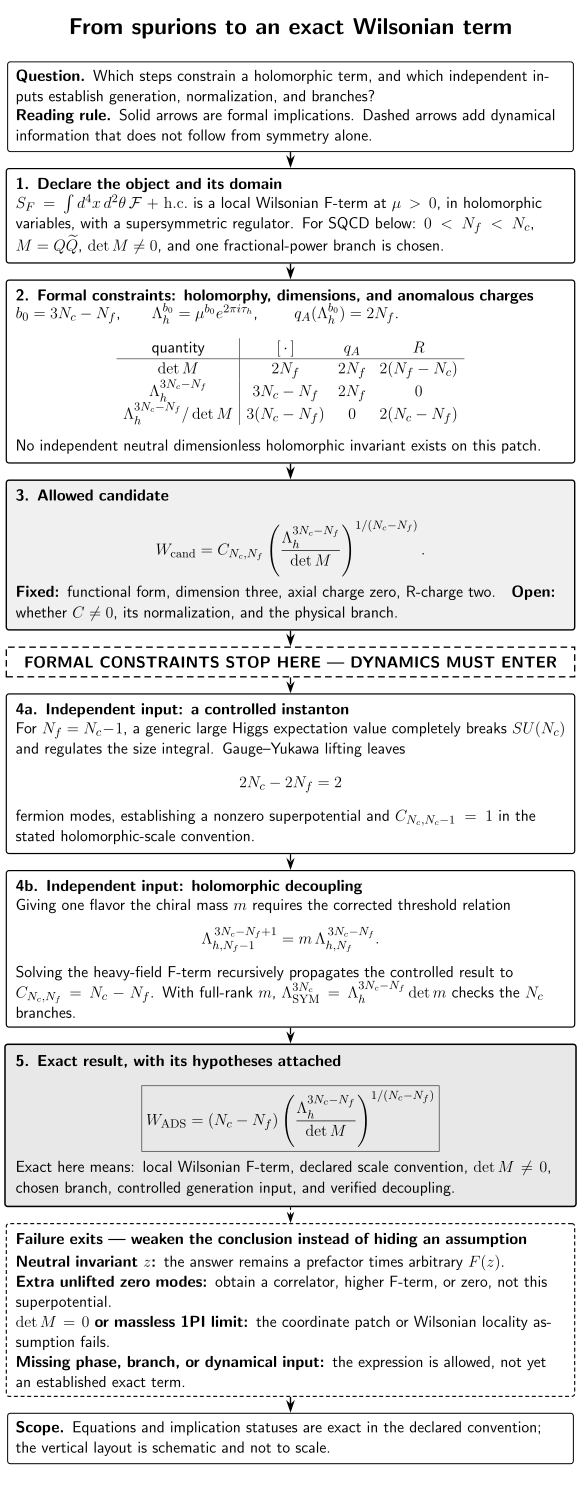
Formal constraints and independent dynamical inputs for SQCD with . On a local Wilsonian patch with , a supersymmetric regulator, the stated holomorphic-scale convention, and a chosen fractional-power branch, dimensions and spurionic charges allow the displayed candidate but do not prove that it is generated. A controlled instanton fixes the seed coefficient, and holomorphic decoupling with the low-energy exponent propagates the normalization and checks the pure-SYM branches after a full-rank mass deformation. The diagram is schematic, not to scale; its structured description records every assumption, implication status, and failure exit.
Singularities, branches, and frozen sources
Section titled “Singularities, branches, and frozen sources”Three qualifications prevent common overclaims.
A holomorphic function may be singular. Integrating out a field produces an effective description valid only where its mass matrix is invertible. Poles or logarithms at the excluded locus can be physically required. Regularity may be imposed only where the effective variables remain valid.
Fractional powers require a branch. A term such as describes local branches. Analytic continuation can permute them. Symmetry fixes how the collection transforms; it does not select a vacuum.
Freezing a source reduces the manifest symmetry. Spurionic covariance relates different constant values of a coupling. Once is fixed, a transformation that changes is not an internal symmetry of that one theory. Ward identities must keep this distinction explicit.
The component of a background chiral source can be used to probe operator insertions or introduce controlled soft breaking. Doing so changes the question: the exact supersymmetric F-term statement applies before such a component is turned on.
Common pitfalls
Section titled “Common pitfalls”Holomorphy determines the function. It determines the analytic type of the dependence. Neutral dimensionless ratios can support arbitrary holomorphic functions until limits or dynamics remove them.
A spurion is a new dynamical field. It is a nondynamical source unless a kinetic term and path integration are explicitly added. Confusing the two changes both the spectrum and the effective action.
Regular at one point means regular everywhere. Coordinates on moduli space and field content of an effective theory can fail at discriminant loci. Regularity is always a statement on a declared patch.
Exercises
Section titled “Exercises”In the Wess–Zumino example, choose instead , so that and . Show that the same invariant and the same functional form follow.
Solution
The ratio has
and it is also neutral under . The prefactor has and mass dimension three. Thus again. Different spurionic charge bases encode the same invariant information.
Why is the limit at fixed not enough to demand that be regular at ?
Solution
At the spectrum and the convenient coordinate patch change: the quadratic mass vanishes, and the expansion that treated as an invertible source no longer applies. Regularity at would therefore be an additional physical assumption, not a consequence of holomorphy on the patch.
References
Section titled “References”Original QFT.org content:CC BY 4.0, unless an item supplies different terms. Third-party material retains its own terms.