

Supergraphs, D-Algebra, and Quantum Effective Actions
Supergraphs are Feynman graphs whose vertices and propagators live in superspace. Their spinor derivatives encode the cancellations that would be spread across many component diagrams. A calculation proceeds in two independent layers: ordinary momentum integration and D-algebra, the reduction of and acting on superspace delta functions. The output must then be classified as a local Wilsonian term or a possibly nonlocal contribution to the one-particle-irreducible functional. Manifest supersymmetry does not remove the need to specify gauge fixing, ghosts, regulator, infrared prescription, counterterms, and normalization.
Required background. Supersymmetric Action Principles and Component Reduction supplies the superspace vertices. The 1PI Effective Action and Mean-Field Equations defines the Legendre transform and its nonlocality.
Helpful background. The Faddeev–Popov Construction is needed before using gauge-superfield propagators.
A supergraph rule has three parts
Section titled “A supergraph rule has three parts”For a fixed superspace convention, every rule records:
- a momentum-space denominator and causal prescription;
- a Grassmann delta function connecting the endpoints; and
- spinor derivatives or chiral projectors acting on that delta function.
For a massless chiral field with quadratic action , where , the mixed propagator is the inverse of the quadratic operator on the chiral subspace. It can be represented by a full-superspace delta together with chiral projectors. Different placements of on the two ends are equivalent after superspace integration by parts, provided the derivative order and contact terms are retained.
We will use the following full-superspace rule. First define the reduced kernel
The full Lorentzian mixed line is . For the interaction , the chiral and antichiral cubic vertices are and , respectively. These phases will be kept explicitly below.
Converting a chiral cubic vertex to a integral places on one of its remaining internal lines; the antichiral vertex places . Integration by parts may move both projectors onto the same Grassmann delta. This convention states where every derivative sits rather than hiding it in the symbol .
The identities that perform most reductions are
and
The factor follows from the declared algebra. A source with different definitions of or must be translated before its projectors are used. The systematic supergraph construction is developed in Gates et al. 1983, chs. 6–7, Open PDF, Grisaru, Siegel, and Roček 1979, pp. 429–450, and Weinberg 2000, ch. 30, pp. 307–316.
One Wess–Zumino loop reduces to a D-term
Section titled “One Wess–Zumino loop reduces to a D-term”Consider the massless model
The one-loop two-point graph has one chiral and one antichiral cubic vertex. The symmetry factor is : choose one external leg at each vertex and pair the two remaining chiral legs with the two remaining antichiral legs. Before D-algebra, the two vertex and two line phases multiply to
Thus the contribution to is
Convert the chiral measures to full measures using the projectors carried by the vertices. Put the and factors on one internal line and leave the other line’s delta unprojected. The complete Grassmann reduction is then
The second line uses, under the superspace integral,
Thus no spinor derivative survives on the external fields in this graph. The two momentum denominators remain untouched, leaving
with
The complete D-algebra conclusion is already strong:
- the answer is a full-superspace D-term, not a superpotential F-term;
- it has the tensor structure of wavefunction/Kähler renormalization;
- the ultraviolet divergence is local; and
- the finite massless answer is nonanalytic at .
The calculation retains four-dimensional spinor derivatives while continuing only the loop momenta to . It therefore uses dimensional reduction, not ordinary dimensional regularization; subtracting defines the convention used here. The scalar bubble is
where . The divergent constant gives the exact real effective-action contribution
It is removed by the local counterterm multiplying . The logarithm is a nonlocal 1PI form factor and cannot be replaced by a local superpotential correction. A supersymmetric Wilsonian action with a finite infrared cutoff instead integrates only a specified momentum shell and admits a local derivative expansion when the external momenta are below that shell.
Dimensional reduction is mathematically distinguishable from ordinary dimensional regularization and requires its own symmetry checks Stöckinger 2005, pp. 1–19, arXiv v3, Open PDF. The graph above is a one-loop chiral example, not a proof that the regulator preserves every supersymmetric gauge identity at higher orders.
The figure consolidates the complete calculation. Follow the left-to-right arrows from the phase-bearing graph through the projector collapse, then compare the three destinations of the same loop kernel: a local ultraviolet counterterm, a nonlocal 1PI logarithm, and a shell-local Wilsonian term.
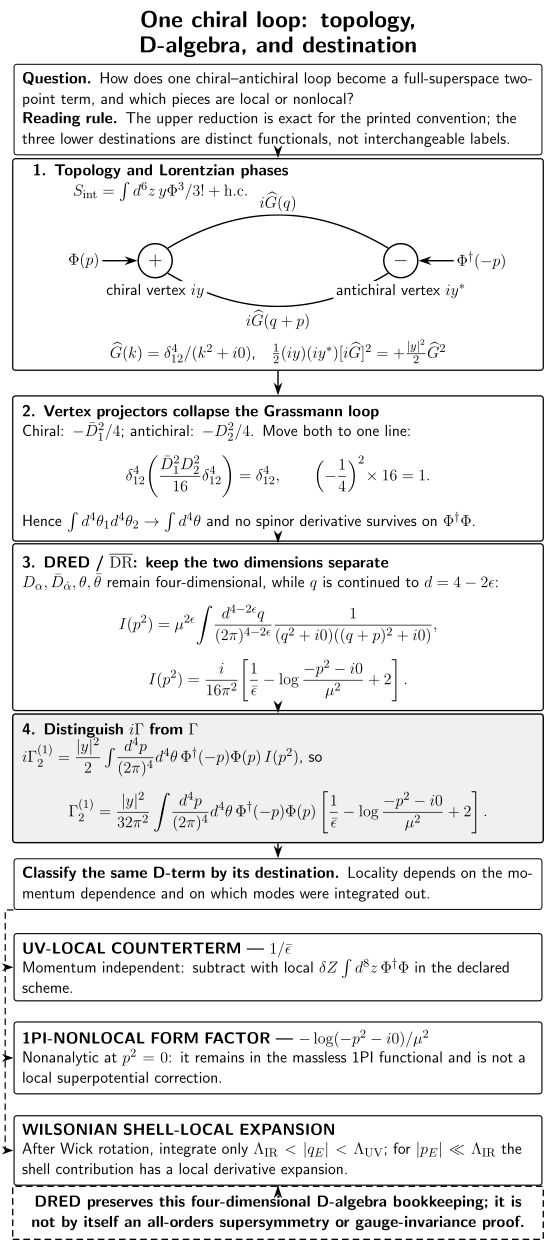
One vertex, one vertex, and two lines give the positive factor and symmetry factor . The factor- projector identity leaves one integral; dimensional reduction and then separate the local pole from the nonlocal 1PI logarithm, while a finite shell becomes locally expandable after Wick rotation. The relationships and coefficients are exact in the declared one-loop convention; the drawing is schematic and not to scale. Structured calculation (JSON).
The coefficient above assumes the interaction and the stated propagator normalization. Using changes the vertex combinatorics. The round-trip check is to expand the resulting D-term into components: the same wavefunction factor must multiply the scalar and fermion kinetic terms.
D-algebra does not by itself prove nonrenormalization
Section titled “D-algebra does not by itself prove nonrenormalization”Power counting and chirality often show that perturbative loop graphs with ordinary local vertices reduce to full-superspace integrals. Turning that observation into a theorem still requires locality, a supersymmetric regulator and subtraction, control of infrared singularities, and a clear choice of Wilsonian functional. In a massless 1PI calculation, factors such as can turn a formally full-superspace nonlocal expression into a chiral-looking one. It remains an infrared nonlocal contribution, not a local renormalization of the Wilsonian superpotential.
The theorem and its exceptions therefore belong to Nonrenormalization Theorems: Wilsonian and 1PI Scope. This page supplies the calculation technology and the destination labels that the theorem needs.
Gauge supergraphs require a complete gauge complex
Section titled “Gauge supergraphs require a complete gauge complex”The vector-superfield quadratic operator is not invertible before gauge fixing. A gauge-supergraph calculation must state:
- the superspace gauge-fixing functional and gauge parameter;
- the Faddeev–Popov and, where required, Nielsen–Kallosh ghost superfields;
- the background/quantum split and which transformations remain manifest;
- the regulator, including how evanescent spinor and vector components are treated; and
- the subtraction scheme and composite-operator basis.
The worked chiral graph above uses dimensional reduction and subtraction because this preserves the declared four-dimensional D-algebra while continuing loop momenta. That choice is not automatically sufficient for every gauge theory or every order. The quantum action principle provides a systematic way to test possible violations; finite restoring counterterms or another regulator may be required. A zero result obtained by dropping an evanescent term is not a supersymmetry proof.
In the background-field method, manifest background gauge invariance organizes the answer into gauge-covariant superspace operators. Quantum gauge parameter dependence may remain in off-shell 1PI terms; physical observables or properly defined Wilsonian matching coefficients require the corresponding Ward/Slavnov–Taylor checks.
Superficial degree is only the first filter
Section titled “Superficial degree is only the first filter”For a graph , ordinary loop momenta give a naive degree of divergence. D-algebra then moves spinor derivatives onto external fields or converts derivative pairs into momenta, lowering or redistributing that degree. The final check asks:
| layer | question |
|---|---|
| graph topology | symmetry factor, representations, group traces, ghost signs? |
| superspace | derivative order, Grassmann deltas, chirality, external projectors? |
| momentum | routing, , UV subdivergences, IR singularities, exceptional momenta? |
| regulator | supersymmetry/gauge identities preserved or restored? |
| locality | polynomial local counterterm or nonanalytic form factor? |
| destination | Wilsonian shell action, connected functional, or 1PI functional? |
| validation | component expansion, Ward identity, known limit, or independent graph? |
A symbolic implementation can cross-check a bounded derivative string, but the worked kernel and the table above remain the scientific explanation. Every Grassmann monomial, integration by parts, and removed contact term must remain inspectable.
Common pitfalls
Section titled “Common pitfalls”Cancelling across an infrared singularity. Algebraic cancellation of a projector’s against a propagator is valid only on the declared distributional domain. At exceptional momentum, zero modes and contact terms can survive.
Calling every superspace loop manifestly gauge invariant. Supersymmetry may be manifest while gauge fixing, ghosts, or the regulator violate a needed identity until counterterms are chosen.
Equating a D-term divergence with a physical running coupling. Convert to canonical fields, specify the renormalization scheme, and distinguish the Wilsonian coupling from the 1PI observable before interpreting a beta function.
Exercises
Section titled “Exercises”1. Collapse the Grassmann kernel. In the projector placement used above, why does exactly one integral survive?
Solution
The unprojected internal line supplies . The other line carries , whose four spinor derivatives saturate the second Grassmann delta. Their product is therefore one delta, not zero:
One of the two Grassmann integrations collapses, and the remaining integral is . Moving the projectors to the other internal line gives the same result by superspace integration by parts.
2. Identify the operator class. Why must the one-loop two-point result above renormalize a D-term?
Solution
After D-algebra the external fields appear as . This is real and has the quantum numbers of the Kähler kinetic operator. A local chiral integral would contain only and ; the graph has one chiral and one antichiral external leg, so it cannot produce that operator locally.
3. Separate UV and IR information. Which part of is removed by a local counterterm, and which part remains in the 1PI functional?
Solution
The momentum-independent pole is local and is cancelled by a counterterm. The logarithm is nonanalytic and remains as a 1PI form factor after renormalization. Its singular behavior near is infrared information, not a new local superpotential coefficient.
Where the method continues
Section titled “Where the method continues”Nonrenormalization Theorems: Wilsonian and 1PI Scope turns the structural observation into a bounded theorem. Holomorphic and Canonical Couplings and the NSVZ Relation tracks the coupling translation, while Perturbative Yang–Mills Consistency owns model-specific gauge-loop identities.
References
Section titled “References”- Gates, S. James, Marcus T. Grisaru, Martin Roček, and Warren Siegel. Superspace, or One Thousand and One Lessons in Supersymmetry. Reading, MA: Benjamin/Cummings, 1983, chs. 6–7. Open PDF, arXiv v5.
- Grisaru, Marcus T., Warren Siegel, and Martin Roček. “Improved Methods for Supergraphs.” Nuclear Physics B 159, no. 3 (1979): 429–450. DOI.
- Stöckinger, Dominik. “Regularization by Dimensional Reduction: Consistency, Quantum Action Principle, and Supersymmetry.” Journal of High Energy Physics 2005, no. 3 (2005): 076. DOI. Open PDF, arXiv v3.
- Weinberg, Steven. The Quantum Theory of Fields, Volume III: Supersymmetry. Cambridge: Cambridge University Press, 2000, ch. 30, pp. 307–316. DOI.
Original QFT.org content:CC BY 4.0, unless an item supplies different terms. Third-party material retains its own terms.