

Sphere Partition Functions and Matrix Models
Localization reduces a supersymmetric sphere path integral to a sum of finite-dimensional integrals over BPS zero modes. Classical actions, one-loop determinants, flux or instanton sectors, and the quotient by residual gauge symmetry all survive the reduction. There is no dimension-independent “sphere matrix model”: every formula below belongs to a stated theory, supercharge, background, measure, and contour.
Required background. Use the derivation of localization loci and one-loop determinants together with complex contours, zero modes, and regularization.
Helpful background. Boundary gluing and Jeffrey–Kirwan residues control sphere formulas built from hemispheres or contour residues.
Assembling a localized sphere integral
Section titled “Assembling a localized sphere integral”Choose a fermionic symmetry with compact on the integration cycle and a deformation whose bosonic part is nonnegative there. If the limit has no boundary contribution in field space, the path integral localizes to connected BPS components . A useful schematic formula is
Here denotes unfixed zero modes, is the residual Weyl group in that sector, and is the cycle inherited from the original real fields, possibly deformed without crossing singularities. The induced measure includes the zero-mode Jacobian. A Vandermonde determinant may instead be absorbed into , but it must appear exactly once. Determinant phases are part of the answer: changing them can amount to changing a background or dynamical Chern–Simons counterterm.
A dependable derivation follows this order:
- solve for every fermion and classify smooth, flux, and pointlike singular sectors;
- divide by gauge transformations and identify the residual Weyl group;
- normalize bosonic and fermionic zero modes separately;
- regularize the determinant with a symmetry-preserving phase convention;
- include flux, vortex, or instanton contributions at fixed points;
- determine the physical cycle from the original real fields, then track any contour deformation;
- record finite counterterms and overall normalization choices;
- test a free or weak-coupling limit.
The left branch of the shared map condenses this assembly order without pretending that its dimension-specific realizations are interchangeable. In the examples below it becomes a three-dimensional Cartan integral, a four-dimensional Coulomb integral with north/south instanton factors, or a two-dimensional flux sum.
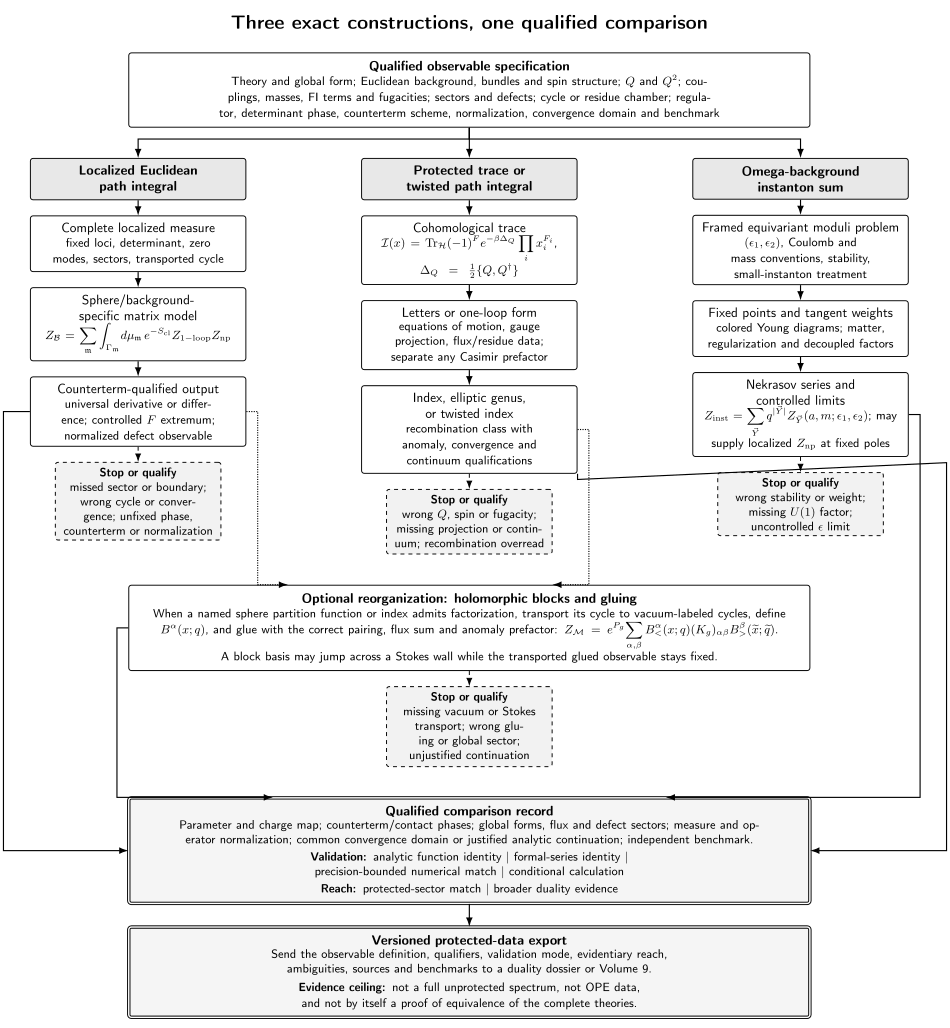
The localized-integral branch carries the complete BPS sectors, zero-mode measure, residual Weyl quotient, classical action, determinant, nonperturbative factors, and inherited cycle into a background-specific finite-dimensional model. Its , , and realizations have different measures and sectors and are examples, not instances of one universal sphere formula. Solid arrows carry required steps along a selected route, dotted arrows mark optional block factorization, and dashed exits mark omitted sectors or poles, field-space boundaries, nonconvergence, determinant-phase or level ambiguities, counterterms, and normalization changes. The map is schematic and not to scale.
The reflowing text equivalent of the exact-observable map preserves every branch, failure exit, comparison field, and evidence limit for narrow-screen and print reading.
Three-dimensional N=2 theories on the round sphere
Section titled “Three-dimensional N=2 theories on the round sphere”Let be compact and connected, write , let be the dimensionless real Cartan scalar, and integrate over the full Cartan . For a three-dimensional theory on the round of radius , one common convention is
The level is an invariant integral quadratic form in this trace convention, has support only on Abelian gauge factors, and includes the flavor charge of the background mass. The weights of the -th chiral representation are , and is its trial R-charge. Gauge and background levels must obey the quantization and parity-anomaly conditions appropriate to the charge lattice and spin structure; suppressed background Chern–Simons terms can multiply the displayed expression by mass-dependent phases.
The special function is fixed on a local branch by
For one free chiral multiplet with and zero mass,
This benchmark catches sign errors in , missing square roots, and incompatible definitions of . The vector and canonical matter determinants for the round sphere were derived in Kapustin, Willett, and Yaakov 2010, §3, especially Eqs. (3.11) and (3.28); the arbitrary trial-R determinant and its mass continuation are given in Jafferis 2012, §§3–4, Eqs. (1.2)–(1.3).
The real integral need not be absolutely convergent. Chern–Simons factors are oscillatory, and matter asymptotics depend on the trial charges. A regulator or contour prescription must be inherited from the localized path integral, not chosen only to make a numerical routine converge.
Four-dimensional N=2 theories on S⁴
Section titled “Four-dimensional N=2 theories on S⁴”For a Lagrangian four-dimensional gauge theory on the round sphere of radius , the Coulomb-locus variable lies on a real Cartan cycle. Put the Cartan Vandermonde in and not in . Then a common form is
Here contains the theta angle. The north pole supports instantons and the south pole anti-instantons, with equivariant magnitudes in these local coordinates. The absolute square is shorthand on the physical real slice. After complex continuation it must be replaced by independent factors and with the continued north and south parameters; they need not be complex conjugates. For a product gauge group, the Gaussian and factors occur separately for each simple or Abelian factor.
Pestun’s localization formula, including the two pole contributions, appears in Pestun 2012, §1, Eq. (1.4), and §§4–5. A nonconformal theory additionally needs a renormalization scale and scheme, and even a conformal answer can carry finite supersymmetric counterterm ambiguity. Those choices are analyzed on the counterterms and universal-data page.
Two-dimensional N=(2,2) theories on S²
Section titled “Two-dimensional N=(2,2) theories on S²”For a two-dimensional theory on the unit round , sum over the cocharacter lattice and integrate the dimensionless constant scalar . With vanishing background flavor flux, and with all Cartan fluxes included before dividing by the full Weyl group, the Benini–Cremonesi convention reads
with
and, for a chiral multiplet of vector R-charge and dimensionless twisted mass ,
Only Abelian gauge factors admit the displayed FI and theta couplings. The root sign in is convention dependent and can be combined with a theta-angle shift, so it must be tracked when comparing formulas. Flux quantization depends on the global form of and on the matter representations, not merely on the Lie algebra. Equivalently, one may sum over Weyl-orbit representatives and divide each sector by its stabilizer rather than dividing the unrestricted sum by .
For positive R-charges the derivation starts from the real cycle. Analytic continuation in or requires moving the cycle so that the same pole families remain on the same side. The determinants and full Coulomb formula are given in Benini and Cremonesi 2015, §3.3, Eqs. (3.24), (3.31), and (3.34)–(3.36), with an independent derivation in Doroud et al. 2013, §§3–5. In FI chambers where the contour closes without a contribution from infinity and the theory is fully Higgsed, residues can reorganize into Higgs vacua times vortex and antivortex factors. This is a derived representation, not a universal replacement for the Coulomb formula.
Convergence, contours, and numerical evaluation
Section titled “Convergence, contours, and numerical evaluation”The original localization derivation determines a real integration cycle. Analytic continuation of masses, couplings, or R-charges can require a deformation in the complexified Cartan; crossing a pole changes the representation by its residue. A numerical integral is meaningful only after this chamber information is fixed.
Check the following before trusting a value:
- large- asymptotics and absolute versus oscillatory convergence;
- singular hyperplanes and the prescription for poles on the cycle;
- Weyl quotient and the normalization of the Cartan metric;
- determinant phases and background Chern–Simons terms;
- the regulator, renormalization scale, and finite local counterterms;
- decoupled or center-of-mass factors;
- flux or instanton truncation error;
- stability under working precision and contour deformation;
- agreement with a free determinant or weak-coupling expansion.
Sphere matrix models compute a defined supersymmetric background observable. Interpreting the answer as a free energy, Kähler potential, R-symmetry functional, or duality test requires the dimension-specific counterterm and normalization analysis appropriate to that use.
Exercises
Section titled “Exercises”- Evaluate the round- formula for a free chiral multiplet with .
Solution
There is no Cartan integral or vector determinant. The one-loop factor is . Integrating with gives , so and .
- Consider the displayed integral for a gauge theory with zero Chern–Simons and FI couplings and two chirals of charges and , both assigned . Using
evaluate the integral. Why is this only a determinant benchmark, not an -maximization result?
Solution
The gauge group has no roots and , so
The last equality follows from . We inserted the trial value by hand. The interacting infrared R-charge must instead be found by varying every allowed mixing direction, subject to superpotential constraints and accidental-symmetry checks.
- In the formula for , compare summing over all ordered flux pairs and dividing by with summing over representatives . What divisor belongs to an unequal pair and to an equal pair?
Solution
An unequal pair has two Weyl images and a trivial stabilizer. The unrestricted sum counts both and the overall factor leaves one copy; the representative sum therefore divides by . An equal pair is fixed by the exchange Weyl transformation. The unrestricted prescription has only one identical flux point but the Cartan integral is also acted on by that residual exchange, so the representative prescription divides that sector by its stabilizer of order . Thus the two organizations agree when each flux sector uses its residual Weyl group.
References
Section titled “References”- Benini, Francesco, and Stefano Cremonesi. “Partition Functions of Gauge Theories on and Vortices.” Communications in Mathematical Physics 334 (2015): 1483–1527. doi:10.1007/s00220-014-2112-z. Open PDF.
- Doroud, Nima, Jaume Gomis, Bruno Le Floch, and Sungjay Lee. “Exact Results in Supersymmetric Gauge Theories.” Journal of High Energy Physics 2013, no. 5 (2013): 093. doi:10.1007/JHEP05(2013)093. Open PDF.
- Jafferis, Daniel L. “The Exact Superconformal R-Symmetry Extremizes .” Journal of High Energy Physics 2012, no. 5 (2012): 159. doi:10.1007/JHEP05(2012)159. Open PDF.
- Kapustin, Anton, Brian Willett, and Itamar Yaakov. “Exact Results for Wilson Loops in Superconformal Chern–Simons Theories with Matter.” Journal of High Energy Physics 2010, no. 3 (2010): 089. doi:10.1007/JHEP03(2010)089. Open PDF.
- Pestun, Vasily. “Localization of Gauge Theory on a Four-Sphere and Supersymmetric Wilson Loops.” Communications in Mathematical Physics 313 (2012): 71–129. doi:10.1007/s00220-012-1485-0. Open PDF.
Original QFT.org content:CC BY 4.0, unless an item supplies different terms. Third-party material retains its own terms.