

Supersymmetric and Superconformal Indices
A supersymmetric index is a graded trace that records the cohomology of one chosen supercharge. Its value is protected because states outside the cohomology pair with states of opposite fermion parity. That sentence becomes a definition only after the Hilbert space, supercharge, commuting charges, spin structure, gauge projection, fugacity domain, and path-integral normalization have all been specified.
Required background. Use Q-cohomology in the path integral and the representation-theoretic BPS shortening bounds.
Helpful background. Characters and multiplet counting organize the protected states after the trace is defined.
Trace data and the pairing argument
Section titled “Trace data and the pairing argument”Let be the Hilbert space obtained by quantizing on a spatial manifold . Choose a supercharge with an adjoint and define
Let be mutually commuting conserved charges satisfying . With , the regulated index is
If the regulated supertrace is cyclic, then
In the last step, moving around the trace produces a minus sign from ; all other insertions commute with it. Equivalently, every positive- eigenspace is paired by . The surviving harmonic states obey and represent -cohomology classes.
This proof has a boundary condition: the operator under the trace must be trace class, or a regulator must make cyclicity and the spectral asymptotics legitimate. In a theory with a continuum, the bosonic and fermionic scattering densities can differ at infinity, leaving a boundary term and genuine dependence Witten 1982, §§2–3. A formal series is therefore not automatically an index of a well-defined Hilbert-space problem.
Even one short conformal multiplet has infinitely many derivative descendants, so the commuting fugacities are also regulators, not merely labels. The Euclidean path integral for this supertrace uses the spin structure induced by the insertion: fermions are periodic around the time circle, up to the declared R-symmetry and flavor holonomies. This is not a thermal partition function.
A four-dimensional N=1 convention
Section titled “A four-dimensional N=1 convention”For a unitary four-dimensional SCFT in radial quantization on , choose the right-handed supercharge . In the standard normalization,
Here is the dilatation eigenvalue, are Cartan generators of , and is the exact superconformal R-charge. A common right-handed index is
where every flavor charge commutes with . The omitted factor may be restored; it drops out only after the pairing argument has been justified. For the usual power-series expansion one takes and chooses flavor fugacities in a common annulus; meromorphic continuation is a later operation, not a substitute for an initial convergence domain Rastelli and Razamat 2017, §2.1, pp. 263–269.
The weak-coupling letter prescription and its RG-invariant use for interacting infrared fixed points were developed in Romelsberger 2006, §§2–3 and Kinney et al. 2007, §3.
The exact infrared R-symmetry matters. If , the same protected trace is regraded by
This substitution is valid only for genuine conserved flavor symmetries. An accidental symmetry or a decoupled free multiplet must first be identified in the infrared description.
From single letters to gauge-invariant states
Section titled “From single letters to gauge-invariant states”For a chiral multiplet of superconformal R-charge in representation , the single-letter contribution is
The first numerator term is the scalar letter. The second is its conjugate fermionic letter after the equation-of-motion subtraction, and the denominator generates the two derivatives that commute with . A vector multiplet contributes
Multi-letter states are generated by the plethystic exponential
For a Lagrangian theory in the vacuum sector, gauge invariance is imposed by the Haar integral:
To see what the integral does, let and expand the integrand as . Then
so only gauge charge zero survives. For non-Abelian , the Weyl quotient and Vandermonde factor are already contained in the normalized Haar measure. The R-symmetry must be nonanomalous and every superpotential monomial must have R-charge two; otherwise the displayed supercharge or grading is not preserved Dolan and Osborn 2009, §§2–3.
The ordinary local-operator index on is often insensitive to the global form of the gauge group. It can become sensitive after line defects, quotient twists, discrete theta angles, or higher-form backgrounds are inserted. Those sectors and their measure must be declared rather than inferred from the Lie algebra.
Free chiral and elliptic-gamma checks
Section titled “Free chiral and elliptic-gamma checks”For one free chiral with flavor fugacity , the plethystic exponential resums to an elliptic Gamma function:
where
The product identity
has a precise Lagrangian interpretation. Two conjugate chirals with may have a supersymmetric mass ; their arguments are and , so their index is one. This is a useful test of conjugate representations, inverse flavor fugacities, and complementary R-charges.
Path-integral normalization
Section titled “Path-integral normalization”The same protected trace has a supersymmetric path-integral realization on . With the standard Hamiltonian convention it takes the form
where is the supersymmetric Casimir energy. On the round sphere of radius , for the standard new-minimal background and supersymmetric regulator,
This prefactor is fixed by anomalies, but it is not part of the bare Hilbert-space index. On the fixed round new-minimal background just specified, is intrinsic and cannot be shifted by an allowed supersymmetric local counterterm. A different supersymmetric background can change the geometric anomaly formula, while choosing whether the Casimir prefactor is included changes which normalized object is called ; neither operation should be hidden inside the index. Comparisons must retain or remove the same prefactor on both sides Assel et al. 2015, eqs. (1.1)–(1.2) and §4.
Gauge holonomies around implement the Haar projection. Flavor fugacities are background holonomies, while and combine angular and R-symmetry holonomies. Changing any of these changes the boundary-value problem, not merely the notation.
The middle branch of the shared map below places this trace construction beside, but does not identify it with, localized sphere integrals and Omega-background instanton sums. Inspect the data carried from the qualified input into the protected trace, especially the gauge projection, flux or residue prescription, Casimir normalization, convergence domain, and recombination ceiling.
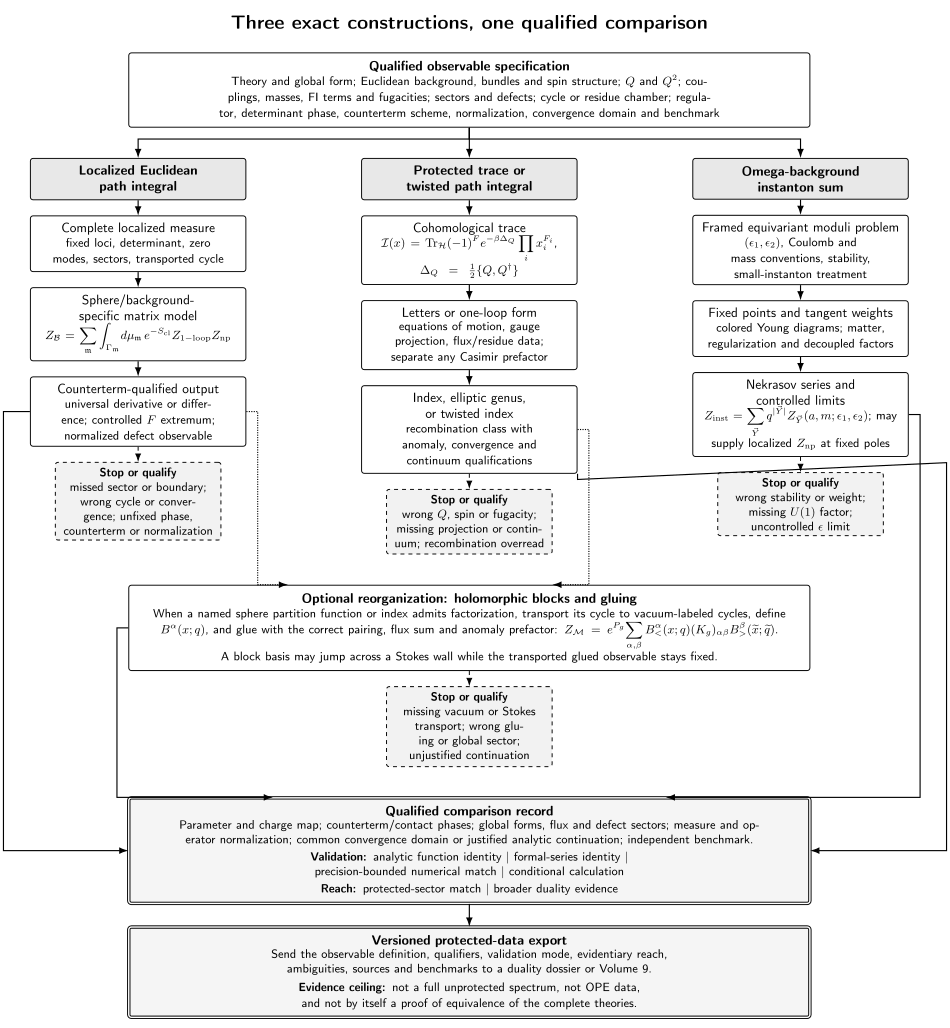
The middle branch is a cohomological trace only after the supercharge, commuting fugacities, spin structure, gauge projection, sectors, and convergence domain are fixed; a path-integral realization may also carry a supersymmetric Casimir prefactor outside the vacuum-normalized index. Solid arrows carry required steps along a selected route, dotted arrows mark optional block factorization, and converging routes do not assert that the three branches compute the same quantity. Dashed exits mark trace-definition failures and the mistake of reading a recombination class as a unique spectrum. The map is schematic, not a dimension-independent formula, and not to scale.
The reflowing text equivalent of the exact-observable map preserves the branch inputs, construction steps, failure exits, comparison fields, and evidence ceiling for narrow-screen and print reading.
What the index forgets
Section titled “What the index forgets”The index is invariant when short multiplets recombine into a long multiplet. It therefore determines protected combinations modulo recombination, not an unambiguous list of short multiplets. It also loses generic OPE coefficients, long-multiplet dimensions, and most unprotected states. The page on index inversion and protected-spectrum limits makes this quotient explicit.
Further limitations include:
- accidental R-symmetry mixing can invalidate ultraviolet fugacity assignments;
- a continuum can leave an asymptotic contribution not captured by discrete cohomology;
- poles and series expansions depend on the chosen fugacity chamber even when the meromorphic function is the same;
- a vanishing index may mean exact cancellation, not absence of supersymmetric states;
- equality of indices is a strong protected-sector test, not by itself a full duality proof.
Exercises
Section titled “Exercises”1. A paired two-state complex
Section titled “1. A paired two-state complex”Let and its normalized partner have the same charges, opposite fermion parity, and eigenvalue ; assume . Show directly that their contribution to the regulated trace vanishes.
Solution
If , then because . Their combined contribution is
The cancellation fails if an inserted charge does not commute with , because the two weights then differ.
2. Gauge projection for U(1)
Section titled “2. Gauge projection for U(1)”Suppose a letter-generating function has Laurent expansion . Evaluate its Haar projection and explain the answer.
Solution
The projection is
The contour extracts the coefficient of , so the result keeps precisely the gauge-neutral states.
3. A massive chiral pair
Section titled “3. A massive chiral pair”Prove the elliptic-Gamma reflection identity from the infinite product and interpret it as a supersymmetric mass term.
Solution
Substituting for interchanges the numerator and denominator factors: the numerator at becomes , while the denominator becomes . Multiplication cancels every factor, giving one in a common convergence domain; meromorphic continuation extends the identity. If , then exactly when . These are the quantum numbers required by .
References
Section titled “References”- Assel, B., D. Cassani, L. Di Pietro, Z. Komargodski, J. Lorenzen, and D. Martelli. “The Casimir Energy in Curved Space and Its Supersymmetric Counterpart.” Journal of High Energy Physics 2015, no. 7 (2015): 043. DOI; Open PDF.
- Dolan, F. A., and H. Osborn. “Applications of the Superconformal Index for Protected Operators and -Hypergeometric Identities to Dual Theories.” Nuclear Physics B 818 (2009): 137–178. DOI; Open PDF.
- Kinney, J., J. Maldacena, S. Minwalla, and S. Raju. “An Index for 4 Dimensional Super Conformal Theories.” Communications in Mathematical Physics 275 (2007): 209–254. DOI; Open PDF.
- Rastelli, L., and S. S. Razamat. “The Supersymmetric Index in Four Dimensions.” In Localization Techniques in Quantum Field Theories, 261–305. Cham: Springer, 2017. DOI; Open PDF.
- Romelsberger, C. “Counting Chiral Primaries in , Superconformal Field Theories.” Nuclear Physics B 747 (2006): 329–353. DOI; Open PDF.
- Witten, E. “Constraints on Supersymmetry Breaking.” Nuclear Physics B 202 (1982): 253–316. DOI.
Original QFT.org content:CC BY 4.0, unless an item supplies different terms. Third-party material retains its own terms.