

Supersymmetric Partition Functions, Counterterms, and Universal Data
A curved-space partition function is first a generating functional for a specified supersymmetric background, not automatically a scheme-independent number. A regulator may change its finite local dependence on the metric, background multiplets, and global sectors without changing separated-point physics. The useful observable is therefore an equivalence class of partition functions modulo allowed counterterms—or a derivative, difference, anomaly coefficient, or fractional contact term that descends to that quotient.
Required background. Use the localization locus and determinant construction and the distinction between renormalization schemes and finite parts.
Helpful background. Anomaly polynomials and inflow identify logarithmic and contact terms that cannot be removed while preserving all desired symmetries.
The partition function as a background functional
Section titled “The partition function as a background functional”Let denote the complete rigid background: the metric, spin or spin- structure, background gauge bundles and holonomies, scalar and auxiliary sources, preserved supercharge, and any boundary data. On a patch where , define
Functional derivatives of generate connected current correlators, including contact terms. The logarithm is only locally single-valued when is complex; changing its branch adds but does not affect derivatives within that patch.
Suppose two regulators define the same theory, use the same background and path-integral normalization, and preserve the same nonanomalous local symmetries. Locality then implies
where is a finite local functional. Supersymmetry requires a completion in the chosen off-shell background multiplets; it does not usually force the functional to vanish. If a symmetry is anomalous, counterterms can move the anomaly among Ward identities but cannot remove its cohomology class. If the manifold has a boundary or defect, boundary and defect counterterms must be classified separately.
The classification must be redone in each dimension and for each background supergravity formulation:
- specify the off-shell supergravity and flavor multiplets, their global bundles, and the preserved supercharge;
- list local invariant densities of the required engineering dimension, including supersymmetric completions;
- impose small and large gauge invariance, diffeomorphism invariance, coefficient quantization, and the chosen Euclidean reality condition;
- evaluate each invariant on the entire background, not just on its metric;
- quotient the proposed observable by the resulting shifts.
For three-dimensional backgrounds, for example, the supersymmetric gauge–gauge and gauge–R Chern–Simons densities contain the background scalars and auxiliary fields as well as the gauge connections Closset et al. 2013, §6.4, Eqs. (6.27)–(6.29). Equal metrics therefore do not imply equal counterterm values.
An overall division by a decoupled sector, a gauge-group volume, or a supersymmetric Casimir factor is a change in the definition or normalization of , not automatically a local counterterm. Record it separately.
The left branch of the shared exact-observable map shows where this classification enters a computation. A localized integral does not become a universal datum merely by being exact: it must first be quotiented by the allowed local supersymmetric counterterms, or reported in a fixed scheme with normalization changes kept separate.
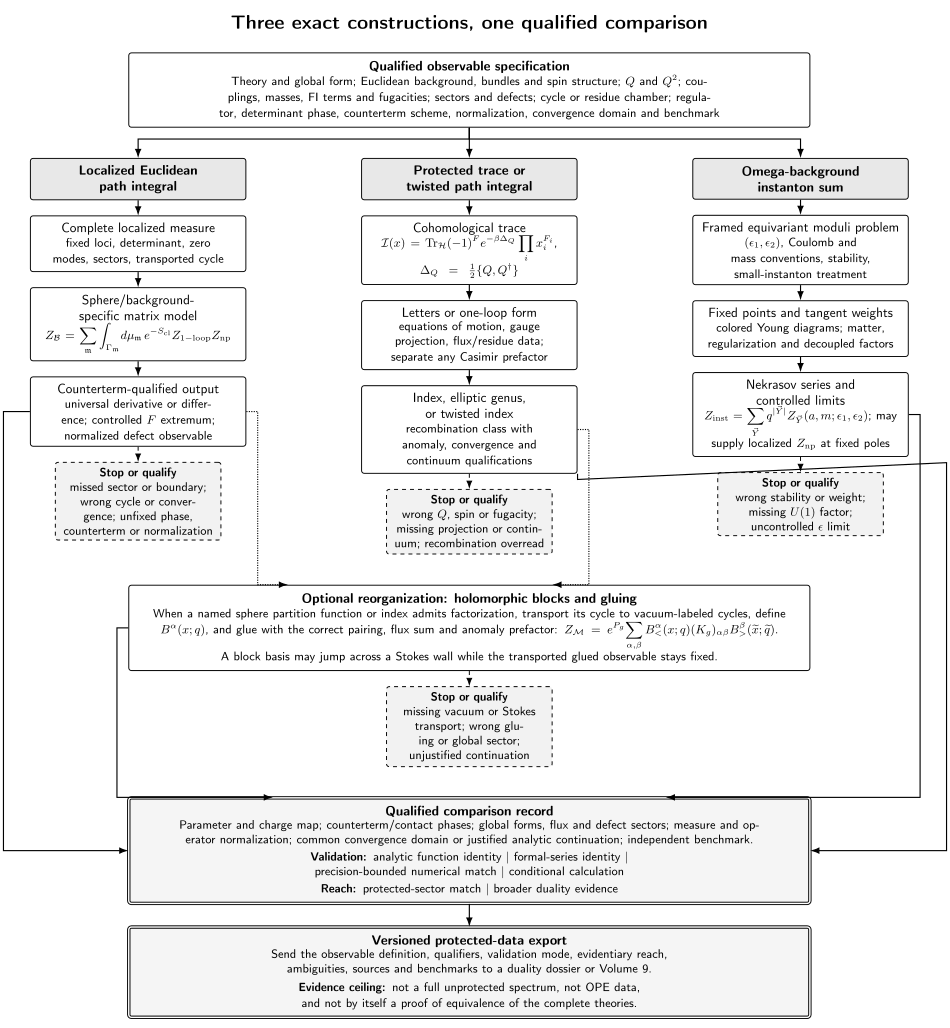
The localized-integral branch ends in a counterterm-qualified result, not an unqualified number. Before a derivative, difference, phase class, or finite part is exported, the dimension- and background-specific integral must retain its sectors, cycle, convergence domain, determinant phase, quantized level lattice, finite-counterterm class, and separately recorded normalization. Solid arrows carry required steps along a selected route, dotted arrows mark optional block factorization, and dashed exits mark missing sectors or poles, field-space boundaries, nonconvergence, phase or level ambiguities, and conflation of counterterms with normalization changes. The map is schematic, not a universal sphere formula, and not to scale.
The reflowing text equivalent of the exact-observable map preserves every branch, failure exit, comparison field, and evidence limit for narrow-screen and print reading.
Why odd and even spheres differ
Section titled “Why odd and even spheres differ”For a conformal theory on a round sphere of radius , the regulated free energy has the schematic structure
Power divergences are removable by local curvature counterterms. In even dimensions, the logarithmic coefficient is fixed by the Weyl anomaly, whereas the finite constant is generally scheme dependent. In odd dimensions without boundary, no parity-even local diffeomorphism-invariant counterterm shifts the real finite constant of a CFT. A gravitational Chern–Simons term can still shift its imaginary part by a quantized amount. These statements concern the conformal sphere with a symmetry-preserving regulator; relevant couplings, boundaries, or extra sources enlarge the counterterm problem Gerchkovitz, Gomis, and Komargodski 2014, §1, especially Eqs. (1.8)–(1.13).
A three-dimensional contact-term benchmark
Section titled “A three-dimensional contact-term benchmark”Consider a three-dimensional SCFT with compact Abelian flavor symmetries and canonically normalized currents. Fix the flat-space convention
Reflection positivity makes positive definite after redundant currents are removed. The contact coefficient depends on the regulator, but for the unit-charge compact- convention its counterterm shift is integral; more general charge lattices or non-spin global structures change the allowed level lattice. Thus modulo that lattice is physical Closset et al. 2012, “Contact Terms, Unitarity,” §2.1, Eqs. (2.2)–(2.3); Closset et al. 2012, “Comments on Chern–Simons Contact Terms,” §§2–3.
Turn on constant real masses and write the dimensionless sources as . In the same convention, the round-sphere generating functional obeys
The real part measures separated-point data; the imaginary part measures the contact term. This is the precise version of the often-used statement that a supersymmetric Chern–Simons counterterm shifts by an imaginary quadratic polynomial. The derivation, including the imaginary auxiliary field required on , is given in Closset et al. 2012, §§3–4, Eqs. (4.1), (4.6)–(4.8).
It is therefore useful to distinguish
The fractional phase is meaningful even though an integer counterterm changes its representative. By contrast, is insensitive to these pure phases. Trial R-current mixing is implemented by the analytic continuation ; the two factors of reverse the sign of the Hessian and lead to -maximization on the dedicated page.
Four-dimensional sphere data and Kähler ambiguity
Section titled “Four-dimensional sphere data and Kähler ambiguity”For a four-dimensional SCFT on the round , regulate while preserving the massive algebra and promote each exactly marginal coupling to its background chiral multiplet. In the normalization of Gerchkovitz, Gomis, and Komargodski,
where is a Kähler potential for the conformal-manifold metric. A supersymmetric finite counterterm implements
and hence multiplies by . The partition function is accordingly a local section rather than a globally defined function on the conformal manifold. The invariant statement is
Both the result and its supersymmetric Kähler ambiguity are established in Gerchkovitz, Gomis, and Komargodski 2014, §5, Eqs. (5.4) and (5.17). The amount of supersymmetry matters: for a four-dimensional SCFT, an allowed supersymmetric finite counterterm can shift the sphere answer by an arbitrary real function of exactly marginal couplings, so the analogous Kähler-potential claim fails Gerchkovitz, Gomis, and Komargodski 2014, §4, Eqs. (4.6)–(4.10).
The logarithmic dependence on is a separate datum controlled by the four-dimensional Weyl anomaly. Its coefficient is universal once anomaly conventions are fixed; no choice of the finite Kähler representative changes it.
How to construct a universal quantity
Section titled “How to construct a universal quantity”| Operation | Why it can be universal | Required check |
|---|---|---|
| Derivative chosen transverse to allowed local shifts | Annihilates the classified holomorphic or polynomial ambiguity | Verify it annihilates every allowed source functional |
| Difference between matched backgrounds | Cancels identical local terms | Match all background multiplets, not only the metric |
| Logarithmic scale coefficient | Fixed by an anomaly | Exclude zero-mode and boundary logarithms |
| Fractional contact coefficient | Quantized shifts are counterterms | Fix charge lattice, spin structure, and large-gauge normalization |
| Real finite part of a unitary odd-sphere CFT answer | No parity-even local bulk term shifts it | Require the conformal background, no boundary, and a diffeomorphism-invariant scheme |
A ratio is not automatically universal. It is safe only if the same local counterterm evaluates equally in numerator and denominator or if its mismatch has been subtracted by a declared convention.
Failure modes
Section titled “Failure modes”Ignoring the background multiplet. Equal metrics do not imply equal supersymmetric backgrounds; auxiliary fields can make a counterterm contribute differently.
Dropping every phase. A phase may contain the fractional part of a physical Chern–Simons contact term. Remove only the quantized scheme freedom.
Differentiating before classifying. A first or second derivative may still be shifted by a local polynomial. The necessary derivative order is dimension and background dependent.
Calling normalization a counterterm. Dividing by a decoupled sector, a gauge-group volume, or a supersymmetric Casimir factor changes the defined object. State that operation separately.
Using one dimension’s classification in another. Three-dimensional Chern–Simons ambiguities, four-dimensional Kähler ambiguities, and even-dimensional Weyl-anomaly logarithms are different structures.
The strongest meaningful claim is always attached to a particular invariant combination, not to the bare symbol .
Exercises
Section titled “Exercises”- In the three-dimensional convention above, show what can be extracted from
Solution
The separated-point coefficient is
and is scheme independent. The imaginary part gives
but only modulo integers. Thus both and the fractional class are physical, while the full complex number is not.
- Under , prove that is invariant. Is invariant?
Solution
Since , the shift is . A mixed derivative annihilates both pieces:
The ratio changes by
so it is not invariant without a chosen Kähler trivialization or an additional cancellation.
- Suppose a source-dependent generating functional can shift by any polynomial of degree at most . What is the first ordinary derivative that is automatically invariant?
Solution
The -st derivative annihilates every allowed polynomial:
No lower derivative is automatically safe because the counterterm may contain a monomial of sufficiently high degree. This is only a toy criterion: in a real field theory one first classifies multivariable, gauge-invariant supersymmetric counterterms, and mixed derivatives can become invariant at a lower total order.
References
Section titled “References”- Closset, Cyril, Thomas T. Dumitrescu, Guido Festuccia, and Zohar Komargodski. “Supersymmetric Field Theories on Three-Manifolds.” Journal of High Energy Physics 2013, no. 5 (2013): 017. doi:10.1007/JHEP05(2013)017. Open PDF.
- Closset, Cyril, Thomas T. Dumitrescu, Guido Festuccia, Zohar Komargodski, and Nathan Seiberg. “Comments on Chern–Simons Contact Terms in Three Dimensions.” Journal of High Energy Physics 2012, no. 9 (2012): 091. doi:10.1007/JHEP09(2012)091. Open PDF.
- Closset, Cyril, Thomas T. Dumitrescu, Guido Festuccia, Zohar Komargodski, and Nathan Seiberg. “Contact Terms, Unitarity, and F-Maximization in Three-Dimensional Superconformal Theories.” Journal of High Energy Physics 2012, no. 10 (2012): 053. doi:10.1007/JHEP10(2012)053. Open PDF.
- Gerchkovitz, Efrat, Jaume Gomis, and Zohar Komargodski. “Sphere Partition Functions and the Zamolodchikov Metric.” Journal of High Energy Physics 2014, no. 11 (2014): 001. doi:10.1007/JHEP11(2014)001. Open PDF.
Original QFT.org content:CC BY 4.0, unless an item supplies different terms. Third-party material retains its own terms.