

Q-Cohomology and Path-Integral Deformation
A -exact deformation can leave selected observables unchanged, but there are two logically separate claims. At finite deformation parameter, a Ward identity can prove independence of that parameter. Evaluating the answer at infinite deformation parameter additionally requires convergence, a justified integration cycle, a complete -fixed locus, and control of zero modes and regulators. The slogan “add and send to infinity” hides this distinction.
Required background. Finite-dimensional equivariant localization states the rigorous model and its compactness hypotheses. -cohomology and Hodge complexes supplies the cohomological interpretation of protected insertions.
Helpful background. Localized transformations and Ward–Takahashi identities supplies the change-of-variables derivation and its anomaly term.
Q-cohomology and the invariant subalgebra
Section titled “Q-cohomology and the invariant subalgebra”Let be an odd symmetry with
where is a bosonic combination of an isometry, gauge transformation, R rotation, or flavor transformation. The cohomology is taken on the -invariant subalgebra:
In a gauge theory, “invariant” must eventually include the gauge-fixing and ghost sectors; that combined differential is constructed on the next page. For the present derivation, assume that all fields, auxiliaries, and regulator variables have already been included in a -invariant integration problem.
If , then a correlator of with separated -closed insertions should vanish only if the change of variables generated by has no anomaly or boundary remainder. Thus “zero in -cohomology” is an algebraic statement; decoupling from a path integral is a Ward-identity statement.
Finite-parameter deformation identity
Section titled “Finite-parameter deformation identity”Let denote the regulated set of bosonic and fermionic variables. Let be a fixed integration cycle in the complexified Euclidean field space, and let denote its regulated measure density. Choose an odd functional and an even observable . Define
The finite-parameter argument requires all of the following:
- , , and ;
- the measure has zero regulated divergence;
- the vector field is tangent to , or its flux through the ends of vanishes;
- spacetime boundary conditions preserve and have no uncancelled supercurrent flux;
- the integral and its derivative converge sufficiently to differentiate under the integral sign.
The first line ensures that the deformed integrand remains invariant. Indeed,
Differentiating at fixed gives
Under assumptions 2–4, the last line is the integral of a total odd variation and vanishes. Therefore and are constant on every connected interval of where the assumptions hold.
For the normalized correlator, differentiation before using the Ward identity gives
Both terms vanish by the same Ward identity, provided . If itself depends on , an additional term remains.
This derivation is a conditional path-integral proposition, not a continuum measure theorem. Its rigorous finite-dimensional cousin assumes a compact supermanifold, a divergence-free odd vector field, a compact bosonic square, and a -invariant integrand Schwarz and Zaboronsky 1997, §3, Theorem 1. A continuum QFT must still justify the regulator removal and integration cycle.
The complete remainder identity
Section titled “The complete remainder identity”It is useful to name rather than suppress the ways in which the Ward identity can fail. For a fixed contour, write schematically
The terms mean:
Measure or regulator anomaly . The Jacobian of may be nontrivial, or the regulator and counterterms may fail to preserve . A classical symmetry does not set this term to zero.
Field-space flux . A noncompact direction, a finite contour endpoint, a pole, a singular gauge orbit, or insufficient decay can leave a surface contribution. Uniform decay is required, not convergence at one value of .
Spacetime boundary term . The integrated local Ward identity contains normal supercurrent flux. Boundary conditions, edge degrees of freedom, or inflow must cancel it.
Insertion term . An insertion may be only classically closed, or moving the symmetry contour through another operator may create a contact term. Separated-operator cohomology does not determine coincident-point products by itself.
If the integration cycle depends on , differentiating also produces a contour-motion term. It vanishes only for a homology through regions where the integrand is holomorphic and decays at the ends. Crossing a pole changes the homology class by a linking cycle and hence a residue. At a Stokes wall, by contrast, the thimble basis and its coefficients can jump oppositely while the total original cycle stays fixed; keeping one thimble instead of transporting the full cycle would change the prescription. These distinctions are derived in Witten 2011, §§2–3, especially §3.1.2. If , the deformation argument fails even earlier because the exponent is not invariant.
With these definitions, set . Then
for a fixed contour and the stated sign convention. This equation is a diagnostic decomposition; each term needs a regulator-specific definition in an actual field theory.
The entire argument can now be read as the decision chain below. The first four stages establish a well-defined -cohomological deformation at finite ; the remaining stages are additional analytic and gauge-theoretic work needed to identify its limit with a locus formula.
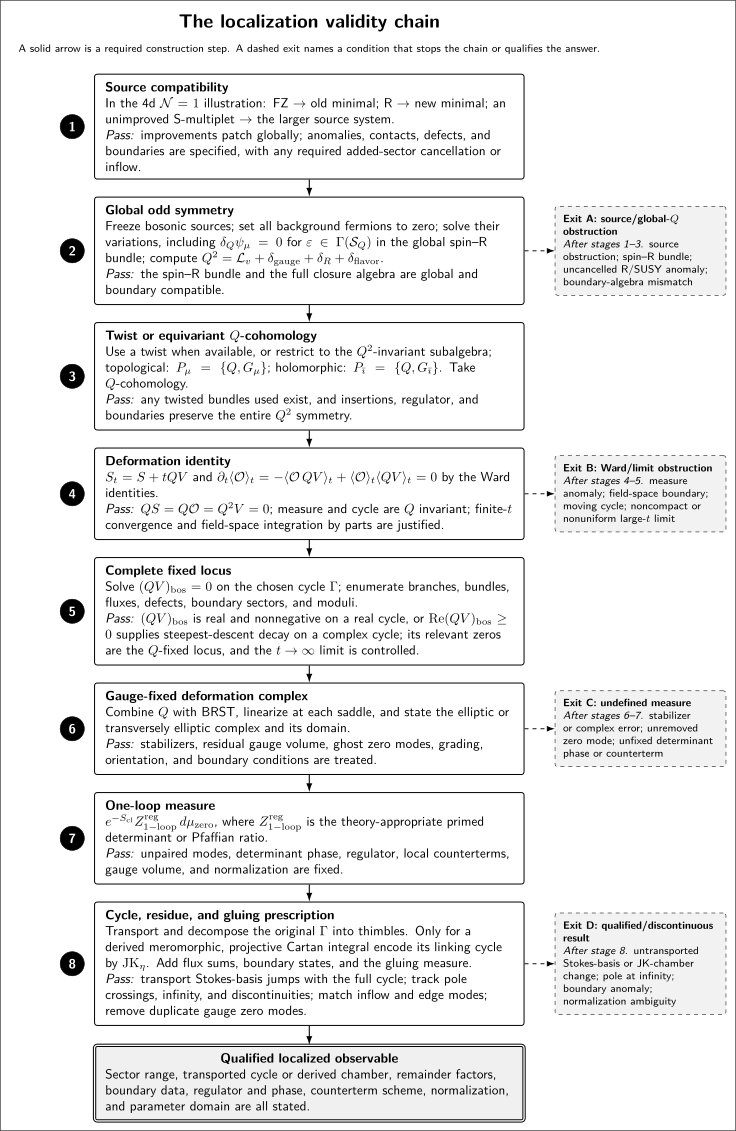
Localization is a chain of conditional statements. Source compatibility, a global odd symmetry, and a valid twist or equivariant restriction lead to the finite- identity only when and the measure, cycle, insertions, and boundaries obey the Ward identity. Reality and nonnegativity on a real cycle—or controlled real-part decay on a complex one—completeness of the locus, a gauge-fixed deformation complex, explicit zero-mode replacement, a regulated determinant, and transport of the original contour are separate requirements for the large- formula. Dashed arrows mark obstruction, noncompactness, anomaly, and untransported Stokes-basis changes. The diagram is schematic and not to scale; supercharge and R-charge normalizations are theory dependent.
Reflowing text equivalent
Section titled “Reflowing text equivalent”The same chain can be read without the diagram. Each stage has its own input, construction, pass condition, and result; passing an earlier stage does not supply a later one.
-
Source compatibility. The source-multiplet construction starts with the flat-space supercurrent multiplet and the nondynamical supergravity formulation one intends to use. In the four-dimensional illustration, test whether improvements patch globally and select old minimal for an FZ multiplet, new minimal for an R-multiplet, or the larger source system for an unimproved S-multiplet. Anomalies, contact terms, defects, and boundary behavior must be specified. The result is an admissible set of metric, R, and auxiliary background sources.
-
Global odd symmetry. In the curved-background construction, freeze those bosonic sources, set every background fermion to zero, and solve every background-fermion variation for a section of the actual global spin–R bundle. Compute on every physical and background field, including its isometry, gauge, R, flavor, and boundary actions. The bundle must patch and this full closure algebra must preserve the boundary conditions. The result is a global supercharge with a declared even square; the later gauge-fixing stage extends this algebra to ghosts and auxiliaries.
-
Twist or equivariant -cohomology. The twist construction regrades Lorentz and nonanomalous R-symmetry data so that becomes a scalar when a twist is used; otherwise work directly in the -invariant subalgebra of the global charge. A topological twist makes every exact, while a holomorphic twist makes only exact. Any twisted bundles must exist, and the insertions, regulator, and boundary conditions must preserve all of . The result is a cohomological field complex and its protected insertions.
-
Deformation identity. Begin with a -invariant action , insertion , cycle , and deformation functional , and set . The finite-dimensional analogue makes the integration-by-parts and convergence hypotheses explicit. For the normalized expectation value,
This vanishes only when and the measure, cycle, finite- convergence, field-space integration by parts, spacetime boundary, and contact terms all satisfy the Ward identity. The result is finite- deformation independence with any remainder shown explicitly—not yet a saddle formula.
-
Complete fixed locus. The locus analysis uses the chosen and to solve the zero equations and enumerate every branch, bundle, flux, defect, boundary sector, and modulus. On a real localization cycle the restricted deformation must be real and nonnegative. On a complex cycle its real part must provide the declared steepest-descent decay, and the relevant zero set must be shown to agree with the -fixed locus. No saddle or contribution at infinity may be missed, and the large- limit must be uniform enough to interchange with integration or summation. The result is the full sector decomposition of .
-
Gauge-fixed deformation complex. The deformation-complex construction combines with BRST at each saddle and linearizes the transformations using the saddle’s stabilizer and the complete gauge symmetry. Extend the algebra consistently to ghosts and auxiliaries, then state the elliptic or transversely elliptic complex and its boundary domain. Reducible saddles, residual gauge volume, ghost zero modes, grading, determinant-line orientation, and boundary conditions must all be treated. The result is a determinant-ready nonzero-mode complex together with explicit kernel and cokernel data.
-
One-loop measure. The one-loop analysis pairs only the nonzero modes, forms the theory-appropriate primed determinant or Pfaffian ratio, and replaces every removed zero mode by its collective-coordinate, stabilizer, or Grassmann measure. The phase and regularization analysis fixes a spectral cut, determinant phase, regulator scale, allowed local counterterms, gauge volume, and benchmark normalization. The result is a regulated sector measure , not merely a formal determinant.
-
Cycle, residue, and gluing prescription. Return to the original declared before deformation and transport it as in the contour analysis into an oriented thimble combination. Only when the reduction has produced a meromorphic, projective Cartan integral may its linking cycle be encoded by a Jeffrey–Kirwan covector and chamber. Add every flux sum, boundary state, and gluing measure described by the boundary, gluing, and residue analysis. Transport Stokes-basis jumps with the full cycle; retain the linking or residue contributions from pole crossings and any resulting discontinuity; match anomaly inflow with edge data; and remove duplicated gauge zero modes. The result is an observable qualified by its chamber, boundary condition, scheme, normalization, and parameter domain.
Failure exits. After stages 1–3, an obstructed source improvement, missing spin–R patching, uncancelled R or supersymmetry anomaly, or incompatible boundary algebra blocks the global construction. After stages 4–5, a measure anomaly, field-space boundary, moving contour, noncompact direction, missed sector, or nonuniform limit blocks the Ward-identity or saddle step. After stages 6–7, a reducible saddle, wrong complex, unremoved zero mode, undetermined phase, or unfixed counterterm leaves the fluctuation measure undefined. At stage 8, an untransported Stokes-basis change, Jeffrey–Kirwan chamber change, pole at infinity, boundary anomaly, or normalization ambiguity qualifies or changes the answer.
When every applicable condition passes, the output has the schematic form
with the theory, background, bundles, , sector range, transported cycle, boundary condition, regulator and phase, local-counterterm scheme, normalization, and parameter chamber stated. The structured semantic record supplies the same content and the primary-source chain in machine-readable form.
From independence to a saddle formula
Section titled “From independence to a saddle formula”On a conventional real localization cycle, choose and so that the restricted bosonic deformation is real and nonnegative. More generally, on a complex cycle require the real part to furnish the chosen steepest-descent decay:
This is an analytic property of the pair , not a consequence of exactness. On a complex cycle, vanishing of the real part alone need not identify the -fixed set; that relation and the behavior of imaginary directions must be established separately. In Euclidean signature, barred and unbarred fields are generally independent complex variables until a real cycle is chosen, so a Lorentzian adjoint relation cannot establish positivity.
Define the zero set
When is a sum of positive norms of fermion variations, this set is described by BPS equations such as . That equivalence itself depends on the selected real slice and on whether every square has positive coefficient.
Finite- independence lets one evaluate at large only after establishing:
- Existence for all : the integral and Ward identity are valid along the entire deformation path.
- Uniform control: differentiation and the limit can be interchanged with integration; no saddle escapes to infinity.
- Locus completeness: every connected component, topological sector, singular stratum, and reducible solution has been included.
- Transverse positivity: negative and complex directions are treated by a justified contour, while flat directions are retained as zero modes rather than put into a determinant.
- Gauge-fixed fluctuations: the quadratic operator belongs to a complete supersymmetry–BRST complex with kernels and stabilizers separated.
- Regularized measure: determinant magnitudes, phases, anomalous Jacobians, and local counterterms use a -compatible regulator.
- Contour stability: no pole crossing, residue jump, or Stokes phenomenon occurs unnoticed as varies.
Only then does the large- asymptotic expansion compute the original integral. Pestun’s four-sphere calculation is a model-specific example of this sequence: off-shell closure is set up in §2.2 and Appendix C, the positive deformation and locus are developed in §3, gauge fixing and the combined cohomological complex in §§4.1–4.3, and the transversely elliptic determinant in §4.4 Pestun 2012, §§2.2–3, §§4.1–4.4, and Appendix C. It is evidence for the method under those hypotheses, not a proof for arbitrary backgrounds or theories.
Dependence that localization does not remove
Section titled “Dependence that localization does not remove”The Ward identity removes dependence only on the coefficient of a deformation that is genuinely exact under the stated conditions. It can leave dependence on:
- -closed but nonexact couplings;
- complex-structure, bundle, mass, and equivariant parameters;
- discrete flux and instanton sectors;
- boundary polarizations and integration cycles;
- renormalization scheme and finite supersymmetric counterterms.
For an allowed local background counterterm ,
can preserve every Ward identity while changing the numerical partition function. A publication-level answer must therefore state the scheme and normalization, or isolate a ratio, derivative, or universal term in which the ambiguity cancels.
Common pitfalls
Section titled “Common pitfalls”“ is exact, so its bosonic part is positive.” Exactness is algebraic. Positivity is a property of the deformation and the integration cycle.
“The derivative vanishes, so there is one saddle.” Finite-parameter independence neither classifies nor determines the thimble coefficients of the original cycle.
“Bosons and fermions cancel.” Nonzero modes pair only after gauge fixing with compatible domains and regulators. Kernels, cokernels, phases, stabilizers, and anomalous Jacobians remain.
“A contour deformation is harmless.” It is harmless only within the same convergent homology class, with no pole crossing or endpoint contribution. At a Stokes wall, transport the full cycle: individual thimbles and their coefficients may jump even when their total does not.
Exercises
Section titled “Exercises”1. Normalized correlator. Starting from , derive its derivative and state exactly when it vanishes.
Solution
The quotient rule gives
For , the first numerator is the Ward identity for and the second is the Ward identity for . Both vanish when the measure, contour, spacetime boundary, regulator, and insertions satisfy the hypotheses. The normalized expression also requires .
2. A cycle with endpoints. Let on the interval . Why need the integral of a -exact one-form not vanish?
Solution
For a function ,
The two endpoint values are the field-space boundary term. Compactness without boundary, decay at infinity, or boundary conditions that cancel this difference are required.
3. Invariance under the bosonic square. Suppose and . Show where the deformation proof stops.
Solution
Although is exact,
when . The deformed exponent is therefore not invariant. Consequently does not reproduce as a pure variation, and the finite-parameter Ward-identity proof does not begin. One must choose a -invariant or change the equivariant complex.
References
Section titled “References”- Pestun, Vasily. “Localization of Gauge Theory on a Four-Sphere and Supersymmetric Wilson Loops.” Communications in Mathematical Physics 313 (2012): 71–129. doi:10.1007/s00220-012-1485-0. Open preprint.
- Schwarz, Albert, and Oleg Zaboronsky. “Supersymmetry and Localization.” Communications in Mathematical Physics 183 (1997): 463–476. doi:10.1007/BF02506415. Open preprint.
- Witten, Edward. “Analytic Continuation of Chern–Simons Theory.” In Chern–Simons Gauge Theory: 20 Years After, AMS/IP Studies in Advanced Mathematics 50, 347–446. Providence, RI: American Mathematical Society, 2011. Open preprint.
Next step
Section titled “Next step”For a gauge theory, the relevant odd symmetry is a combined differential. Construct it on the gauge-fixed localization deformation complex.
Original QFT.org content:CC BY 4.0, unless an item supplies different terms. Third-party material retains its own terms.