

Seiberg Duality in SQCD
Seiberg duality proposes that two asymptotically different four-dimensional gauge theories flow to the same infrared physics. The canonical pair is completely specified by its gauge groups, matter, singlets, superpotential, global charges, scale relation, and rank regime. This page gives the generic left–right flavor card for and ; confining endpoints and the pseudoreal theory require separate qualifications. Omitting any part of the card turns the claim into an ambiguous mnemonic.
Required background. SQCD fields, symmetries, and classical moduli defines the electric theory, and duality claims and dictionaries fixes the comparison standard. Helpful background. Infrared phases and the conformal window explains the rank-dependent regimes.
Electric and magnetic theory cards
Section titled “Electric and magnetic theory cards”The electric theory has gauge group , pairs of chiral multiplets,
and . Use the global symmetry notation
with the understanding that the faithful group includes quotients by common centers. Normalize and . A convenient charge-conjugation-symmetric, baryon-unmixed representative of the anomaly-free R-current is
Gauge-anomaly cancellation fixes the sum of the two quark R-charges, not their difference: is also anomaly-free. The displayed is the natural representative when charge conjugation is unbroken.
For , the generic magnetic theory has
magnetic quarks , a gauge-singlet matrix , and
Here is normalized to map to the dimension-two electric composite , so the matching parameter has mass dimension one. Equivalently, define a dimension-one elementary singlet and write .
The charge table is
| Field | Gauge | ||||
|---|---|---|---|---|---|
Every term in is a flavor singlet, has zero baryon charge, and has R-charge two. Gauge anomalies cancel because and are vectorlike. The mixed gauge–R anomaly also vanishes:
where the first term is the gaugino and the second includes both magnetic-quark species with . The magnetic theory and its charge assignments are constructed in Seiberg 1995, §§2–4, Open PDF and reviewed in Intriligator and Seiberg 1996, §5.3, pp. 21–23, Open PDF.
The figure below keeps the theory cards, normalized protected map, and one-flavor deformation test in one view. Inspect the upper row for data that belong to the duality claim itself, then follow the lower square to see why an electric mass must become magnetic Higgsing rather than an ordinary magnetic mass.
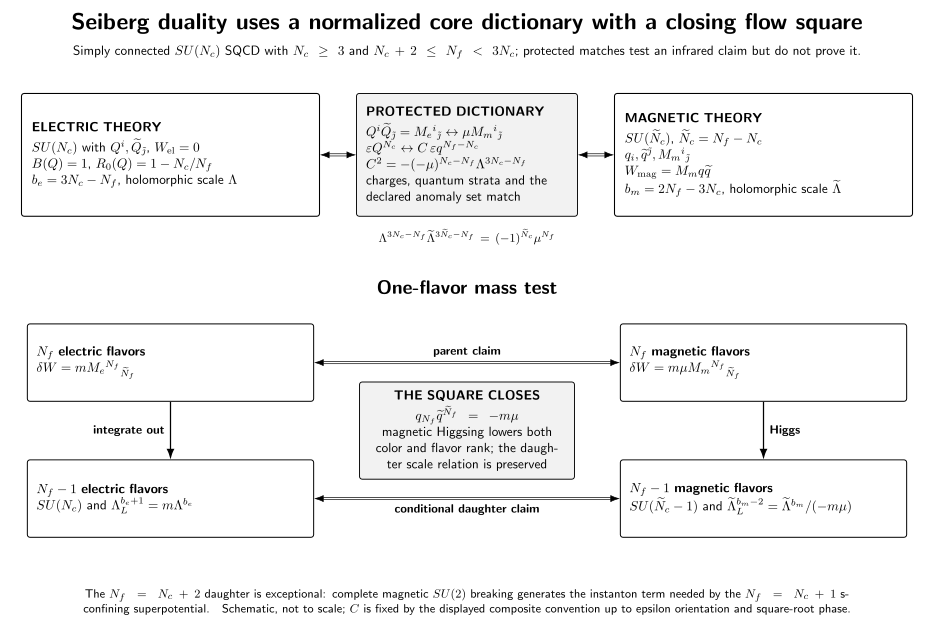
For simply connected SQCD with and , the upper row records the dimension-one magnetic singlet in the convention , the convention-fixed baryon coefficient, and the holomorphic scale relation. The lower row is a schematic, not-to-scale holomorphic dynamical flow check: an electric mass produces magnetic Higgsing and the daughter scale relation; at , complete magnetic breaking also supplies the instanton term required at the s-confining endpoint. The protected dictionary and this dynamical check strongly test, but do not prove, the infrared equivalence. Select the figure for full-size inspection. Read the semantic SQCD dictionary.
Meson normalization and the role of μ
Section titled “Meson normalization and the role of μ”The basic map is
The parameter records the normalization change between a dimension-two electric composite and a dimension-one elementary magnetic singlet. It is not an additional physical modulus. Rescaling changes , the baryon-map coefficients, and the magnetic holomorphic scale together.
Electric baryons map to magnetic baryons made from quarks in the complementary antisymmetric flavor representation. Their baryon charges agree because , but the convention-fixed coefficient also contains and . The operator-dictionary page gives that coefficient and explains why the electric meson-rank constraint is reproduced by quantum, not merely classical, magnetic dynamics.
Holomorphic scale matching
Section titled “Holomorphic scale matching”Let and be the electric and magnetic holomorphic scales in a common scheme. A standard convention gives
The phase depends on definitions of the scales and baryons, but it cannot be discarded after a convention is fixed: it ensures consistent decoupling and moduli-space matching. Since
the magnetic theory is infrared free when and asymptotically free when . Electric asymptotic freedom requires .
The two descriptions therefore have complementary weak-coupling regions. Their holomorphic scales are not independent parameters; changing the arbitrary matching normalization rescales the magnetic singlet and shifts so physical predictions remain invariant. When the magnetic beta-function coefficient is negative, is most naturally interpreted as a holomorphic ultraviolet Landau-pole parameter rather than an infrared strong-coupling scale.
Rank regimes and special endpoints
Section titled “Rank regimes and special endpoints”| Range | Infrared description and qualification |
|---|---|
| Electric theory is not asymptotically free; the canonical ultraviolet setup changes. | |
| Candidate interacting conformal window; both descriptions can be strongly coupled in the interior. | |
| Free magnetic phase: the magnetic gauge coupling and the interaction flow to zero in the extreme infrared. | |
| s-confining description in mesons and baryons with a generated superpotential; the formal magnetic rank is one. | |
| Quantum-modified moduli space; no generic magnetic gauge group. | |
| Affleck–Dine–Seiberg dynamics and, without masses, a runaway for the standard theory. | |
| Pure super-Yang–Mills with gaugino condensation and isolated vacua, not an ADS runaway. |
At equality or , beta-function coefficients vanish at leading order and logarithmic or accidental effects require separate analysis. Open-window formulas should not be asserted at endpoints without that analysis.
Small ranks also matter. is not an ordinary gauge group. For , the doublets are pseudoreal and the flavor symmetry enhances to , so the generic left–right charge and anomaly card is only a subgroup presentation. Baryon representations can also coincide with mesonic structures. Each such case deserves its own theory card.
Global form and line data
Section titled “Global form and line data”With dynamical fundamental quarks, the electric center one-form symmetry is absent because a fundamental Wilson line can end on . The magnetic center is likewise screened by . This removes a common source of line-lattice mismatch, but it does not make global data automatic. The faithful flavor symmetry is a quotient involving baryon number and flavor centers, and background bundles can obey correlated flux conditions.
A complete duality statement maps those background bundles and all discrete anomalies. If one changes the gauge group, gauges baryon number, or quotients a flavor center, the resulting dual pair can acquire nontrivial one-form symmetries and topological sectors. It is a new operation, not an innocuous notation change.
Evidence and status
Section titled “Evidence and status”The duality is supported by matched continuous anomalies, chiral rings and moduli, holomorphic scale relations, mass and Higgs flows, special-rank limits, and superconformal-index identities. For ordinary SQCD, discrete subgroups do not supply an independent Abelian anomaly test beyond the continuous symmetries; quotient-background anomalies require their own global analysis. Dolan and Osborn identify the Seiberg-duality index relation with an elliptic-hypergeometric transformation in Dolan and Osborn 2009, §§4–5, Open PDF. These checks are powerful but correlated: several use the same global charges and holomorphy.
The safe statement is that Seiberg duality is a strongly supported infrared equivalence in its specified regimes, with many exact protected consequences. It is not a proven equality of ultraviolet Lagrangians, and a protected-index identity alone is not a proof of the full infrared claim.
Common pitfalls
Section titled “Common pitfalls”Writing only the magnetic rank. Without , , charges, and scale matching, one has not defined the magnetic theory.
Using with inconsistent dimension. If has dimension two in the ultraviolet normalization, belongs in the cubic superpotential.
Extending the generic card through special ranks. and have confining and quantum-modified descriptions that must be written separately.
Exercises
Section titled “Exercises”For and :
- find the magnetic rank;
- compute , , and ;
- verify that has R-charge two;
- determine whether the magnetic gauge coupling is infrared free at one loop.
Solution
. The charges are
Their superpotential sum is . The magnetic one-loop coefficient is , so the magnetic theory is asymptotically free, not infrared free. Since , the pair lies in the candidate interacting conformal window.
References
Section titled “References”- Dolan, F. A., and Hugh Osborn. “Applications of the Superconformal Index for Protected Operators and -Hypergeometric Identities to Dual Theories.” Nuclear Physics B 818 (2009): 137–178. DOI. Open PDF.
- Intriligator, Kenneth, and Nathan Seiberg. “Lectures on Supersymmetric Gauge Theories and Electric–Magnetic Duality.” Nuclear Physics B Proceedings Supplements 45BC (1996): 1–28. DOI. Open PDF.
- Seiberg, Nathan. “Electric–Magnetic Duality in Supersymmetric Non-Abelian Gauge Theories.” Nuclear Physics B 435 (1995): 129–146. DOI. Open PDF.
Further reading
Section titled “Further reading”- Weinberg, Steven. The Quantum Theory of Fields, Volume III: Supersymmetry. Cambridge University Press, 2000, ch. 29. doi:10.1017/CBO9781139644198.
Original QFT.org content:CC BY 4.0, unless an item supplies different terms. Third-party material retains its own terms.