

Complex Contours, Stokes Chambers, and Regularization
A localized path integral is not defined by its meromorphic integrand alone. It also needs a middle-dimensional cycle in complexified Euclidean field space, a rule for transporting that cycle as parameters vary, a treatment of degenerate directions, and a regulator with a phase convention. Stokes jumps, poles, and determinant-line holonomy can change these data even when the formal -cohomology is unchanged.
Required background. Localization loci and one-loop determinants supplies the finite-dimensional integrand and its omitted kernels. The method of steepest descent supplies saddle contours and asymptotic expansions.
Helpful background. Branches, sheets, continuation, and monodromy supplies spectral cuts and analytic continuation.
The Euclidean integral includes a cycle
Section titled “The Euclidean integral includes a cycle”After continuation to Euclidean signature, variables related by Lorentzian conjugation are often independent complex fields. The notation
therefore includes essential data : an oriented, middle-dimensional relative homology cycle whose ends lie in regions where . The cycle may be inherited from a Lorentzian prescription, selected by a reflection-positive real slice, or defined directly by analytic continuation. These constructions can lead to the same contour, but they are not interchangeable arguments.
Localization adds two conditions. The change of variables must preserve , or be deformable back to it without crossing a singularity or moving an endpoint at infinity. On a real cycle, must be real and nonnegative; on a complex cycle, its real part must give the required steepest-descent decay. A positive expression on a formal real slice says nothing about convergence on a different complex cycle, and the vanishing of its real part need not by itself identify the -fixed locus.
The final stage of the shared chain below begins with this original cycle, not with a convenient residue prescription chosen after the integrand is known. Its dashed exits emphasize that Stokes jumps, poles at infinity, determinant-line phases, and counterterm choices can qualify or change the result.
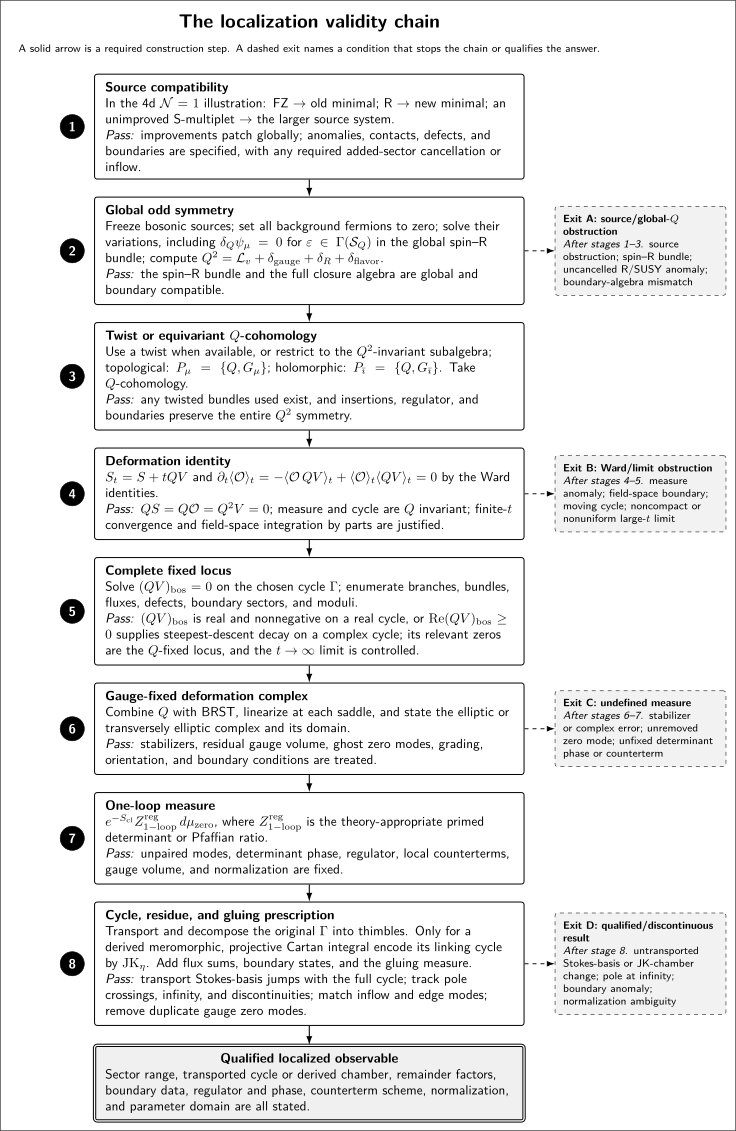
The last two stages turn a formal one-loop integrand into a defined observable: kernels are replaced by their measures, nonzero modes receive a spectral cut, phase, regulator, and counterterm scheme, and the original cycle is transported into an oriented thimble combination. Only when the reduction has produced a meromorphic, projective Cartan integral may that derived cycle be represented by a declared Jeffrey–Kirwan covector and chamber. A Stokes basis jump need not change the fixed original cycle, whereas crossing a pole or changing the contour prescription can change its representation or value. The full diagram is schematic and not to scale; supercharge and R-charge normalizations are theory dependent.
The reflowing text equivalent of the eight-stage chain preserves every input, construction, pass condition, output, and failure exit for narrow-screen and print reading.
Lefschetz thimbles and the original cycle
Section titled “Lefschetz thimbles and the original cycle”Consider first a finite-dimensional complex manifold with holomorphic Morse function and isolated, nondegenerate critical points . Choose a Hermitian metric and use the downward flow
It obeys
Define the convergent thimble as the set of points that approach as . Following the same trajectories backward takes their ends toward larger , where decays. The dual upward cycle has the complementary flow orientation. Under the usual holomorphic-Morse and tameness hypotheses,
Solving the saddle equations finds candidate ; it does not determine the intersection numbers . Those remember the original cycle.
Stokes data versus dominance
Section titled “Stokes data versus dominance”With the convention used here, a Stokes wall between saddles and requires
and an actual connecting flow. Across such a wall a thimble can jump by an integral multiple of another thimble, for example
The coefficients transform oppositely, so the homology class stays fixed. Equality of exponential magnitudes,
is instead an anti-Stokes or dominance wall in this terminology. Some literature exchanges these names, so the two equations are more reliable than the labels. The thimble jumps and their intersection-theoretic origin are developed in Witten 2011, §§2–3, especially §3.1.2.
This is a theorem in suitable finite-dimensional relative homology problems. Its use for an infinite-dimensional gauge-theory field space is conditional: one still needs control of the flow, gauge quotient, bubbling or singular strata, and behavior at infinity. A formal thimble diagram is evidence, not a universal existence proof.
Worked example: transporting a Gaussian cycle
Section titled “Worked example: transporting a Gaussian cycle”Let , take , and consider
The real line converges only for . A steepest-descent cycle through is
because . With the transported orientation,
The square-root branch is fixed by transporting , not by the symbol alone. When increases by , the oriented thimble reverses and the integral changes sign. This elementary monodromy is the finite-dimensional prototype of a determinant-line phase.
Zero modes, negative modes, and singularities
Section titled “Zero modes, negative modes, and singularities”Three failures of an isolated Gaussian require different repairs.
A smooth critical manifold. In the Morse–Bott case, integrate tangent zero modes as collective coordinates and construct thimbles only in the normal directions. Gauge tangent modes are first quotiented using the combined gauge complex.
A changing Hessian rank. When a nonzero eigenvalue reaches zero, the Gaussian expansion is nonuniform. Retain that mode and its leading nonlinear terms in a finite-dimensional effective integral. Simply deleting it with a prime loses the interpolation through the singular parameter value.
A negative direction on a real slice. This signals that the proposed slice is not a local steepest-descent cycle. Rotating the direction supplies a phase fixed by the oriented contour; replacing the eigenvalue by its absolute value discards that phase.
Localized integrands are also often meromorphic. A contour crossing a pole changes by a small linking cycle and hence by a residue. Pinching poles can obstruct analytic continuation. Because a pole can mark a field that has become massless, one must check whether the correct description restores that field instead of integrating it out and choosing a residue afterward.
Spectral cuts and the phase of a determinant
Section titled “Spectral cuts and the phase of a determinant”For a positive operator with its kernel removed,
For complex eigenvalues, choose an Agmon ray and a branch , then define
The cut is part of the definition. For an invertible self-adjoint , take for and for . Analytic continuation then gives
Moving the cut below the negative axis complex-conjugates the displayed phase convention. The eta invariant measures spectral asymmetry, while the term records the regularized number of modes. In families, this phase is naturally attached to a determinant line; nontrivial holonomy can be a global anomaly and cannot in general be erased by a local counterterm Dai and Freed 1994, §§1–3.
Regulators, counterterms, and what is actually proved
Section titled “Regulators, counterterms, and what is actually proved”A regulator must preserve the gauge symmetry and the same action used in the localization argument, or its anomalous variation must be included. Two symmetry-preserving schemes may differ by finite local supersymmetric counterterms. The allowed ambiguity depends on dimension, background multiplets, and the preserved supercharges. In four-dimensional new-minimal backgrounds, one versus two opposite-chirality supercharges impose sharply different restrictions Assel, Cassani, and Martelli 2014, §§4–5.
It is useful to distinguish three levels of claim:
- finite-dimensional theorem: a thimble decomposition follows under stated Morse, convergence, and tameness hypotheses;
- model-specific field-theory result: analytic control, a regulator, and boundary behavior justify the infinite-dimensional reduction;
- formal localization formula: a saddle sum or residue prescription is proposed but its original cycle or behavior at infinity has not been derived.
A reproducible result therefore states the original cycle, thimble orientations and chamber, every pole crossed, every zero-mode replacement, the spectral cut and scale, the determinant-line convention, and the finite counterterms used to fix normalization.
Exercises
Section titled “Exercises”1. Gaussian convergence sectors. For fixed , find the asymptotic directions along which decays.
Solution
Decay requires , or . The steepest directions through the saddle satisfy , so .
2. Stokes or dominance? Suppose . Which condition is met? What additional fact is needed before a thimble jump follows?
Solution
The real part vanishes, so the two exponentials have equal magnitude: this is a dominance or anti-Stokes condition in the convention of this page. Their imaginary parts are not aligned, so it is not the displayed Stokes condition. Even when the imaginary part does vanish, a connecting gradient trajectory must exist before the thimble basis jumps.
3. Recover the eta phase. Let and . Derive the self-adjoint determinant formula above using the cut with phase on negative eigenvalues.
Solution
With this cut,
Therefore . Meanwhile
so . Substitution gives the stated formula.
References
Section titled “References”- Assel, Benjamin, Davide Cassani, and Dario Martelli. “Supersymmetric Counterterms from New Minimal Supergravity.” Journal of High Energy Physics 2014, no. 11 (2014): 135. doi:10.1007/JHEP11(2014)135. Open preprint.
- Dai, Xianzhe, and Daniel S. Freed. “-Invariants and Determinant Lines.” Journal of Mathematical Physics 35, no. 10 (1994): 5155–5194; erratum 42, no. 5 (2001): 2343–2344. doi:10.1063/1.530747. Open preprint.
- Witten, Edward. “Analytic Continuation of Chern–Simons Theory.” In Chern–Simons Gauge Theory: 20 Years After, 347–446. AMS/IP Studies in Advanced Mathematics 50. Providence, RI: American Mathematical Society, 2011. Open preprint.
Next step
Section titled “Next step”Contours acquire additional chamber and anomaly data in the presence of boundaries, cutting and gluing, and Jeffrey–Kirwan residues.
Original QFT.org content:CC BY 4.0, unless an item supplies different terms. Third-party material retains its own terms.