

Quantum-Modified Moduli and s-Confinement
Massless SQCD changes character at and . In the first theory, quantum mechanics deforms the moduli space into a smooth manifold while leaving massless composite coordinates. In the second, a globally regular infrared effective field theory exists in terms of gauge-invariant composites, even though its vacuum variety is singular at the origin. These are exact holomorphic statements, but neither one by itself proves a mass gap or an area law.
Required background. The Affleck–Dine–Seiberg superpotential supplies the neighboring result and its scale conventions. Singular loci and low-energy degrees of freedom explains why coordinates valid at a generic point can fail at an enhanced-symmetry locus. Helpful background. ‘t Hooft anomaly matching provides the anomaly tests used below.
The quantum-modified space at Nf = Nc
Section titled “The quantum-modified space at Nf = Nc”Take , gauge group , , no tree superpotential, and the same unit-instanton normalization of the holomorphic scale used on the SQCD theory card:
The gauge-invariant chiral operators are
Classically they obey . Quantum mechanically the exact relation is instead
With the composite definitions and scale convention inherited from the theory card, the coefficient on the right-hand side is one. A finite rescaling of or of the baryons would move that coefficient, so formulas from another convention must be translated as a set. The deformation follows from holomorphy, the nonanomalous global symmetries, weak-coupling behavior far out on moduli space, and decoupling to ; its original derivation and consistency checks are in Seiberg 1994, § 4, arXiv PDF pp. 7–10.
A convenient local description introduces a Lagrange-multiplier chiral field ,
imposes a constraint; it is not an additional propagating coordinate of the moduli space. There are composite coordinates and one complex equation, hence complex dimension , equal to the ultraviolet count . The gradient of the constraint cannot vanish on the constraint surface: if every cofactor of vanished and , the left side would be zero. Thus the quantum space is smooth even though different points have different unbroken flavor groups. In particular, the classical origin is removed.
Mass deformation recovers the ADS branch
Section titled “Mass deformation recovers the ADS branch”Give the last flavor a mass and split so that while the off-diagonal components vanish on the branch of interest. Then
The and equations select the mesonic branch for . Eliminating and gives
This is precisely the ADS superpotential. The check is stronger than matching charges: it tests the branch, exponent, and threshold relation simultaneously. It also explains why the quantum-modified theory has no superpotential before the mass is turned on—a regular function on its moduli space must flow to the singular ADS expression only after a coordinate has been integrated out. See Intriligator and Seiberg 1996, § 4.2, arXiv PDF pp. 16–17 for this deformation in a unified treatment.
The s-confining theory at Nf = Nc + 1
Section titled “The s-confining theory at Nf = Nc + 1”For , define
With a compatible choice of composite normalization, the exact infrared superpotential is
Both numerator terms have engineering dimension ; division by produces dimension three. They have -charge two because the anomaly-free microscopic charge is . Flavor and baryon number permit the same two structures, while the relative sign is fixed by requiring the correct invariant relations and mass flow.
To see the relations rather than merely assert them, define
The three sets of F-term equations are
These are precisely the meson–baryon compatibility and maximal-minor relations defining the classical vacuum variety. The anomaly matching, superpotential, and mass-deformation checks were established in Seiberg 1994, § 5, arXiv PDF pp. 13–15 and reviewed in Intriligator and Seiberg 1996, § 4.3, arXiv PDF pp. 17–19.
There is an important distinction at the origin. The common zero set of these F-terms is singular there: all first derivatives of the defining equations vanish, so its Zariski tangent space is larger than its generic tangent space. The effective field theory is nevertheless regular because are all retained as unconstrained fields and is a polynomial in them. The singular vacuum variety records that additional composites become massless at the origin; it is not a singularity of the chosen field coordinates or superpotential.
Power counting near the origin becomes transparent after writing, up to unknown nonholomorphic factors of order one,
Then
For , the determinant interaction is irrelevant, while the classically marginal cubic is marginally irrelevant and flows logarithmically to zero in the infrared. For , both terms belong to one cubic Pfaffian interaction, which is likewise marginally irrelevant. Equivalently, the composite theory at the origin is infrared free. Thus s-confinement means that the infrared physics over the entire moduli space, including the origin, is described by gauge-invariant chiral fields with a regular Wilsonian description and no remaining gauge field. It does not mean that all excitations are massive—the composites at the origin are massless—nor does it assert an asymptotic Wilson-loop area law. Fundamental dynamical matter screens fundamental external charges.
A quick anomaly check
Section titled “A quick anomaly check”For , normalize the cubic anomaly of a left-handed fundamental of to . In the ultraviolet, the color copies of give
In the infrared, contains left fundamentals, one for each right-flavor index, whereas is a left antifundamental and contributes . Therefore
The remaining continuous and mixed anomalies match as well. This check is independent of the superpotential’s dimensional analysis, but anomaly matching alone would not establish that these are the complete infrared degrees of freedom.
Exact regimes connected by mass deformations
Section titled “Exact regimes connected by mass deformations”Fix and the unit-instanton normalization of . If the theory with flavors gives its last flavor a holomorphic mass , one-loop exact holomorphic matching gives
In the figure, inspect what changes at the two thresholds and : a regular composite superpotential first yields a deformed constraint, and the next mass deformation yields the ADS superpotential.
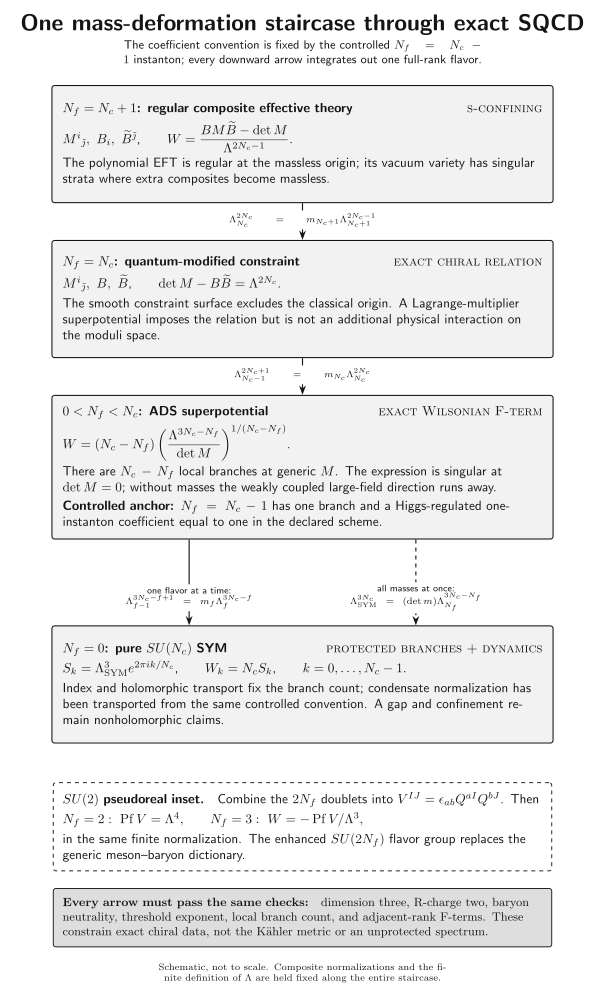
Exact SQCD regime flow at fixed in the unit-instanton holomorphic convention. Each downward arrow integrates out one flavor and obeys . The boxes distinguish generated superpotentials from the quantum-modified constraint. The diagram is schematic and not to scale; it does not assert a mass gap or an asymptotic Wilson-loop area law.
The labels, equations, and directed mass-flow edges are also available as structured regime data (JSON). The following semantic table supplies the same scientific content without relying on the image.
| Flavor regime | Exact holomorphic object | Massless infrared interpretation | Destination after one mass |
|---|---|---|---|
| , | Pure SYM has condensate branches. | — | |
| The massless theory runs away; over there are local branches. | The ADS theory with , or pure SYM at | ||
| The quantum moduli space is smooth and the classical origin is absent. | The ADS theory | ||
| The composite EFT is regular at the origin, while its F-flat vacuum variety is singular there. | The quantum-modified theory |
This map governs exact F-terms and holomorphic thresholds. It does not determine the Kähler metric, normalization-dependent scattering data, or non-holomorphic confinement diagnostics. For the hypotheses, evidence class, failure test, and source boundary attached to each row, consult the chapter-wide regime and evidence table and its machine-readable record.
Special ranks and what is not fixed
Section titled “Special ranks and what is not fixed”For , fundamental and antifundamental representations are equivalent. Combine the quarks and antiquarks into doublets and define the antisymmetric tensor
The two regimes on this page become
The sign and unit coefficients use the epsilon-tensor and holomorphic-scale convention declared here. These formulas, including the enhanced organization, appear in Seiberg 1994, Eqs. (4.1) and (5.4), arXiv PDF pp. 7 and 14–15. Applying the split left–right formulas without this reorganization can double-count operators or miss anomaly relations.
Holomorphy fixes the complex constraint and superpotential, not the full Kähler potential. Regularity of the composite effective field theory is supported by all exact checks, yet detailed scattering amplitudes and normalization-dependent masses require nonholomorphic information. The broader classification of s-confining theories likewise needs a case-by-case analysis of all branches, not merely a formal confining superpotential; see Csáki, Schmaltz, and Skiba 1997, pp. 799–802.
Common pitfalls
Section titled “Common pitfalls”Calling the constraint a generated superpotential. At , the physical statement is a deformed chiral-ring relation. is a device for imposing it, and treating as an unconstrained light particle changes the theory.
Equating s-confinement with a mass gap. The composite theory has massless fields at its origin. The word describes the variables and regularity of the infrared field description, not smoothness of the vacuum variety or the absence of low-energy excitations.
Ignoring normalization when comparing formulas. Rescaling baryons or the holomorphic scale moves nonzero constants and signs. Dimensionless, charge-neutral comparisons should be made only after declaring conventions; mass flows and anomaly coefficients are more robust checks.
Exercises
Section titled “Exercises”1. Tangent-space dimension
Section titled “1. Tangent-space dimension”Show directly that the quantum constraint defines a smooth complex manifold of dimension .
Solution
There are coordinates. For , a singular point would require every cofactor of to vanish and . The latter conditions would make , so no singular point lies on . The holomorphic implicit-function theorem therefore gives dimension everywhere.
2. Decoupling one flavor from the s-confining theory
Section titled “2. Decoupling one flavor from the s-confining theory”Add to . Explain why the low-energy relation has the form and determine the scale match.
Solution
Let and retain the light baryons and . On the branch where the mixed heavy components vanish, the terms containing are
The equation therefore gives
Here and , so the last equality is exactly the one-flavor scale match. The other heavy components and their baryonic partners are eliminated by their own F-terms.
References
Section titled “References”- Csáki, Csaba, Martin Schmaltz, and Witold Skiba. “Confinement in SUSY Gauge Theories and Model Building Tools.” Physical Review Letters 78 (1997): 799–802. doi:10.1103/PhysRevLett.78.799. Open PDF.
- Intriligator, Kenneth, and Nathan Seiberg. “Lectures on Supersymmetric Gauge Theories and Electric–Magnetic Duality.” Nuclear Physics B Proceedings Supplements 45BC (1996): 1–28. doi:10.1016/0920-5632(95)00626-5. Open PDF.
- Seiberg, Nathan. “Exact Results on the Space of Vacua of Four-Dimensional SUSY Gauge Theories.” Physical Review D 49 (1994): 6857–6863. doi:10.1103/PhysRevD.49.6857. Open PDF.
Original QFT.org content:CC BY 4.0, unless an item supplies different terms. Third-party material retains its own terms.