

Consistency of Perturbative Yang–Mills Theory
Perturbative Yang–Mills theory is consistent because BRST symmetry survives renormalization when the gauge anomaly vanishes. Its Slavnov–Taylor identity ties the counterterms of gauge, ghost, and matter vertices to one gauge coupling, while BRST cohomology removes the negative-metric and ghost sectors from physical external states. The conclusion is an order-by-order statement around a specified perturbative vacuum—not a construction of the nonperturbative theory.
Required background. Gauge-fixed Yang–Mills action and ghost sector supplies the nilpotent BRST differential and auxiliary field. Symmetry constraints and the space of counterterms supplies locality, power counting, and symmetry restoration by counterterms.
Helpful background. BRST cohomology and physical observables develops the general cohomological meaning of physical operators and states.
The diagram makes the perturbative consistency dependencies explicit. Follow the upper route from curvature to equations and vertices, and the lower route from gauge fixing to BRST and counterterms; the two routes meet only in gauge-invariant physical amplitudes.
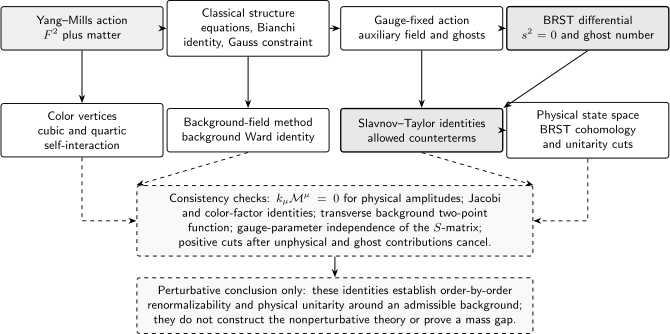
Perturbative Yang–Mills consistency map. Classical curvature, the Gauss and Bianchi identities, gauge fixing, ghosts, BRST symmetry, color factors, running, and counterterms are linked by exact identities; only BRST-cohomology amplitudes carry the physical unitarity statement. The diagram is schematic and does not assert nonperturbative construction.
The Slavnov functional identity
Section titled “The Slavnov functional identity”For clarity, first display the pure gauge, ghost, and auxiliary sector. Let be the gauge-fixed classical action with sources and coupled to the nonlinear BRST variations:
The sources are needed because the composite operators and also renormalize. Matter fields require corresponding sources for and and add their paired derivative terms to the identity. With a consistent choice of left and right Grassmann derivatives, the displayed sector of the renormalized 1PI functional obeys
Differentiating this functional equation with respect to fields produces the Slavnov–Taylor identities among propagators and vertices. They replace the simple Abelian Ward identity because a gauge transformation of is nonlinear and the Faddeev–Popov operator depends on . The original generalized identities were obtained independently in Slavnov 1972, pp. 99–104 and Taylor 1971, pp. 436–444; their BRST organization was developed in Becchi, Rouet, and Stora 1976, pp. 287–321.
At tree level and is equivalent to BRST invariance. Linearizing around defines an operator with . This nilpotency is the algebraic device that classifies both admissible counterterms and possible symmetry breakings.
Why the counterterm space closes
Section titled “Why the counterterm space closes”The all-orders argument is inductive:
- Suppose the theory has been renormalized through order and the Slavnov identity holds to that order.
- Locality of ultraviolet subtractions implies that the order- divergent part is an integrated local polynomial. In four-dimensional power-counting-renormalizable Yang–Mills theory it has ghost number zero and dimension at most four.
- The order- Slavnov identity requires the divergence to be closed under .
- Ghost-number-zero cohomology consists of gauge-invariant parameter deformations, while -exact terms are field, source, and gauge-fixing redefinitions. Subtracting those terms restores the identity at order .
For pure Yang–Mills theory the CP-even invariant deformation is the action; is the topological CP-odd possibility. With matter, gauge-invariant masses and couplings allowed by the declared model join the list. Arbitrary mass terms for an unbroken gauge field, unmatched three- and four-gauge couplings, or a ghost mass in linear covariant gauge are not allowed counterterms.
The historical diagrammatic proof that massless Yang–Mills fields are perturbatively renormalizable and unitary under its stated assumptions is ’t Hooft 1971, pp. 173–199. The modern local-cohomology classification, including hypotheses, counterterms, and anomaly classes, is reviewed in Barnich, Brandt, and Henneaux 2000, §§ 2.3 and 12.2–12.3.
The anomaly condition
Section titled “The anomaly condition”A regulator or subtraction can break the Slavnov identity at loop order :
Consistency implies
If , a local counterterm removes the breaking. If instead represents a nontrivial ghost-number-one cohomology class, it is a gauge anomaly and the Slavnov identity cannot be restored within the model. Pure Yang–Mills theory has no chiral matter measure and no perturbative gauge anomaly; vectorlike matter is also safe in this respect. A chiral gauge theory requires its representation-dependent anomaly coefficients to cancel. Power counting alone never proves that cancellation.
A single renormalized coupling
Section titled “A single renormalized coupling”Write
If , , and denote the complete multiplicative factors of the three-gauge, four-gauge, and ghost–gauge vertices, the Slavnov identity requires
Equivalently,
Matter vertices supply the same after their wave-function factors are removed. These are not accidental equalities among a few one-loop graphs: they are consequences of the functional identity and must persist order by order. The background-field relation is a particularly economical realization, developed on Background-field Yang–Mills effective action.
As a practical Slavnov check, compute from two independent vertices. A discrepancy after including all diagrams and counterterms signals a missing ghost graph, an inconsistent color normalization, or a symmetry-breaking subtraction that has not been repaired. A direct pedagogical derivation of the common coupling renormalization from BRST symmetry is Srednicki 2007, § 74, pp. 435–442.
Physical unitarity on cohomology
Section titled “Physical unitarity on cohomology”Covariant gauge quantization uses an indefinite-metric state space. The ordinary cutting relation for a gauge-fixed Green function therefore includes timelike and longitudinal gauge modes and ghost cuts; positivity is not expected term by term in that enlarged space. BRST supplies the physical quotient.
Let be the nilpotent BRST charge. If the Slavnov identity is anomaly free, the scattering operator commutes with it:
Therefore maps to itself and maps to itself, so it descends to
In perturbation theory around the free massless vacuum, longitudinal and timelike modes pair with ghosts, antighosts, and auxiliary excitations in BRST quartets. Their contributions cancel from matrix elements between cohomology classes, leaving the two transverse polarizations with positive norm. Kugo and Ojima formulate the subsidiary conditions and the resulting physical -matrix statement in Kugo and Ojima 1978, pp. 459–462.
Gauge-parameter independence has the same origin. Since changing changes the gauge fermion,
its insertion between BRST-closed physical states vanishes, provided the measure and renormalization preserve BRST and no boundary or infrared term invalidates the argument. This does not say that off-shell propagators or the effective action are independent of .
The perturbative ceiling
Section titled “The perturbative ceiling”The result established here is perturbative renormalizability plus unitarity of the physical, anomaly-free BRST cohomology under the assumptions needed to define the scattering problem. It does not supply:
- a nonperturbative continuum construction of four-dimensional Yang–Mills theory;
- a proof of a mass gap, confinement, or the infrared particle spectrum;
- a global gauge slice free of Gribov copies;
- an infrared-finite colored-particle -matrix in a confining theory; or
- anomaly cancellation for an undeclared chiral matter representation.
Even perturbatively, massless amplitudes may require inclusive, dressed, or factorized observables before an infrared-finite prediction exists. For QCD, external colored partons are useful short-distance ingredients, not nonperturbative asymptotic states. Renormalizability controls ultraviolet counterterms; it does not settle those infrared and global questions.
Independent checks and limits
Section titled “Independent checks and limits”- Slavnov check: extract independently from the three-gauge and ghost–gauge vertices after dividing by wave-function factors. They must agree.
- Cohomology check: replacing a physical external polarization by its momentum must give a BRST-trivial contribution to the complete amplitude, not necessarily to each diagram.
- Gauge-parameter check: a complete physical result has ; an off-shell Green function need not.
- Anomaly check: the possible breaking has ghost number one. It must be shown cohomologically trivial or canceled by the matter content before the all-orders induction can proceed.
Common pitfalls
Section titled “Common pitfalls”Equating power counting with renormalizability. Dimensionless makes only finitely many local operators possible; the Slavnov identity is what prevents unrelated gauge, ghost, and vertex counterterms.
Demanding positive cuts in the enlarged state space. Covariant gauges are indefinite. Positivity is a statement about the BRST quotient after unphysical and ghost sectors cancel.
Using perturbative BRST as a nonperturbative existence proof. The argument is an order-by-order formal construction around a chosen vacuum and gauge patch. Its validity ceiling must travel with the conclusion.
References
Section titled “References”- Glenn Barnich, Friedemann Brandt, and Marc Henneaux, “Local BRST Cohomology in Gauge Theories,” Physics Reports 338 (2000), 439–569, DOI, Open PDF.
- C. Becchi, A. Rouet, and R. Stora, “Renormalization of Gauge Theories,” Annals of Physics 98 (1976), 287–321, DOI.
- Gerard ’t Hooft, “Renormalization of Massless Yang–Mills Fields,” Nuclear Physics B 33 (1971), 173–199, DOI, Open PDF.
- Taichiro Kugo and Izumi Ojima, “Manifestly Covariant Canonical Formulation of Yang–Mills Theories: Physical State Subsidiary Conditions and Physical S-Matrix Unitarity,” Physics Letters B 73 (1978), 459–462, DOI.
- A. A. Slavnov, “Ward Identities in Gauge Theories,” Theoretical and Mathematical Physics 10 (1972), 99–104, DOI.
- Mark Srednicki, Quantum Field Theory, Cambridge University Press (2007), § 74, DOI.
- J. C. Taylor, “Ward Identities and Charge Renormalization of the Yang–Mills Field,” Nuclear Physics B 33 (1971), 436–444, DOI.
Original QFT.org content:CC BY 4.0, unless an item supplies different terms. Third-party material retains its own terms.