

The Ward–Takahashi Identity and Charge Renormalization
The Ward–Takahashi identity says that contracting the exact QED vertex with the photon momentum equals a difference of exact inverse electron propagators. It is the off-shell, all-orders expression of electric-current conservation. When the regulator and counterterms preserve the Abelian gauge symmetry, it forces the vertex and electron-field renormalizations to agree, ; charge running is then controlled by the photon factor , not eliminated.
Required background. Electron and photon renormalization defines , , and . Contact terms in Ward identities explains why differentiating a time-ordered product produces delta functions.
Helpful background. Currents, sources, and generating functionals gives the general functional derivation.
The map below shows why the Ward identity is a structural checkpoint rather than one isolated calculation: the same gauge constraint connects the renormalized fields and vertex to running charge, infrared-safe observables, form factors, and the operators used for bound states. Follow the solid arrows for the calculational chain and the dashed arrows for checks that can expose an inconsistent intermediate result.
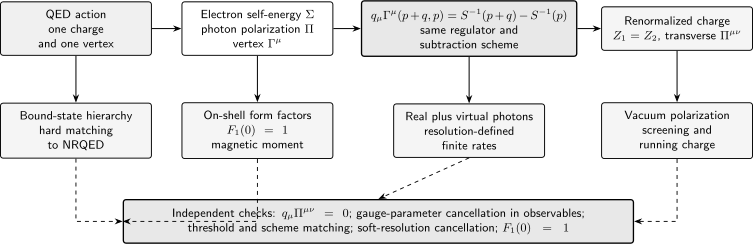
The QED prediction chain. The Ward–Takahashi identity links electron and vertex renormalization, whereas photon vacuum polarization controls charge running; infrared cancellation, form-factor normalization, and NRQED matching add separate checks. The diagram is schematic and not an ordering in perturbative size.
The current identity with contact terms
Section titled “The current identity with contact terms”For clarity, factor the signed electric charge out of the current and write
Current conservation does not imply that the divergence of a time-ordered product vanishes. Time ordering differentiates step functions, producing equal-time commutators at operator insertions. In the convention used below,
The two terms have opposite signs because and carry opposite current-generator action. Fourier transforming and amputating the external electron propagators turns those contact terms into inverse propagators. With incoming electron momentum , incoming photon momentum , and outgoing electron momentum ,
Here is the reduced propagator, with and . The proper photon-vertex rule is , so has both the signed charge and the factor removed. For an electron this rule is . At tree level,
The original short Ward identity and Takahashi’s off-shell generalization are Ward 1950, p. 182 and Takahashi 1957, pp. 371–375. A generating-functional derivation is given in Schwartz 2014, § 14.8, pp. 277–283.
Equal-momentum limit and form factors
Section titled “Equal-momentum limit and form factors”If the vertex and inverse propagator are regular as , expand the right-hand side:
The identity then gives
Near the perturbative electron pole, the coefficient that normalizes the propagator residue is therefore the same coefficient that normalizes the zero-momentum vector vertex. For on-shell spinors the exact parity-even vertex has the form
and charge renormalization fixes when the electric charge is defined in the Thomson limit. The transverse Pauli term is unconstrained at because ; its value is the anomalous magnetic moment developed on the lepton magnetic-moments page.
With the electron charge magnitude, the bare and renormalized Lagrangians use
The divergent local part of the inverse propagator proportional to is cancelled by . The divergent local part of the vertex proportional to is cancelled by . Because the Ward–Takahashi identity equates their contractions for arbitrary nonexceptional momenta, symmetry-preserving subtraction requires
Consequently,
This is the precise sense in which charge renormalization is determined by photon vacuum polarization. It does not say , and it does not make the beta function vanish.
For massless QED at nonexceptional Euclidean external momenta in a covariant gauge,
The equality holds at even though each constant changes with . A finite scheme shift
preserves the identity. Shifting only one of them does not. This is an efficient adversarial test of a counterterm implementation.
Charge universality—and its limits
Section titled “Charge universality—and its limits”Suppose several matter fields carry integer or rational representation labels and couple through
Their vector Ward identities preserve one common renormalized gauge coupling multiplying the fixed labels . Radiative corrections do not generate a different electromagnetic coupling for each process. The statement assumes that the fields really transform under the same unbroken gauge symmetry and that matching across thresholds is performed consistently.
The relation between the common charge, photon-field normalization, and threshold matching is derived in Weinberg 1995, § 10.4, pp. 443–449.
The identity does not determine the allowed charge lattice or the global form of the gauge group, does not prove anomaly cancellation in a chiral theory, and does not replace matching when heavy charged particles are removed. Those are separate structural questions.
When the inference can fail
Section titled “When the inference can fail”The bare identity is exact for vector QED, but a calculation may violate it if the setup is inconsistent:
- a hard momentum cutoff can spoil shift invariance of linearly divergent integrals;
- different momentum routings can leave spurious surface terms;
- vertex and self-energy graphs can be truncated at different orders;
- counterterms can be chosen in mismatched schemes;
- a regulator can break gauge symmetry without the required restoring counterterms; or
- exceptional on-shell momenta can mix infrared singularities into a purported ultraviolet test.
Dimensional regularization preserves the vector identity in ordinary QED. A regulator that breaks it is not automatically forbidden, but the breaking must be local, diagnosed, and removed by symmetry-restoring counterterms before physical conclusions are drawn.
Independent checks
Section titled “Independent checks”- Tree check: contract with and recover the difference of free inverse propagators.
- On-shell check: sandwich the identity between external spinors; both inverse propagators vanish, so a physical photon amplitude passes the polarization-to-momentum replacement.
- Pole check: at one loop, verify for more than one gauge parameter.
- Scheme check: apply the same finite shift to both constants and verify the equality survives.
A reproducible calculation should cover these benchmarks; the equations above are the complete analytic criteria.
Common pitfalls
Section titled “Common pitfalls”is conditional, not regulator-free magic. It follows when the regulated and renormalized theory satisfies the vector Ward identity.
The identity does not forbid charge running. It moves charge renormalization into , whose scale dependence is nonzero.
Dropping contact terms destroys the off-shell identity. Ordinary current conservation applies away from insertions; the delta functions are what become the inverse propagators.
A longitudinal vertex test is not the whole amplitude. Transverse structures such as contain physical information that the contraction with cannot determine.
References
Section titled “References”- Matthew D. Schwartz, Quantum Field Theory and the Standard Model, Cambridge University Press (2014), §§ 14.8 and 19.4–19.5, doi:10.1017/9781139540940.
- Yasushi Takahashi, “On the Generalized Ward Identity,” Il Nuovo Cimento 6 (1957) 371–375, doi:10.1007/BF02832514.
- John C. Ward, “An Identity in Quantum Electrodynamics,” Physical Review 78 (1950) 182, doi:10.1103/PhysRev.78.182.
- Steven Weinberg, The Quantum Theory of Fields, Volume I: Foundations, Cambridge University Press (1995), § 10.4, doi:10.1017/CBO9781139644167.
Original QFT.org content:CC BY 4.0, unless an item supplies different terms. Third-party material retains its own terms.