

Dirac, Majorana, and Seesaw Neutrino Masses
Dirac neutrino masses require sterile right-handed fields and can preserve total lepton number; Majorana masses pair a chiral field with its charge conjugate and violate lepton number by two units. With only Standard Model fields, the first gauge-invariant neutrino-mass interaction is the dimension-five Weinberg operator. A Type-I seesaw is one ultraviolet completion: integrating out heavy singlet Majorana fermions gives when , but the low-energy operator does not uniquely identify that completion.
Required background. Electroweak Gauge and Matter Structure supplies the lepton and Higgs representations. Majorana Fields and Reality Conditions supplies charge conjugation and Majorana normalization. Integrating Out Heavy Fields supplies tree-level matching and its decoupling assumptions.
Helpful background. Representation and Spurion Constraints on Operator Bases supplies the operator-classification logic used for the dimension-five interaction.
The map below separates the timeless theoretical interfaces from mutable evidence. A mass mechanism determines a mass matrix and mixing structure; oscillation, absolute-mass, Majorana-sensitive, and charged-lepton-flavor observables then constrain different combinations before any joint likelihood is formed.
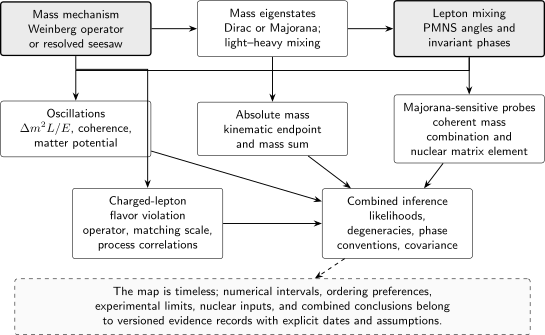
Different neutrino and lepton probes constrain different functions of masses, mixing, coherence, operators, and nuclear inputs. Numerical intervals and combined preferences belong to versioned evidence records; the diagram is schematic.
Gauge-invariant neutrino mass structures
Section titled “Gauge-invariant neutrino mass structures”Let have hypercharge , let have hypercharge , and define . Flavor indices are . Adding gauge-singlet right-handed fields permits
If and no Majorana term is present, this interaction preserves total lepton number. A singular-value decomposition gives positive Dirac masses. Both chiralities are independent fields, so continuous rephasing of each massive neutrino remains available.
Because is a gauge singlet, the renormalizable term
is also gauge invariant. It changes total lepton number by two units if is treated as a fixed parameter. In contrast, a Majorana mass written directly for is not invariant under the unbroken electroweak gauge group.
With Standard Model fields alone, the leading remedy is
where . After , this operator produces a symmetric Majorana mass matrix proportional to ; its overall sign follows the displayed mass-term convention and can be removed by a common Majorana field phase. It is the unique independent dimension-five operator made from Standard Model fields, up to flavor and Hermitian conjugation Weinberg 1979, pp. 1566–1570. A four-component rendering of the same gauge-invariant structure appears in Weinberg 1996, § 21.3, pp. 317–318.
These constructions answer different questions:
| Structure | New field content | Lepton number | Low-energy statement |
|---|---|---|---|
| Dirac Yukawa | At least one | Can be exact | A small mass is a small dimensionless Yukawa coupling |
| Singlet Majorana mass | Violated by two units | Heavy neutral states may be integrated out if kinematics and mixing permit | |
| Weinberg operator | No new light field specified | Violated by two units | Encodes a light Majorana mass, not a unique mediator |
| Type-I seesaw | with both and | Generally violated | Predicts a particular tree-level matching relation and higher-order remnants |
Type-I seesaw and tree-level matching
Section titled “Type-I seesaw and tree-level matching”Collect left-handed fields into . After symmetry breaking,
is complex symmetric, so the physical diagonalization is a Takagi factorization,
An ordinary Hermitian eigenvalue calculation can return negative algebraic eigenvalues in a real example; those signs are converted to positive masses by allowed Majorana phases and are not negative-energy particles.
When every singular value of is large compared with and the external momentum, block diagonalization gives
while the heavy block is . Solving the heavy classical equation of motion gives the same Weinberg coefficient, with its sign fixed by the chosen definition of . At the next order, dimension-six operators modify kinetic and charged-current normalization by ; retaining only therefore does not reconstruct all high-energy parameters Broncano, Gavela, and Jenkins 2003, pp. 177–184.
The matching hypotheses are consequential:
- must be invertible on the modes being removed; a light or nearly singular combination stays as an explicit degree of freedom.
- External momenta and electroweak scales must remain well below the relevant heavy singular values.
- The expansion is in the matrix norm and spectral gaps, not entry-by-entry smallness in an arbitrary flavor basis.
- Loop matching, running of , and thresholds are additional operations; the tree formula is not scale independent by itself.
Exact one-generation checkpoint
Section titled “Exact one-generation checkpoint”For real positive and , take
The signed algebraic eigenvalues are
whereas the positive Takagi masses are
The invariants
check both branch and normalization. For ,
At the exact synthetic point , the masses are . The displayed truncations are and , each with absolute residual
A reproducible calculation checks this branch, residual, and the failure of the expansion when is not small. Exact all-order block-diagonalization methods and their domain are discussed by Grimus and Lavoura 2000, §§ 2–3.
Symmetry and parameter boundaries
Section titled “Symmetry and parameter boundaries”A vanishing Dirac Yukawa restores a chiral symmetry of , so a small Dirac Yukawa is technically natural in the symmetry sense; that statement does not explain its numerical value. In a Majorana theory, setting every lepton-number-violating parameter to zero restores total lepton number. A large instead suppresses the low-energy operator by decoupling, but it is not by itself an approximate lepton-number symmetry.
The low-energy symmetric matrix fixes light masses and mixing only after the charged-lepton mass basis is specified. It does not determine the number or spectrum of heavy singlets, their individual Yukawa couplings, leptogenesis, or whether another ultraviolet completion generated the same . Conversely, an exact seesaw model can contain cancellations or approximate symmetries that invalidate the estimate “light mass equals ” entry by entry while preserving the matrix relation.
Checks and typed handoffs
Section titled “Checks and typed handoffs”- Gauge and dimensions: has dimension four; has dimension five and hypercharge zero.
- Takagi check: verify , is diagonal, and every reported mass is nonnegative.
- Decoupling check: as with fixed, and active–heavy mixing vanish with one power of .
- Rank check: at tree level; fewer heavy singlets can leave exactly massless light combinations.
- Matching check: compute the low-energy two-lepton–two-Higgs amplitude both from heavy exchange and , including transpose and factor conventions.
Lepton Mixing, PMNS Parameters, and Majorana Phases takes the positive light masses and the charged-lepton rotation to the observable mixing matrix. Generic operator matching remains with Integrating Out Heavy Fields; current model rankings and heavy-neutrino exclusions require a dated Research evidence record.
Common pitfalls
Section titled “Common pitfalls”Diagonalizing a symmetric mass matrix as if it were Hermitian. Majorana masses require , not . Signed real eigenvalues can be an intermediate check, but physical masses are the nonnegative Takagi singular values.
Equating the Weinberg operator with a Type-I seesaw. The seesaw matches onto that operator, but so can other heavy physics. Low-energy alone does not identify the mediator or its parameter count.
Using the seesaw expansion outside its spectral regime. Small-looking entries do not suffice if has a small singular value. Diagonalize exactly or retain the corresponding state whenever is not uniformly small.
References
Section titled “References”- Broncano, A., M. B. Gavela, and E. Jenkins. “The Effective Lagrangian for the Seesaw Model of Neutrino Mass and Leptogenesis.” Physics Letters B 552 (2003): 177–184. DOI.
- Grimus, Walter, and Luís Lavoura. “The Seesaw Mechanism at Arbitrary Order: Disentangling the Small Scale from the Large Scale.” Journal of High Energy Physics 2000, no. 11 (2000): 042. DOI.
- Weinberg, Steven. “Baryon- and Lepton-Nonconserving Processes.” Physical Review Letters 43 (1979): 1566–1570. DOI.
- Weinberg, Steven. The Quantum Theory of Fields. Volume II: Modern Applications. Cambridge: Cambridge University Press, 1996, § 21.3. DOI.
Original QFT.org content:CC BY 4.0, unless an item supplies different terms. Third-party material retains its own terms.