

Flavor Symmetry and Yukawa Spurions
With Yukawa couplings set to zero, the quark gauge and kinetic terms have an independent rotation for each of , , and . The Yukawa matrices break that flavor group. Treating them as spurions—background tensors assigned compensating transformation laws—restores formal covariance and makes basis invariants, residual symmetries, alignment, and allowed flavor structures systematic. A spurion analysis classifies breaking; it does not explain the numerical Yukawa hierarchy.
Required background. Yukawa couplings and fermion masses supplies the quark mass matrices; multiplets, invariants, and selection rules supplies tensor transformation rules. Helpful background. Flavor, Hermiticity, and CP bookkeeping supplies operator-basis and conjugation checks.
The full route from spurions to flavor observables is shown below. The key point is that every transition carries an interface—basis rotations, weak matching, QCD running, hadronic matrix elements, propagation, or likelihood assumptions—and the strong- invariant remains a separate branch.
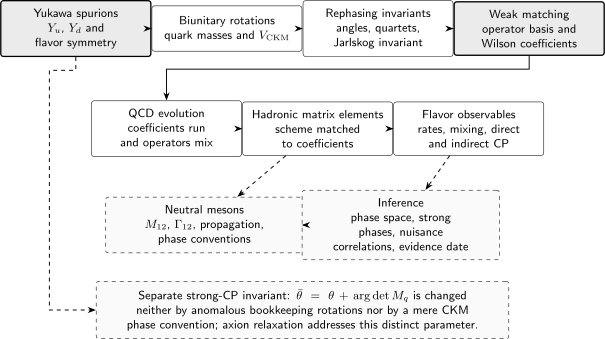
Quark-flavor predictions require matched conventions at every step from Yukawa spurions to observables and inference. The strong- combination is not a CKM phase; the diagram is schematic and contains no current fit results.
The quark kinetic flavor group
Section titled “The quark kinetic flavor group”For three generations, collect fields with identical gauge quantum numbers into vectors
The gauge-covariant kinetic terms are invariant under
The quark Yukawa interactions are
For fixed numerical , these terms are generally not invariant under . Formal invariance is restored by assigning the spurion transformations
Equivalently, transforms as and as under the special-unitary factors. This is the Standard Model quark-spurion construction used in minimal-flavor-violation analyses D’Ambrosio et al. 2002, § 2, pp. 157–160.
The abelian factors require care. Vector baryon number is left unbroken by both Yukawas. Axial field redefinitions are legitimate basis transformations, but their anomaly moves phase into the QCD topological term. They therefore participate in the full Standard Model parameter count only together with ; the invariant combination is developed on the strong- route.
Parameter counting and residual symmetries
Section titled “Parameter counting and residual symmetries”Two complex matrices contain real parameters. The group has generators, but one common leaves generic unchanged. Thus flavor transformations remove unphysical coordinates:
Those ten quark-flavor parameters are six nonnegative Yukawa singular values, three mixing angles, and one weak phase. This count assumes three generations, generic nonzero nondegenerate singular values, and generic misalignment. Enhanced symmetry changes the count:
| Yukawa background | Residual quark flavor symmetry | Consequence |
|---|---|---|
| all flavor directions are equivalent | ||
| , | diagonal | complete generation degeneracy |
| diagonal, nondegenerate, and aligned | vector family phases | no physical intergenerational mixing |
| generic nondegenerate, misaligned | common | three angles and one irreducible weak phase |
| any exact degeneracy | an enlarged unitary rotation in the degenerate subspace | some mixing coordinates cease to be physical |
The stabilizer, not a memorized subtraction, determines the correct count in a symmetry limit.
Basis invariants and alignment
Section titled “Basis invariants and alignment”The Hermitian combinations
transform only under the left-handed factor:
Therefore traces of words such as are weak-basis invariants. The characteristic polynomials of and determine the squared Yukawa singular values. The commutator
measures left-handed misalignment. Since two Hermitian matrices are simultaneously unitarily diagonalizable exactly when they commute,
is the alignment condition. With nondegenerate spectra it makes the CKM matrix diagonal up to phases and permutations. With degeneracies, rotations inside degenerate eigenspaces remain unobservable, so individual mixing angles are not invariant.
For three generations a CP-odd invariant is
Choose the eigenvalue ordering and and define
In the standard CKM phase convention,
This identity exposes every weak- null limit: vanishes if or if any equal-charge pair of up- or down-type Yukawa singular values becomes degenerate. The commutator formulation is independent of weak basis and was introduced precisely as a convention-independent measure Jarlskog 1985, pp. 1039–1042.
Spurions classify effective operators
Section titled “Spurions classify effective operators”Suppose a left-handed flavor current contains a matrix :
It is formally invariant when . If the Yukawas are the only permitted flavor-breaking spurions, a Hermitian can be expanded as
with real coefficients for the displayed Hermitian structures. Cayley–Hamilton identities reduce higher powers to a finite matrix basis, although an EFT may still contain many Lorentz, gauge, and derivative operators.
In the down-quark mass basis,
Thus off-diagonal flavor structure is carried by invariantly defined Yukawa insertions and CKM products, not by an arbitrary new matrix. This is the organizing hypothesis of minimal flavor violation. It is an assumption about allowed breaking sources, not a theorem of generic ultraviolet completions and not a prediction of the values of .
From a formal invariant to an amplitude
Section titled “From a formal invariant to an amplitude”Spurion covariance is only the flavor layer of a calculation. A physical EFT amplitude still has the form
| Layer | What the spurion analysis fixes | What remains to be supplied |
|---|---|---|
| Flavor tensor | permitted contractions and symmetry-breaking insertions | Wilson coefficients and any additional ultraviolet assumptions |
| Operator basis | flavor representation of each local operator | Lorentz/gauge basis, equations of motion, evanescent completion |
| Renormalization | mixing is restricted to operators with compatible exact quantum numbers | anomalous-dimension matrix, subtraction scheme, thresholds |
| Observable | basis rotations cannot change the complete contraction | hadronic matrix elements, kinematics, strong phases, covariance |
Under a finite operator-basis change , coefficients transform as , so . Flavor-basis invariance does not make or separately scale or scheme independent.
Independent checks and limitations
Section titled “Independent checks and limitations”- Transformation round trip: substitute , , and into ; every must cancel.
- Parameter count: subtract only broken generators. Removing all generators would incorrectly discard baryon number and leave nine instead of ten parameters.
- Hermiticity: are Hermitian and is anti-Hermitian. Consequently is purely imaginary and is real.
- Degenerate limit: when two like-charge singular values coincide, a rotation inside their subspace can change apparent CKM parameters while leaving every invariant fixed.
- Alignment: is a basis-independent statement. A visually diagonal matrix in one basis is not evidence of alignment unless both and are diagonal there.
- RG behavior: the Yukawa spurions themselves run. A symmetry relation is preserved by symmetry-respecting RG flow, while numerical invariant values depend on the common renormalization scheme and scale.
- Domain: the construction classifies Standard Model quark flavor and MFV-type EFT insertions. It does not supply a complete flavor EFT, ultraviolet flavor dynamics, or current hierarchy data.
Common pitfalls
Section titled “Common pitfalls”Calling the spurion a new propagating field. Here a spurion is a bookkeeping background assigned a transformation law and then fixed to the physical Yukawa matrix. A dynamical flavon is an additional model-dependent degree of freedom.
Equating MFV with flavor conservation. MFV permits flavor-changing processes; it restricts their breaking tensors to Yukawa combinations. Wilson coefficients and long-distance matrix elements remain independent inputs.
Ignoring the anomalous abelian rotation. It may remove a phase from a mass matrix while shifting . Weak mixing invariants and the strong- invariant must be counted separately.
Informal self-check
Section titled “Informal self-check”Show that and are weak-basis invariant, and identify two distinct reasons why can vanish.
Answer
Both and transform by the same similarity map . Cyclicity of the trace therefore leaves and unchanged. The CP-odd invariant vanishes when the rephasing invariant vanishes, and also when any two equal-charge up-type or down-type Yukawa singular values are degenerate, because the corresponding factor in is zero.
Handoffs
Section titled “Handoffs”- Send the two biunitary rotations and a fixed singular-value ordering to the CKM construction.
- Send a spurion-dressed local basis, matching scale, and coefficient convention to the weak-Hamiltonian workflow.
- Send anomalous quark rephasings and the complex mass determinant to the strong- invariant.
References
Section titled “References”- D’Ambrosio, Giancarlo, Gian F. Giudice, Gino Isidori, and Alessandro Strumia. “Minimal Flavour Violation: An Effective Field Theory Approach.” Nuclear Physics B 645 (2002): 155–187. DOI · Open PDF
- Jarlskog, Cecilia. “Commutator of the Quark Mass Matrices in the Standard Electroweak Model and a Measure of Maximal CP Nonconservation.” Physical Review Letters 55 (1985): 1039–1042. DOI
- Schwartz, Matthew D. Quantum Field Theory and the Standard Model. Cambridge: Cambridge University Press, 2014, § 29.3.2, pp. 595–598. DOI
Original QFT.org content:CC BY 4.0, unless an item supplies different terms. Third-party material retains its own terms.