

What Is an Anomaly?
For the symmetry problems considered here, an anomaly is the part of a quantum symmetry failure that remains after the same classical theory, its regulator and integration data, and every admissible globally defined local counterterm have been specified. A failed Ward identity or a nonunit Jacobian is therefore evidence to examine, not yet the definition.
The physical verdict depends on what the transformation means. If it is a redundancy of a dynamical gauge field, a nonremovable total anomaly obstructs the standalone quantum theory. If it is an exact global symmetry probed by a fixed background, the theory can exist but cannot be gauged by itself; this is an ’t Hooft anomaly, and the same class must persist under any symmetry-preserving renormalization-group flow. Whether the obstruction is detected infinitesimally or only by a large transformation is a separate question.
This page develops that decision procedure and applies it to four-dimensional Weyl fermions. It uses a local index test and Witten’s sign anomaly to show why perturbative cancellation is necessary but not sufficient. Triangle coefficients, descent, determinant-line theorems, and concrete Standard Model cancellation are handed off to their dedicated pages.
Required background. Localized Transformations and Ward–Takahashi Identities supplies the regulated Ward identity with its contact, explicit-breaking, boundary, and measure terms. Changes of Variables and Regulated Jacobians supplies the fixed-regulator Jacobian calculation and explains why a formal continuum determinant is not by itself an anomaly.
Helpful background. Current Sources and Generating Functionals supplies background-source transformations, functional Ward identities, and local counterterm freedom.
An anomaly is an unremovable quantum obstruction
Section titled “An anomaly is an unremovable quantum obstruction”Let denote all fixed background data: bundles, connections, metric, spin structure, boundary conditions, and any nondynamical coupling sources. In a local trivialization of the quantum amplitude for a unitary background problem, write the finite law for acting from the left as
Composition requires the phase cocycle condition
With , adding a local counterterm changes the representative by
The anomaly is the obstruction to making this phase trivial with an admissible . Admissibility is part of the problem: must be local, globally defined on the allowed bundles and backgrounds, compatible with the boundary domain, and consistent with reality, power counting or EFT rules, and every other symmetry that must remain exact. A density written only in one trivializing patch is not automatically an allowed counterterm. This counterterm test is explicit in Bilal 2008, § 6.2, arXiv v1, pp. 42–43, eq. (6.7), Open PDF, while the background-field definition and its mixed version are summarized in Bhardwaj et al. 2024, § 4.2.1, arXiv v2, pp. 67–69, Open PDF.
Infinitesimally, for , define the consistent variation
If for an admissible , the breaking is removable. A counterterm can also move a nonzero representative between Ward identities without trivializing the total class. “Scheme dependent” therefore does not mean “physically absent.”
Several nearby phenomena stop before this definition:
| observation | diagnosis |
|---|---|
| the transformation changes a fixed mass, coupling, boundary condition, or domain | explicit breaking of the stated problem |
| the action and Ward identity are invariant but the chosen vacuum is not | spontaneous symmetry breaking; this observation is not itself an anomaly test and does not exclude a simultaneous ’t Hooft anomaly |
| a regulator violates the identity and an allowed local counterterm restores every required symmetry | removable regulator or scheme artifact |
| no allowed local repair restores the quantum transformation law | genuine anomaly class |
The obstruction test keeps three classifications independent
Section titled “The obstruction test keeps three classifications independent”A reliable diagnosis has four steps.
- Declare the transformation, the fields integrated over, all fixed backgrounds and bundle sectors, boundary conditions, the regulator, and which symmetries must be preserved simultaneously.
- Check that the transformation preserves the same classical problem. If it changes fixed data rather than transforming them as sources, the result is explicit breaking.
- Derive the complete regulated or renormalized quantum identity, including contact terms, measure variation, boundary flux, and transformed insertions. Then test every admissible local counterterm.
- Only for a surviving obstruction, classify its symmetry role and its detector. Those two labels do not determine one another.
The diagram makes the stopping points visible. Follow the vertical path first; only after reaching the double-border anomaly node should the lower two axes be assigned.
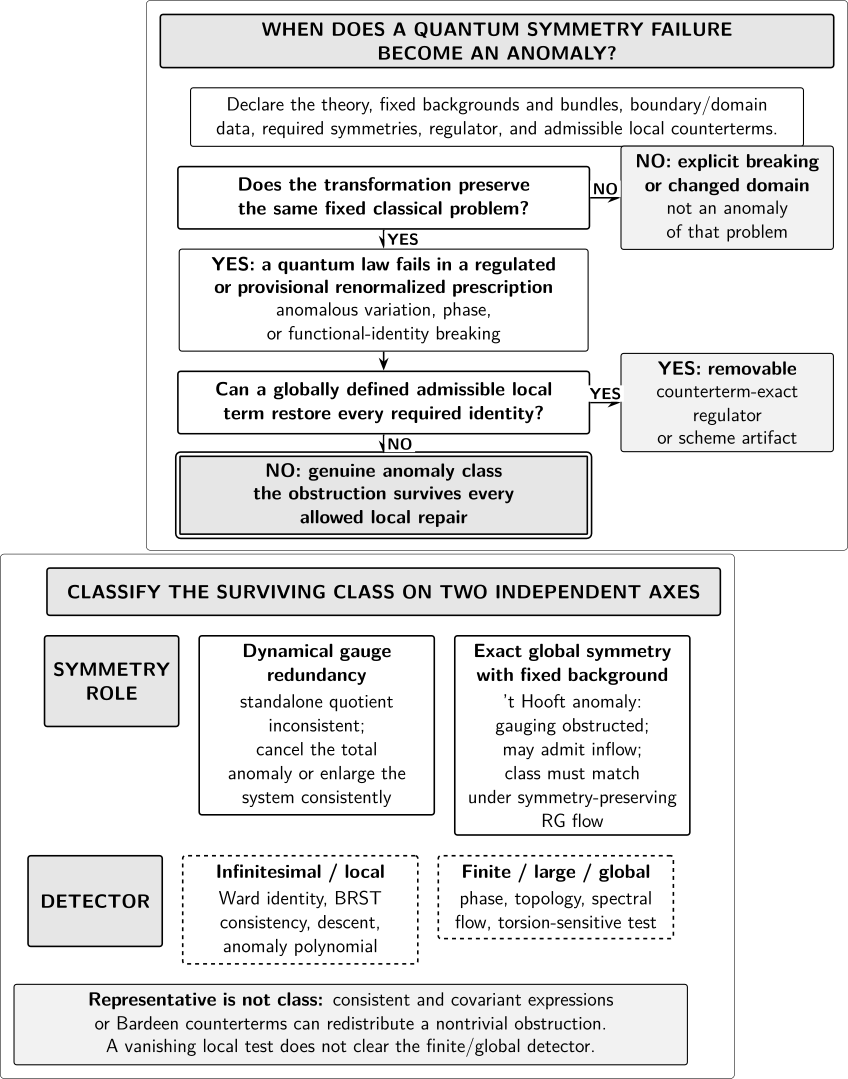
First preserve the same classical problem, then ask whether a globally defined admissible local term restores every required identity. Only a failure that survives both tests is an anomaly. The lower panel classifies that class on two independent axes: dynamical redundancy versus exact global symmetry, and local/infinitesimal versus finite/global detection. The schematic diagram is not exhaustive; in particular, a vanishing local test does not clear a global obstruction.
The full chapter taxonomy adds further independent labels:
| axis | distinctions that must remain separate |
|---|---|
| status | explicit breaking; removable scheme artifact; genuine anomaly |
| symmetry role | gauge inconsistency; global/’t Hooft obstruction |
| detection | perturbative/local; global/torsion |
| background type | internal; spacetime or gravitational; mixed; discrete; orientation reversing |
| representative | consistent; covariant; Bardeen-shifted |
| consequence | non-gaugeability; inflow or relative theory; infrared matching |
A regulated Jacobian, triangle diagram, descent calculation, spectral flow, or determinant phase is a detector. None replaces the counterterm and global-definition tests. Conversely, a negative result from one detector does not prove that every other detector vanishes.
Gauge redundancy and global symmetry have different verdicts
Section titled “Gauge redundancy and global symmetry have different verdicts”The first operational question is whether the connection is integrated over. A background connection probes a global symmetry; a dynamical connection participates in the gauge quotient and its constraints.
| question | dynamical gauge redundancy | exact global symmetry with fixed background |
|---|---|---|
| is the connection integrated over? | yes | no |
| what does a nontrivial anomaly mean? | the proposed quotient and decoupling of unphysical modes fail | coupling to arbitrary backgrounds cannot be made invariant |
| can the standalone theory exist? | not with that uncanceled total anomaly | yes at zero background, but it cannot be gauged by itself |
| what must happen? | the total gauge anomaly must cancel or the quantum system must be consistently enlarged | the class may be represented by inflow and must match in the infrared |
This distinction is developed from the background-versus-dynamical viewpoint in Bhardwaj et al. 2024, §§ 4.1–4.2.1, arXiv v2, pp. 60–69, Open PDF. In BRST, Slavnov–Taylor, or BV language, a cutoff breaking of ghost number one is initially only a candidate. If an allowed local counterterm removes it while preserving the subsidiary identities, it is not a gauge anomaly. If its class survives, changing the gauge-fixing fermion cannot remove the obstruction.
There is also a terminology trap. A global-symmetry anomaly names the role of an exact symmetry coupled to a background. A global anomaly usually names a finite or large-transformation detector. A global symmetry can have a perturbative local ’t Hooft anomaly, and a dynamical gauge redundancy can have a global gauge anomaly. These are crossings of two axes, not synonyms.
An anomalously broken classical current is another case. For example, an Adler–Bell–Jackiw calculation can reduce a classical continuous axial group to an exact quantum subgroup. The lost continuous group is not automatically an exact global symmetry carrying an ’t Hooft anomaly; one must first identify the actual quantum symmetry and its allowed backgrounds.
Local representatives and global phases answer different questions
Section titled “Local representatives and global phases answer different questions”For infinitesimal transformations satisfying , associativity of the quantum transformation law implies the Wess–Zumino consistency condition
This is a necessary local consistency test, not the complete anomaly classification. In local BRST notation the same first test is represented by a class in relative local cohomology : a ghost-number-one top form is closed modulo a spacetime derivative and is identified modulo an allowed local BRST coboundary and derivative. On a manifold with boundary, the derivative term is trivial only when its surface integral vanishes or is canceled by permitted boundary data; the explicit integration-by-parts qualification appears in Bilal 2008, § 9, arXiv v1, p. 69, eq. (9.1), Open PDF. The detailed descent belongs to the later Wess–Zumino page. The original consistency condition is Wess and Zumino 1971, pp. 95–97; the relative local cohomology and counterterm statement is Barnich, Brandt, and Henneaux 2000, §§ 2.3, 2.6, and 4.4, arXiv v3, pp. 9–11, 16–17, and 23–24, eqs. (2.23) and (2.36)–(2.38), and theorem 4.1(ii), Open PDF.
Even inside the local sector, expression and class must be separated. With a background connection , the current obtained by differentiating the effective action is the consistent current,
A local Bardeen–Zumino polynomial can define
The first is integrable as a functional derivative and its anomaly obeys the consistency condition; the second transforms covariantly but is not generally the derivative of one effective action. A Bardeen counterterm can redistribute a mixed consistent anomaly among currents. It cannot erase a nontrivial total class while preserving every required symmetry. The original distinction is worked out in Bardeen and Zumino 1984, §§ 1–3, pp. 423–436.
Global information instead lives in the finite phase . Its infinitesimal derivative can vanish while its holonomy around a noncontractible loop in background-field space is nontrivial. A 2025 unrefereed sigma-model preprint reports a topological fermion phase even though its local determinant-line curvature and anomaly-polynomial test vanish Choi 2025, §§ 2.2–2.6 and 3.1, arXiv v1, pp. 7–15, Open PDF. More generally, vanishing of the anomaly polynomial can leave an -invariant phase Witten and Yonekura 2021, §§ 3.2–3.3, arXiv v3, pp. 34–39, Open PDF. The 2025 calculation is a current specialized preprint example, not a foundation for or replacement of the general decision procedure.
A four-dimensional Weyl fermion makes both tests visible
Section titled “A four-dimensional Weyl fermion makes both tests visible”For the local test, pass to a closed oriented Euclidean spin four-manifold and a complex line bundle over it. Locally write its real nondynamical connection as , normalized so that the unit-charge holonomy is . Its curvature is global and obeys only in each local trivialization. Set
For a positive-chirality Weyl fermion of allowed integral charge use . Its anti-Hermitian bundle curvature is , so . Define
All species below are counted with this positive Euclidean chirality. A fermion of the opposite chirality and charge contributes with the opposite sign; equivalently, it may be represented in this bookkeeping by a positive-chirality charge-conjugate field of charge .
Introduce the two charge sums
The index-normalized degree-six anomaly polynomial is a universal formal characteristic form built from these four-dimensional background curvatures. It is not a nonzero six-form living on itself; the index and descent construction evaluates the same polynomial on suitable auxiliary six-dimensional extension or family data. It is
The first term detects the perturbative class; the second detects the mixed –gravitational class. Four-dimensional spin- fields have no perturbative pure gravitational anomaly, so the second term should not be renamed one. These normalizations follow Álvarez-Gaumé and Vázquez-Mozo 2024, § 3, arXiv v2, pp. 5–8 and 10, eqs. (11), (17)–(19), and (22), Open PDF. This page uses the polynomial only as a local detector; its descent and Lorentzian phase conventions are developed later.
The interpretation is immediate:
- One charge- Weyl fermion has .
- A Dirac pair contributes charges and in the positive-chirality bookkeeping, so both sums vanish.
- With fixed, a nonzero class is an ’t Hooft anomaly of the global background symmetry.
- If becomes dynamical, the same nonzero total class is a gauge inconsistency unless the full quantum system cancels it.
- Setting or taking a flat metric can make one representative vanish on that background without trivializing the universal class.
Now change the group. A single positive-chirality doublet has no cubic local anomaly, but the nontrivial element of changes the fermion functional integral by a sign:
Thus an odd number of doublets is inconsistent when is dynamical, whereas an even number cancels the sign. With kept as a background, the same phase is a global ’t Hooft anomaly. This is Witten’s original counterexample to the claim that vanishing perturbative coefficients prove complete anomaly freedom Witten 1982, pp. 324–328.
Boundaries, inflow, and matching change the complete system
Section titled “Boundaries, inflow, and matching change the complete system”The fermion test above used a closed manifold so that no surface term could be mistaken for an anomaly. On a region with boundary, the redundancy group must be declared before the verdict:
- transformations required to vanish at the boundary are proper redundancies; an unremovable anomaly under them obstructs the gauge theory;
- transformations allowed to be nonzero may carry surface charge and act as physical boundary symmetries, so their background response is classified as a global-symmetry question; and
- the Ward identity must include normal flux, variation of the boundary action and boundary conditions, and any edge degrees of freedom.
Boundary conditions as part of the theory, and a Maxwell example in which only transformations vanishing at the boundary are quotiented while the others carry charge, are given in Harlow and Wu 2020, Introduction and § 3.3, arXiv v4, pp. 1–5 and 26–27, eqs. (3.18)–(3.25), Open PDF. A changed boundary domain or an uncanceled classical flux is not automatically a quantum anomaly.
In an inflow realization, the bulk variation cancels the boundary variation and makes the combined bulk–boundary system invariant. It does not turn the isolated boundary into an absolute anomaly-free theory. An anomaly often admits an invertible-bulk description, but a local representative alone does not construct a globally defined bulk theory on every allowed background or supply its trivialization; those require separate global checks. Anomaly matching says that an exact global anomaly class is unchanged along an RG flow that preserves the symmetry Bhardwaj et al. 2024, Introduction and § 4 opening, arXiv v2, pp. 3 and 59, Open PDF. It does not determine a unique infrared phase; it constrains whatever infrared degrees of freedom realize the symmetry. The qualified relative/invertible-field-theory formulation is summarized in Freed 2023, §§ 3–4, arXiv v1, pp. 8–15, Open PDF; the classic four-dimensional perturbative matching logic is reviewed in Harvey 2005, § 2.3, arXiv v1, pp. 19–20, Open PDF. The theorem-level formulation is developed in Mathematical QFT.
Common pitfalls
Section titled “Common pitfalls”Calling a Jacobian the anomaly. A regulated Jacobian supplies a candidate variation. The anomaly is the class that remains after compatible regulators, allowed counterterms, and the full transformation law are tested.
Using “scheme dependent” to mean removable. Representatives can move under local counterterms while the obstruction stays nontrivial. A repair that breaks another required symmetry is not a simultaneous repair.
Equating a global-symmetry anomaly with a global anomaly. The first label states the symmetry’s physical role; the second states how the obstruction is detected. Either a gauge or a global symmetry can be tested by local and by large transformations.
Treating a zero anomaly polynomial as complete clearance. It clears the corresponding local/free part under the stated conventions. It says nothing by itself about torsion or large-transformation phases, as the example shows.
Saying inflow removes the boundary anomaly. Inflow restores invariance of the combined system. The boundary remains relative to the bulk response.
Check your understanding
Section titled “Check your understanding”-
A regulator breaks a Ward identity by , where is globally defined, local, and preserves every other required symmetry. Classify the result.
Solution
It is a removable regulator or scheme artifact. Adding restores the identity, so the representative is trivial in the admissible local counterterm quotient.
-
Compute and for positive-chirality charges . Which local coefficient vanishes?
Solution
The linear sum is , while . The mixed –gravitational coefficient vanishes, but the cubic coefficient does not. If the is dynamical, this spectrum is not locally gauge-anomaly-free.
-
Why does an even number of doublets pass a test that one doublet fails, even though both have zero cubic local anomaly?
Solution
Each doublet contributes a sign under the nontrivial class in . For doublets the phase is , so it is trivial only for even . The cubic local test cannot see this phase.
What to carry forward
Section titled “What to carry forward”- Regulated Jacobians and Measure Variation turns the measure diagnostic into a controlled local calculation.
- Perturbative Chiral and Gauge Anomalies computes the triangle and representation-trace coefficients.
- Consistent and Covariant Anomalies develops the Bardeen–Zumino shift without confusing representative and class.
- Wess–Zumino Consistency and Descent derives the local cocycle and form-degree hierarchy.
- Anomaly Polynomials and Inflow derives the index polynomial and the bulk cancellation mechanism.
- Global and Torsion Anomalies develops large-transformation, spectral-flow, and torsion-sensitive tests.
- ’t Hooft Anomaly Matching states the RG hypotheses and the allowed infrared realizations.
- Gauge-Anomaly Cancellation and Quantum Consistency owns the full Standard Model charge sums and consistency test.
- Determinant Lines, Global Obstructions, and Orientations and Anomalies as Relative and Invertible Field Theories supply the theorem-level global and invertible-theory formulations.
References
Section titled “References”- Álvarez-Gaumé, Luis, and Miguel Á. Vázquez-Mozo. “Anomalies and the Green–Schwarz Mechanism.” In Handbook of Quantum Gravity, edited by Cosimo Bambi, Leonardo Modesto, and Ilya L. Shapiro. Singapore: Springer, 2024, 2241–2284. DOI. Open PDF, arXiv v2.
- Bardeen, William A., and Bruno Zumino. “Consistent and Covariant Anomalies in Gauge and Gravitational Theories.” Nuclear Physics B 244, no. 2 (1984): 421–453. DOI.
- Barnich, Glenn, Friedemann Brandt, and Marc Henneaux. “Local BRST Cohomology in Gauge Theories.” Physics Reports 338, no. 5 (2000): 439–569. DOI. Open PDF, arXiv v3.
- Bhardwaj, Lakshya, Lea E. Bottini, Ludovic Fraser-Taliente, Liam Gladden, Dewi S. W. Gould, Arthur Platschorre, and Hannah Tillim. “Lectures on Generalized Symmetries.” Physics Reports 1051 (2024): 1–87. DOI. Open PDF, arXiv v2.
- Bilal, Adel. “Lectures on Anomalies.” LPTENS-08/05, arXiv:0802.0634v1, 2008. Open PDF.
- Choi, Changha. “Global Anomalies in Sigma Models with Majorana–Weyl Fermions.” arXiv:2508.14895v1, 2025. Open PDF.
- Freed, Daniel S. “What Is an Anomaly?” arXiv:2307.08147v1, 2023. Open PDF.
- Harlow, Daniel, and Jie-qiang Wu. “Covariant Phase Space with Boundaries.” Journal of High Energy Physics 2020, no. 10 (2020): 146. DOI. Open PDF, arXiv v4.
- Harvey, Jeffrey A. “TASI 2003 Lectures on Anomalies.” arXiv:hep-th/0509097v1, 2005. Open PDF.
- Wess, Julius, and Bruno Zumino. “Consequences of Anomalous Ward Identities.” Physics Letters B 37, no. 1 (1971): 95–97. DOI.
- Witten, Edward. “An Anomaly.” Physics Letters B 117, no. 5 (1982): 324–328. DOI.
- Witten, Edward, and Kazuya Yonekura. “Anomaly Inflow and the -Invariant.” In Memorial Volume for Shoucheng Zhang, edited by Biao Lian, Chao-Xing Liu, Eugene Demler, Steven Kivelson, and Xiao-Liang Qi, 283–352. Singapore: World Scientific, 2021. DOI. Open PDF, arXiv v3.
Original QFT.org content:CC BY 4.0, unless an item supplies different terms. Third-party material retains its own terms.