

Finite Volume, Thermodynamic Limits, and Pure Phases
A symmetric ground-state vector at one finite spatial volume answers a finite-system spectral question. It does not decide whether a family of larger systems has distinct, symmetry-related limiting phases. When the finite-volume Hamiltonian preserves the symmetry and its ground state is unique, that state must be invariant up to phase; tunneling or collective rotation can combine phase-like configurations into this symmetric eigenstate. The decisive fact is that the corresponding low-energy splittings may collapse as the volume grows.
The standard diagnostic is therefore an ordered limiting procedure. Couple a physical local order parameter to a selector , take the spatial volume to infinity at fixed nonzero , and only then remove . A nonzero limiting order parameter can coexist with a zero answer in the reversed order. The method is reliable only when the volume family, boundary conditions, state preparation, local observables, and mode of convergence are specified, and when the selected limiting state passes a clustering check. Finite-volume tunneling and the ordered-limit logic are developed in Tong 2019, §§ 2.1.1–2.1.2, pp. 50–58, official PDF and Weinberg 1995, § 19.1, pp. 163–167.
Required background. Symmetry Realization and Order Parameters supplies the distinction between an exact symmetry of the theory and its realization in a state, as well as the stabilizer test for a physical order parameter. Vacua, States, and Representations supplies the state–algebra–representation distinctions needed when finite- and infinite-volume descriptions are compared.
Helpful background. Clustering, Vacuum Assumptions, and Long-Range Correlations explains why long-distance factorization requires declared state and spectral assumptions.
What a finite-volume eigenstate can establish
Section titled “What a finite-volume eigenstate can establish”Let be a symmetry-preserving Hamiltonian in spatial volume . If its ground eigenspace is one-dimensional, then for every ,
The associated state is -invariant, so . A charged component, or more generally a component in a nontrivial representation with no invariant vector, consequently has zero expectation value. This conclusion uses uniqueness: exact degeneracies protected by topology, boundary data, or other structure can occur at finite volume, and no general statement should erase them.
Even in the common unique-ground-state case, low-lying states may form a quasi-degenerate set whose splittings shrink with . For a discrete symmetry, phase-like states can be mixed into symmetric and antisymmetric eigenstates by tunneling. For a continuous symmetry, quantization of a collective orientation can produce a low-lying rotor-like tower. The closing rate is model-dependent—exponential in some gapped discrete systems, power-law for some collective towers, and different in other regimes. The general conclusion is only
for the relevant phase-mixing levels. Once that happens, an arbitrarily weak extensive bias can dominate the mixing at sufficiently large volume. A finite-volume symmetry eigenstate can therefore hide, rather than exclude, the phase structure of the limiting theory.
The source-selection method
Section titled “The source-selection method”The method needs five inputs:
- a specified family of volumes, regulators, and boundary conditions for which the symmetry is exact before selection;
- a physical local Hermitian order parameter and its spatial average;
- a source orientation and sign convention;
- a state-preparation or ground-state-projection prescription; and
- a notion of convergence for observables whose support remains bounded as the volume grows.
For a one-component diagnostic in -dimensional spacetime, let be the spatial region whose volume is the number , and define
Thus favors positive . Let
The procedure is:
- hold fixed and take along the declared family;
- verify convergence of every local correlator needed to specify the state, not only ;
- remove the selector from a fixed orientation, such as ; and
- test clustering and compare with an independently selected bulk state.
The two order-parameter limits are
In an ordered regime one may find while under the usual unique symmetric finite-volume condition. At every fixed nonzero , the theory is explicitly broken. Spontaneous breaking refers to the limiting state after has been removed, not to the source-deformed theory.
The diagram below keeps four operations separate: adding or removing the bulk selector, enlarging the volume, sending a selecting boundary away, and extending an observation or projection time. The solid fork compares the two source-volume orders. Dashed stages are conditional validation routes, not claims that boundary and time limits commute with the source prescription.
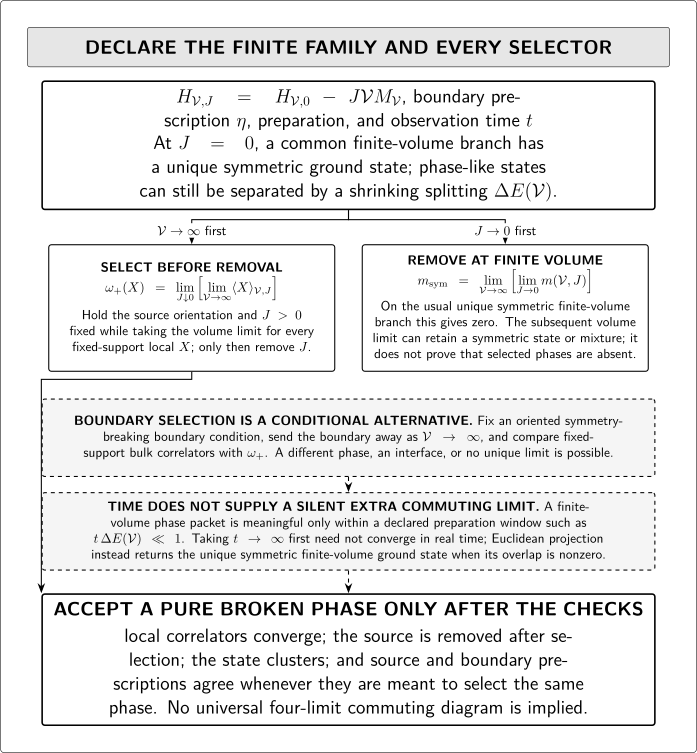
The source and volume limits can disagree: in the usual unique symmetric finite-volume branch, first gives zero order parameter, while at fixed oriented followed by can retain a nonzero value. A fixed oriented boundary sent away with the volume is an alternative selector only when its fixed-support bulk correlators agree with the source-selected state. Time is a separate preparation variable: a finite-volume phase packet is meaningful in a declared window such as ; real-time need not converge, while Euclidean projection at fixed volume returns the unique symmetric ground state when the overlap is nonzero. The diagram is schematic and asserts no universal four-limit commutativity.
The same relationships are available without the image.
| Operation | Quantity held fixed | Possible result | Required check |
|---|---|---|---|
| , then | Source orientation and during the volume limit; fixed support of local | A selected state with nonzero order parameter | Convergence of all needed local correlators and clustering after is removed |
| at fixed , then | The chosen finite-volume family and its zero-source branch | Zero order parameter for the common unique symmetric branch | Do not infer from this alone that selected infinite-volume phases are absent |
| Send an oriented boundary away with | Boundary geometry and orientation; observables remain in the bulk | The same phase, another phase, an interface, or no unique limit | Compare fixed-support bulk correlators with the source-selected state |
| Observe a phase-localized packet for finite | Preparation and finite-volume spectrum | Phase-like behavior when | State the preparation and spectrum; do not replace phase selection by an assumed limit |
| Euclidean-project at fixed | Nonzero overlap with the ground state | The unique symmetric finite-volume ground eigenstate | Take the volume limit in the intended state prescription afterward |
The actual output of the method is a state on local observables,
for every fixed-support physical in the declared domain. A convergent order parameter alone is not enough if other local correlators fail to converge or give incompatible limits.
A two-state calculation
Section titled “A two-state calculation”A minimal discrete-symmetry model makes the noncommutativity transparent. Let and be phase-like states with order-parameter densities . On their low-energy span, write
where the zero-source level splitting is .
Assume at every finite volume and as . Thus this two-state model has the common unique symmetric finite-volume ground state while its phase-mixing doublet collapses. Exact finite-volume degeneracy is a different branch and is not described by the following one-sided zero-source limit. Define the extensive bias
The ground state aligns with the effective field , so
At fixed , sending gives . At fixed , taking gives whenever ; removing afterward retains . This ratio condition is enough for an extensive fixed source to dominate, but a diverging mixing time additionally requires the absolute splitting to vanish, as assumed here. The calculation requires no universal formula for .
The two-state Hamiltonian demonstrates spontaneous breaking only when it arises from a genuine increasing-volume family with local observables and a limiting state. A single quantum-mechanical double well, however small its tunnel splitting, has no thermodynamic-limit parameter and is not by itself a spontaneously broken phase.
It also exposes the practical difficulty. The selector should dominate phase mixing without appreciably deforming the bulk physics. Within this two-state approximation, that requires a window of the form
where denotes a model-dependent scale beyond which the source substantially changes local dynamics. If no such window opens in the available regime, the method has not isolated spontaneous breaking.
The complex scalar and its finite-volume rotor
Section titled “The complex scalar and its finite-volume rotor”Return to the exact- complex scalar in a regime where quantum effects permit an ordered phase. Freeze radial fluctuations for a semiclassical low-energy check and write the spatially uniform mode as
At the canonical frozen-radius level, the phase stiffness equals . More generally, quantum effects can renormalize the stiffness, so denote it by and write
Periodicity quantizes , and hence
Within this rotor Hamiltonian, the finite-volume ground wavefunction is uniform in , so ; the full unique finite-volume QFT ground state is likewise -invariant. Each fixed- level in the collective tower collapses as in this effective description. In the already assumed ordered regime, this makes phase localization possible, but the existence and clustering of a limiting phase must still be checked. The coefficient and law belong to this rotor approximation, not to every broken-symmetry system. This zero-mode tower is also distinct from the propagating gapless excitations whose existence requires Goldstone’s theorem. The phase circle itself is developed in Tong 2019, §§ 2.1.2–2.2, pp. 55–61, official PDF.
Use a temporary complex selector
to choose an orientation, take , and then take along that orientation. This is not the permanent anisotropy from the preceding page. Fixed explicitly reduces the phase rotations to ; a separate selector can then test whether a limiting state also breaks that exact residual subgroup.
The example assumes a dimension and dynamics that admit the ordered phase. Infrared obstructions and altered counting belong to Goldstone Counting, Low-Dimensional Obstructions, and Spacetime Exceptions.
Pure phases and the clustering test
Section titled “Pure phases and the clustering test”Use “pure phase” operationally here for a selected limiting state that is not a nontrivial convex mixture of the relevant limiting phases and that satisfies the appropriate cluster property. The full relation among extremal, factorial, and algebraically pure states requires additional hypotheses and belongs to the rigorous handoff.
For translations and fixed-support local observables and , the clustering check is
The infinite-volume limit must already have been taken so that the separation can grow while both observables remain far from a boundary.
For the scalar phases with
form the symmetric mixture
It has , but if every clusters, then
The product of its one-point functions is zero, so the mixture fails clustering and is not one selected clustering phase. This gives an independent check that a vanishing one-point function can conceal broken-phase structure.
A coherent finite-volume superposition is not the same mathematical object as this convex mixture. It is a vector state with interference terms, whereas the mixture is a state-level average. In an infinite-volume phase limit, matrix elements of bounded-support local operators between distinct phase sectors can vanish, making the coherent sequence locally indistinguishable from the corresponding mixture. That local-observable mechanism and its cluster consequence are described in Weinberg 1995, § 19.1, pp. 165–167.
Boundary and time selection
Section titled “Boundary and time selection”A symmetry-breaking boundary condition can replace the bulk source. Fix the boundary in an orientation, send the boundary away while taking , and examine observables supported in the bulk. Agreement of these local correlators with the source-selected state is a useful independent validation. It is not automatic: different boundary conditions can select different phases, interfaces, or no unique limit, so the boundary prescription must be named.
State preparation and time also matter. At fixed finite volume, a phase-localized packet can mix on a timescale controlled by the inverse low-lying splitting. Real-time unitary evolution can oscillate or dephase and need not converge as ; the packet remains phase-like only on times short compared with the relevant mixing time. Euclidean or imaginary-time projection at fixed volume instead isolates the symmetric ground eigenstate when it is unique and the prepared state has nonzero overlap with it. If the splitting tends to zero, the mixing time can diverge with volume, while thermodynamic-limit selection can retain a broken phase. No universal time law is implied; the spectrum and preparation determine it.
Validation and stop conditions
Section titled “Validation and stop conditions”The method supports a phase claim only when all of the following hold:
- local correlators converge along a declared family of geometries, regulators, and selectors;
- the selector can be removed after the volume limit without the order parameter collapsing;
- the limiting state clusters in the stated observable sector;
- source and boundary selection agree on bulk local correlators when they are intended to select the same phase;
- when finite-volume mixing dynamics is invoked, its low-lying spectrum or tunneling analysis is compatible with the claimed phase-mixing timescale; and
- the dimension, interaction range, and infrared behavior permit the assumed ordered phase.
Stop short of a spontaneous-breaking conclusion if the limit does not exist, depends uncontrollably on the volume family, has no regime separating finite-size mixing from source deformation, or yields a nonclustering symmetric mixture when a single phase was claimed. These are scientific failures of the method, not merely demands for a larger finite-volume calculation.
Rigorous construction and classification of infinite-system states belong to Mathematical QFT and Many-Body QFT and Quantum Matter. Numerical finite-size scaling, continuum–volume ordering, and uncertainty belong to Finite Volume as a Controlled Deformation.
Common pitfalls
Section titled “Common pitfalls”“A unique symmetric finite-volume ground state rules out breaking.” It rules out a noninvariant state at that fixed volume. It does not determine whether phase-mixing splittings collapse or selected clustering phases exist as .
“All phase splittings are exponentially small.” Discrete tunneling, continuous rotors, gapless modes, and long-range systems can scale differently. Derive or measure the law for the model rather than importing one.
“A nonzero order parameter at fixed proves spontaneous breaking.” Fixed explicitly breaks the symmetry. The test is whether the nonzero value remains after and then .
“A coherent superposition is a mixed state.” The first is a vector-state construction and the second a convex combination. They can agree on limiting local observables only after cross-phase local matrix elements vanish.
“Clustering can be checked before the volume limit.” Arbitrarily large separation is unavailable in one bounded region. The thermodynamic limit and the separation limit must be ordered and stated.
“Any symmetry-breaking boundary condition is harmless.” A boundary can select a bulk phase, create an interface, or change the limit. Its geometry and orientation are part of the method.
Check the method
Section titled “Check the method”These questions are for self-study and are not graded.
- In the two-state model, why does at fixed give zero order parameter, while at fixed can give ?
- Why does the symmetric mixture fail the clustering test even though its one-point order parameter vanishes?
Check
- At fixed volume the tunneling term remains nonzero, so the ground state aligns along the symmetry-restoring direction as the bias disappears. At fixed positive , the extensive bias eventually dominates any with , selecting the positive phase. Removing only after that limiting state has formed leaves .
- Averaging over phase orientations cancels , but the phase cancels between and inside each component state. Their large-separation correlator therefore approaches , whereas the product of the mixture’s one-point functions is zero.
What follows
Section titled “What follows”The source-selection procedure explains how a symmetric finite-volume eigenstate can coexist with broken infinite-volume phases and supplies checks that distinguish a selected phase from a symmetry-restoring mixture. It does not yet determine the geometry of all selected states or imply a gapless excitation.
- Vacuum Orbits and Unbroken Subgroups organizes the selected states and their stabilizers.
- Goldstone’s Theorem: Hypotheses and Pole Argument states the additional locality, current, spectral, and translation assumptions required for a gapless-pole conclusion.
- Elitzur’s Theorem and the Gauge-Invariant Higgs Mechanism explains why this physical-global-symmetry procedure cannot be applied unchanged to gauge-variant fields.
References
Section titled “References”- Tong, David. The Standard Model: 2 Broken Symmetries. Part III lecture notes. Cambridge: University of Cambridge, Department of Applied Mathematics and Theoretical Physics, 2019. Official PDF accessed August 2, 2026. Official course page. Official PDF.
- Weinberg, Steven. The Quantum Theory of Fields. Volume II: Modern Applications. Cambridge: Cambridge University Press, 1995. DOI.
Original QFT.org content:CC BY 4.0, unless an item supplies different terms. Third-party material retains its own terms.