

Non-Invertible Topological Defects and Fusion
A defect can generate a symmetry without having a group inverse. The required replacement is not merely a formal fusion formula: the defect must be topological on a declared deformation domain, fuse with a unit into a coherent network of same-support outputs, and act consistently on operators or sectors. It is noninvertible exactly when no defect supplies a two-sided fusion inverse. In a finite semisimple line sector, fusion into the identity plus additional channels is a decisive witness of that failure.
This page isolates that operational test. Direct sums, integer multiplicities, and scalar quantum dimensions are used only in a finite semisimple unitary line sector. A four-dimensional compact-Maxwell example then shows why higher-dimensional wall fusion can instead contain an entire finite-symmetry surface network and topology-dependent three-dimensional data. Full fusion-category and higher-category axioms, detailed actions, construction by gauging, and anomaly or renormalization-group constraints are separate subjects.
Required background. Fusion, Junctions, and Endpoints supplies the regulated collision, channel-space, multiplicity, and junction conventions. Higher-Form Symmetry from Operators and Linking supplies the group-like comparator, topological deformation domain, support degrees, and linking action.
Evidence on the operational fusion test and the compact-Maxwell wall below was reviewed through 9 August 2026. The checked literature supports the finite semisimple control and the stated higher-dimensional construction, but also shows that a noninvertible wall need not act by a unitary automorphism and that higher-dimensional fusion coefficients need not be numbers. Those qualifications prevent the finite-line formulas from becoming a universal classification.
Topological deformation is the first test
Section titled “Topological deformation is the first test”Work first in an oriented Euclidean -manifold . Let be a closed oriented codimension-one defect, and keep all other insertions outside a swept region. If and are related by a deformation that crosses no insertion, endpoint, junction, physical boundary, or singular background, topologicality means
The statement carries the orientation, framing when required, background data, and every lower-dimensional stratum along the deformation. It is not a claim that an arbitrary geometric interface can be moved, that the defect can cross a charged operator freely, or that its collision with another defect is finite. Fusion still requires the regulated parallel-collision limit supplied by the prerequisite page.
Topologicality is what permits the defect to implement a conserved operation: one may move it through a correlation function until it surrounds or crosses an operator. The result can be a phase, a linear combination of sectors, an attached operator, or—in a local operator-algebra formulation—a quantum operation. It need not be conjugation by a unitary. Okada and Tachikawa make this last point precise for local actions in Okada and Tachikawa 2024, pp. 191602-1–191602-4, especially eqs. (1)–(2). The detailed action and its selection rules belong to the next page; here its existence and compatibility with fusion are part of the symmetry test.
A topological defect can nevertheless be invertible. Topologicality answers whether it is conserved under allowed deformations. Invertibility answers a different question about its collision algebra.
Fusion without a two-sided inverse is decisive
Section titled “Fusion without a two-sided inverse is decisive”Impose a controlled setting: a finite semisimple unitary sector of topological lines, with simple unit , finite-dimensional junction spaces, and duals. For simple labels , protected fusion takes the form
An object is invertible when there is a label and chosen equivalences
Both directions matter. A one-sided relation is not a group inverse, and the absence of any such is the definition of noninvertibility.
Write for the orientation-reversed label. Orientation reversal is geometric. Evaluation and coevaluation junctions satisfying the two snake identities make a dual. Only when fusion with that dual has no additional channel does it become an inverse. For a simple object in the rigid setting,
Thus a nonzero additional channel is a complete obstruction to inversion in this domain. A decomposing fusion is a useful witness, not the definition in a nonsemisimple sector or in a higher-dimensional fusion problem that does not reduce to a finite direct sum.
The figure contrasts the group-like and branching cases. Inspect especially the difference between reversing a defect and canceling it, and the separate junction and coherence data attached to every branch.
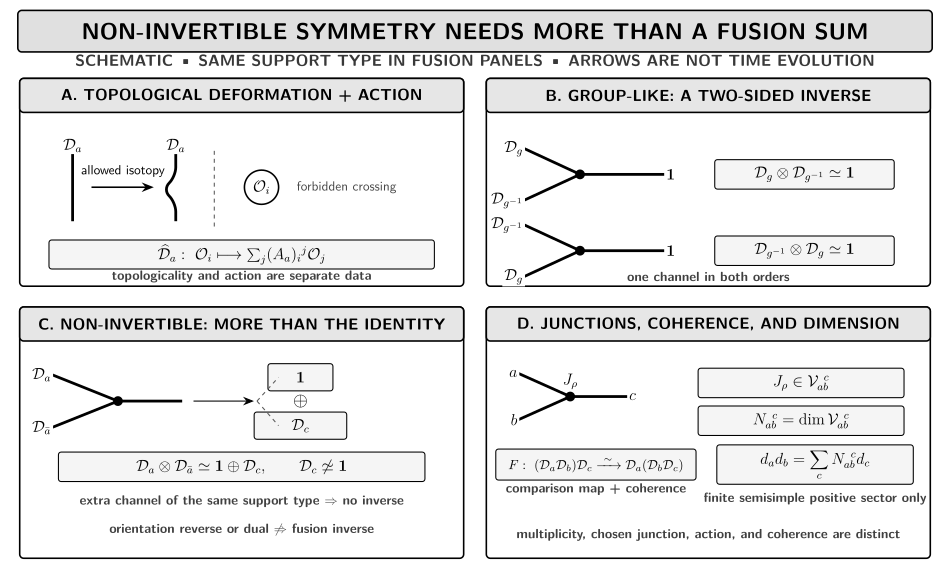
Topological deformability supplies conservation, while fusion decides invertibility. In the finite semisimple line control, a group-like defect has a two-sided identity channel and no other output; a noninvertible defect can fuse with its orientation dual into the identity plus an additional same-support channel. Multiplicities count junction spaces only under the stated hypotheses, associators compare resolved networks, and a scalar dimension is conditional. The diagram is an original monochrome schematic, not to scale; arrows denote deformation, fusion, or comparison rather than time evolution, and higher-dimensional wall fusion may require TQFT- or network-valued data instead of the displayed finite sum.
The table is a complete nonvisual reading of the comparison. Its stop column is as important as its positive test: no single row licenses the missing structure in another row.
| Test | Required data | Group-like case | Noninvertible conclusion or stop |
|---|---|---|---|
| Deformation | Support, orientation, framing, backgrounds, and forbidden crossings | Correlators are unchanged in the allowed sweep | Topologicality is still required; branching alone is not a symmetry |
| Fusion output | A regulated collision and closed output sector | One group-law output | Several same-support channels, multiplicity, or more general wall data may appear |
| Two-sided inverse | Left and right fusion equivalences with the unit | An inverse exists in both orders | No such defect exists; this is the decisive definition |
| Orientation and dual | Reversal plus evaluation, coevaluation, and snake identities | The dual is also the inverse | A dual can exist while extra fusion channels obstruct inversion |
| Multiplicity and junction | Typed junction spaces and chosen basis operators | A selected one-dimensional fusion equivalence implements multiplication | An allowed coefficient does not construct or normalize a junction |
| Associativity | Comparison maps for two resolved fusion trees | Coherent comparison data remain required and may carry an anomaly | A fusion ring without coherent comparison maps is incomplete |
| Action | Crossing or surrounding maps on operators and sectors | Often an invertible representation or automorphism | May mix sectors, attach defects, or act as a quantum operation |
| Dimension | A finite semisimple rigid setting and a chosen dimension notion | A simple invertible object has dimension one | Dimension greater than one diagnoses noninvertibility only in that setting |
| Higher-dimensional ceiling | Wall topology and lower-dimensional worldvolume theories | A group-like wall still cancels to the identity wall | Coefficients can be surface networks or TQFT data, not integers |
Schäfer-Nameki develops the topological-defect viewpoint, the group-like comparator, and the first noninvertible fusion examples in Schäfer-Nameki 2024, arXiv v2, printed pp. 5–11, eqs. (1.1)–(1.9), figs. 2–4, Open PDF. The source explicitly warns that a simple scalar fusion cartoon suppresses higher-fusion data. The table above therefore states a sequence of checks, not a definition by picture alone.
Junctions, associators, and an action complete the data
Section titled “Junctions, associators, and an action complete the data”In the finite line control, the oriented junction space for two incoming lines and one outgoing line is
The second equality uses all of the semisimple finite-dimensional hypotheses. A vector is a chosen junction operator. Neither its normalization nor its transformation under other symmetries is contained in the integer .
For four external labels, associativity compares two resolved networks. One convenient orientation of the comparison is
The map must be invertible and the resulting comparisons must be coherent. This page uses that statement as a physical completeness test; it does not develop the pentagon equation or categorical classification.
Finally, the defect network must act consistently. Crossing first with and then with must agree, after the selected junction and associator maps, with the direct sum of actions of the fusion outputs. A fusion rule without such an action is an abstract based ring, not yet a symmetry of the declared QFT. Conversely, noninvertibility does not mean nonunitarity: the ambient QFT and the defect sector can be unitary even though the induced local operation is not an invertible automorphism.
Kaidi gives a current finite-line account of fusion objects, Hom-space junctions, orientation duals, quantum dimensions, and associators in Kaidi 2026, §§ 3.1–3.2, arXiv v2, printed pp. 32–37, eqs. (3.1)–(3.20), Open PDF. Those unrefereed notes are used only as recent corroboration; their own higher-dimensional discussion emphasizes that the theory beyond this control is less complete Kaidi 2026, § 4, arXiv v2, printed p. 69, Open PDF.
Quantum dimension is a conditional diagnostic
Section titled “Quantum dimension is a conditional diagnostic”Still within a unitary fusion category, the canonical positive dimensions obey
For a simple invertible object in this setting,
Thus is a useful diagnostic, not the definition. Outside a unitary pivotal setting one must distinguish Frobenius–Perron from categorical or statistical dimension, and outside a finite semisimple sector the displayed scalar equations may not exist at all.
The minimal arithmetic control has an invertible line and a self-dual line with
The dimension equation gives
The line is self-dual but not invertible. This is the simplest round trip through fusion, duality, and dimension; it is not a classification of two-dimensional rational CFTs.
An S₃ fixed-point-net check
Section titled “An S₃ fixed-point-net check”There is a second controlled physical check under standard Doplicher–Haag–Roberts fixed-point-net hypotheses. Let a Haag-dual field net carry a faithful action of the finite group , and set . The induced finite-statistics DHR sectors contain a full symmetric tensor subcategory equivalent to . For the trivial representation , sign representation , and two-dimensional real representation ,
Their statistical dimensions equal the representation dimensions:
The fusion-dimension check is . The one-dimensional sectors are invertible; the self-conjugate sector is not. If is trivial, these induced sectors exhaust ; without that extra hypothesis they are only a full subcategory. Müger states the fixed-point reconstruction and dimension result in Müger 2001, arXiv v2, printed p. 4, Propositions 2.4–2.5, Open PDF. The theorem-level construction, conjugates, left inverses, and index are continued in Conjugates, Statistics Operators, and Statistical Dimension.
First application: a compact-Abelian duality wall and its finite network
Section titled “First application: a compact-Abelian duality wall and its finite network”Now switch frameworks deliberately. Work in four-dimensional Euclidean pure compact gauge theory on an oriented spin manifold , with no dynamical electric charges or monopoles. Let be a compact connection, locally, and
for every closed oriented two-cycle . Use the Euclidean action and coupling convention
Fix an integer and the fixed point of electric- gauging followed by electromagnetic -duality,
At this point, gauging the electric subgroup sends to , and electromagnetic -duality returns the theory to . For the half-gauging derivation, assume that the closed oriented three-manifold separates and gauge one component. For a general two-sided , cut along and glue the two boundary copies with the same duality kernel. The result defines a topological wall. Write it as and its orientation reverse as . A local wall representative is
This formula is only a local compact-connection representative; the global wall includes the finite gauging sectors and their junction data. A physical boundary would require a separate boundary completion. The half-gauging construction itself belongs to the later constructions page.
The finite one-form network contains Wilson lines
and topological electric surfaces with . For closed, oriented, disjoint and in a controlled linking region,
Here denotes all other insertions outside the deformation sweep. A two-in/one-out junction of the surface sheets is a line carrying a chosen operator
The signed incidence is necessary; it neither constructs nor normalizes the junction space. The same surface can be absorbed into the duality wall only through a selected surface-to-wall junction:
A fundamental Wilson line crossing the wall becomes an improperly quantized ’t Hooft line with an attached surface. The attachment is operator-level evidence that the wall does not act by an ordinary invertible automorphism.
Fusion with the reversed wall does not give the identity wall. In the untwisted normalization of Choi and collaborators,
where is the condensation wall. On a connected closed oriented support ,
More generally the normalization is , and an Euler counterterm can change the overall convention. Every in the sum is a finite-symmetry surface network condensed on the wall worldvolume. The output is therefore a codimension-one wall, not a codimension-mismatched direct sum of bulk codimension-two surfaces.
Take . Since , the fusion becomes
This makes the obstruction to inversion visible: the reversed wall produces a projector-like average over a surface network rather than the identity wall. One closed-manifold amplitude is not by itself an equality of defects; the junctions and worldvolume topological data are part of . In still more general higher-dimensional fusion, coefficients can be partition functions or entire lower-dimensional TQFTs.
The continuum model and its conventions appear in Choi, Córdova, Hsin, Lam, and Shao 2023, § 6.1, arXiv v2, printed pp. 31–32, eqs. (6.1)–(6.9), Open PDF; the combined fixed point, wall, line attachment, and orientation-sensitive fusion are developed in Choi et al. 2023, arXiv v2, printed pp. 35–36, eqs. (6.22)–(6.28), Open PDF. The surface-absorption junction is made explicit in Choi et al. 2023, §§ 4–4.1, arXiv v2, printed pp. 23–24, eqs. (4.1)–(4.3), Open PDF. The condensation-wall normalization and topology dependence are given in Choi et al. 2023, arXiv v2, printed pp. 9–10, especially eqs. (2.5)–(2.9), Open PDF, while the fusion algebra is checked in Choi et al. 2023, § 3.1, arXiv v2, printed pp. 17–20, especially eqs. (3.4)–(3.7), Open PDF. The example assumes the exact pure Maxwell symmetries and the identified combined fixed point; adding charged matter, monopoles, a boundary, or different global data requires a new analysis.
What the diagnosis establishes—and what it does not
Section titled “What the diagnosis establishes—and what it does not”The operational diagnosis establishes four things when all its gates pass:
- the defect is conserved under the allowed topological deformations;
- its collision closes in a declared network with a unit;
- no two-sided fusion inverse exists; and
- junction, associator, and action data make that network a symmetry of the QFT rather than a list of formal labels.
It does not establish a universal categorical framework, gaugeability, an anomaly class, a phase of matter, or a renormalization-group endpoint. Those questions require additional input.
The clean line formulas stop when the protected sector is nonsemisimple, infinite, nonrigid, or does not have finite-dimensional junction spaces. The Maxwell example stops when the wall topology, boundary condition, spin/global data, or available surface sectors differ from the stated setup. In higher dimensions, a junction can support a genuine lower-dimensional QFT and a fusion coefficient can itself be a TQFT rather than a number.
The research literature also corrects a tempting analogy with ordinary symmetry: a noninvertible local action can be a completely positive quantum operation rather than an algebra automorphism. That result is compatible with the topological network definition, but it means that ordinary representation language must be earned rather than assumed. Likewise, the noninvertible fusion of a unitary defect does not make the ambient theory nonunitary.
Common pitfalls
Section titled “Common pitfalls”Calling every topological defect a noninvertible symmetry. A topological defect can be group-like, and an isolated topological insertion may not belong to a fusion network with an action. Check both the collision algebra and the rest of the symmetry data.
Equating reversal, duality, and inversion. Orientation reversal is a geometric operation; duality additionally needs evaluation, coevaluation, and snake identities. An inverse exists only when fusion in both orders leaves the identity and no extra channel.
Treating multiplicities as junctions. The integer can equal the dimension of a junction space in the finite semisimple control. It does not choose a basis, normalization, associator, or localized junction theory.
Using a scalar quantum dimension in every dimension. The equation belongs to a finite fusion setting. A four-dimensional wall can instead have topology- and TQFT-valued fusion data, so no conclusion for the Maxwell wall follows.
Writing a wall as a direct sum of bulk surfaces. In the Maxwell example, is a codimension-one condensation wall whose worldvolume sums surface networks. The support dimension never changes across the wall fusion equation.
Inferring dynamics from the fusion rule. Noninvertible symmetry can constrain phases and flows, but the fusion rule alone does not select a vacuum, prove a gap, or determine an anomaly. Those consequences belong to the later anomaly and RG analysis.
Check your understanding
Section titled “Check your understanding”Each answer states the assumptions needed for the conclusion.
1. Is a self-dual line necessarily invertible?
Section titled “1. Is a self-dual line necessarily invertible?”Suppose and , with . Decide whether is invertible.
Checked answer
No. Self-duality identifies the orientation dual, but fusion with that dual contains the additional channel . Therefore it is not equivalent to the identity, so the dual is not an inverse.
2. Recover the minimal noninvertible dimension
Section titled “2. Recover the minimal noninvertible dimension”Use , , and in a unitary fusion category.
Checked answer
Positivity and give . The last fusion rule then gives , hence . The conclusion uses the finite unitary fusion setting; it is not a formula for a generic wall.
3. Check the S₃ sector arithmetic
Section titled “3. Check the S₃ sector arithmetic”Verify the statistical-dimension identity for .
Checked answer
The left side has dimension . The right side has . Since is simple and has dimension two, it is noninvertible even though it is self-conjugate.
4. Keep the Maxwell support dimensions straight
Section titled “4. Keep the Maxwell support dimensions straight”In four dimensions, identify the dimensions of , , , and the surface-junction support .
Checked answer
is a codimension-one three-dimensional wall. The one-form symmetry operator is a codimension-two two-dimensional surface, is a one-dimensional line, and a junction at which surface sheets meet is also a one-dimensional line. The sum inside lives on the wall worldvolume; it does not turn the wall fusion output into a bulk surface.
5. Evaluate the connected-wall normalization
Section titled “5. Evaluate the connected-wall normalization”For , compute the number of terms in the untwisted sum and its prefactor.
Checked answer
, so there are surface-network sectors. Connectedness gives , hence the prefactor is . This is a finite-gauging normalization with a local-counterterm convention, not an integer fusion multiplicity.
6. Diagnose a near miss
Section titled “6. Diagnose a near miss”An interface has a formal branching collision rule, but its correlators change under a small deformation even when no insertion is crossed. Is it a noninvertible symmetry defect?
Checked answer
Not from the stated data. It fails the topological-deformation test, so the branching rule describes an interface collision rather than a conserved noninvertible symmetry. One would need a protected topological limit before using the symmetry language.
Continue to actions, constructions, and theorem-level structure
Section titled “Continue to actions, constructions, and theorem-level structure”Continue first to Actions, Generalized Charges, and Selection Rules for the crossing maps, sector mixing, attachments, and selection rules that complete the operational action. Constructions from Gauging, Duality, and Condensation then develops half-gauging and condensation rather than treating the Maxwell wall as a black box. Anomalies, RG Constraints, and Framework Limits asks which networks can be gauged and what survives along a flow.
For theorem-level structure, Noninvertible Symmetries, Fusion, and Junction Data and Fusion Categories, Module Categories, and Bimodule Defects develop the axioms suppressed here. Interfaces, Folding, and Fusion specializes the collision problem to two-dimensional conformal interfaces; its rational-CFT results should not be used as a classification in higher dimensions.
References
Section titled “References”- Choi, Yichul, Clay Córdova, Po-Shen Hsin, Ho Tat Lam, and Shu-Heng Shao. “Non-invertible Condensation, Duality, and Triality Defects in 3+1 Dimensions.” Communications in Mathematical Physics 402, no. 1 (2023): 489–542. DOI. Open PDF, arXiv v2.
- Kaidi, Justin. “Introduction to Generalized Symmetries.” arXiv:2603.08798v2 [hep-th], revised 6 July 2026. Open PDF.
- Müger, Michael. “Conformal Field Theory and Doplicher–Roberts Reconstruction.” In Roberto Longo (ed.), Mathematical Physics in Mathematics and Physics: Quantum and Operator Algebraic Aspects, Fields Institute Communications 30, 297–319. Providence, RI: American Mathematical Society, 2001. DOI. Open PDF, arXiv v2.
- Okada, Masaki, and Yuji Tachikawa. “Noninvertible Symmetries Act Locally by Quantum Operations.” Physical Review Letters 133, no. 19 (2024): 191602. DOI. Open PDF, arXiv v2.
- Schäfer-Nameki, Sakura. “ICTP Lectures on (Non-)Invertible Generalized Symmetries.” Physics Reports 1063 (2024): 1–55. DOI. Open PDF, arXiv v2.
Original QFT.org content:CC BY 4.0, unless an item supplies different terms. Third-party material retains its own terms.