

Anomalies, Inflow, and Matching
An anomaly is not just a failed formal symmetry check. It is the part of a quantum symmetry obstruction that remains after the theory, fixed backgrounds, boundary domain, regulator, and admissible globally defined local counterterms have been specified. This chapter organizes that diagnosis along two independent axes: whether the symmetry is a dynamical gauge redundancy or an exact global symmetry, and whether the obstruction is visible locally or only through finite, large, or torsion-sensitive data.
Choose the regulated-identity route when a Jacobian or Ward identity has failed. Choose the descent-and-inflow route when a characteristic form or higher-dimensional response is already in hand. Choose the global-and-matching route when perturbative coefficients vanish, a large transformation changes a phase, or the infrared realization is the question. All three routes begin with the same repair test and use a four-dimensional chiral fermion as a common normalization check.
Helpful background. Changes of Variables and Regulated Jacobians supplies the finite-dimensional change-of-variables logic that underlies the regulated measure calculation. Characteristic Classes and Chern–Weil Theory supplies the curvature polynomials used in descent and inflow. Neither is required merely to choose a route through this overview.
Parent volume. Symmetry and Gauge Structure
Jump to: apply the obstruction test · choose a route · follow the Weyl thread · open the exact guide · review the chapter
A genuine anomaly survives the repair test
Section titled “A genuine anomaly survives the repair test”Let collect all fixed background data, including bundles, connections, metric or tangential structure, boundary conditions, and nondynamical couplings. In a local trivialization, a finite symmetry transformation may act on the quantum amplitude as
Adding an admissible local counterterm changes the representative,
The anomaly is the obstruction to making the transformation law trivial by such a . The word admissible matters: the term must be local, globally defined on every allowed background, compatible with the boundary domain and quantization rules, and preserve every other symmetry that the problem requires. A density defined only in one gauge patch is not automatically a counterterm. This counterterm quotient is developed in Bilal 2008, § 6.2, printed pp. 42–43, especially eq. (6.7), PDF and in the background-field formulation of Bhardwaj et al. 2024, §§ 4.1–4.2.1, arXiv v2, printed pp. 60–69, PDF.
A dependable diagnosis therefore proceeds in this order:
- Declare the problem. State which fields are integrated over, which are fixed backgrounds, the allowed bundles and tangential structures, the boundary domain, and the symmetries that must remain exact.
- Check the classical domain. If the transformation changes a fixed coupling or boundary condition rather than transforming it as background data, the result is explicit or domain breaking, not an anomaly of the original problem.
- Derive the regulated quantum law. Include the action, measure, insertions, contact terms, boundary flux, and regulator. A Jacobian or triangle graph is evidence at this step, not yet the final verdict.
- Test every allowed local repair. Only a failure that survives the counterterm test defines an anomaly class.
- Classify the surviving class. Assign its gauge-versus-global role and its local-versus-global detector independently.
The shared decision diagram makes the two stopping points and the two independent classifications visible. Follow the upper path before reading the lower matrix.
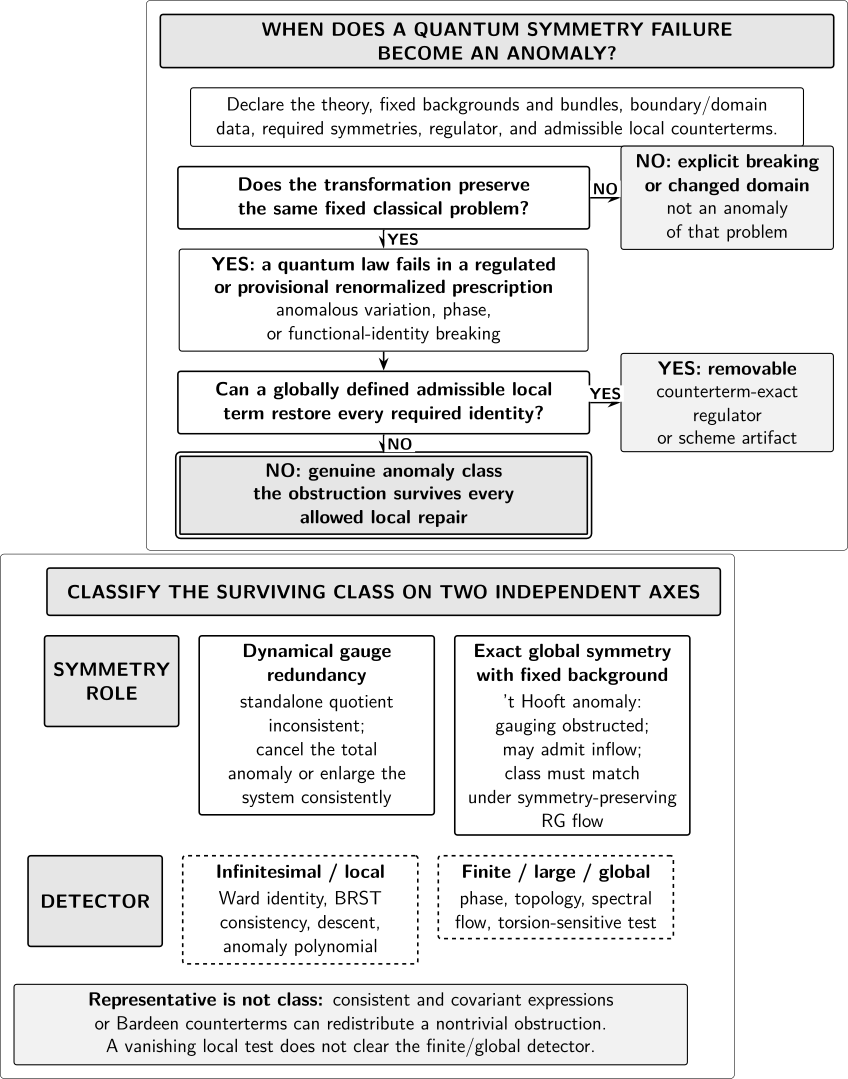
First preserve the same classical problem, then ask whether a globally defined admissible local term restores every required identity. Only a failure that survives both tests is an anomaly. The lower panel classifies that class on two independent axes: dynamical redundancy versus exact global symmetry, and local/infinitesimal versus finite/global detection. The schematic diagram is not exhaustive; in particular, a vanishing local test does not clear a global obstruction.
The same content can be read without the figure:
| Question | If the answer is yes | If the answer is no | What is still undecided |
|---|---|---|---|
| Does the transformation preserve the same classical problem? | Derive the complete regulated quantum identity | Explicit breaking or a changed domain | Whether any quantum obstruction exists |
| Can one admissible local term restore every required identity? | Removable regulator or scheme representative | Genuine anomaly class | The class's physical role and detector |
| Is the transformed connection dynamical? | Gauge anomaly: the standalone quotient is inconsistent unless the total class cancels or the system is enlarged consistently | Global-symmetry anomaly: the theory may exist, but gauging the symmetry is obstructed | Whether the detector is local or global |
| Does the infinitesimal local test vanish? | Continue to finite transformations, topology, spectral flow, and torsion-sensitive tests | Use representation traces, consistency, descent, and inflow to identify the local class | The complete global refinement in either case |
Three distinctions follow immediately. A global-symmetry anomaly names the physical role of an exact symmetry coupled to a background; a global anomaly names a finite or topology-sensitive detector. A gauge redundancy can have a global gauge anomaly, and a global symmetry can have a local perturbative ‘t Hooft anomaly. Likewise, consistent and covariant formulas are representatives with different uses, not independent anomaly classes.
| Axis | Main alternatives | Question answered |
|---|---|---|
| Status | Explicit breaking; removable representative; genuine obstruction | Has the repair test been passed? |
| Symmetry role | Dynamical gauge redundancy; exact global symmetry with fixed background | Does the class obstruct the theory itself or the attempt to gauge a symmetry? |
| Detector | Infinitesimal or local; finite, large, global, or torsion-sensitive | Which experiment or calculation sees the obstruction? |
| Background type | Internal; gravitational; mixed; discrete; orientation reversing | Which bundles and tangential structures define the problem? |
| Representative | Consistent; covariant; Bardeen-shifted; another counterterm scheme | Which local formula or current is being used? |
| Consequence | Gauge inconsistency; obstructed gauging; inflow-relative realization; infrared matching | What physical constraint follows from the class? |
Choose the route from the failed test
Section titled “Choose the route from the failed test”The routes below are reading orders, not equivalences. Enter at the first column that matches the information already available, and repair the first missing prerequisite before continuing.
| Starting question | Recommended route | Preparation to check | Capability at the end |
|---|---|---|---|
| A regulated Ward identity or fermion measure has changed. Is that a genuine anomaly? | Obstruction test → regulated Jacobian → representation traces → current representatives | Changes of variables, quantized fermions, and the relevant representation theory | Separate regulator data, removable terms, local anomaly coefficients, and the gauge-or-global verdict |
| A characteristic polynomial is known. What boundary variation and inflow does it imply? | Obstruction test → consistency and descent → polynomial and inflow | Differential forms, de Rham cohomology, background bundles, and characteristic classes | Track form degree, normalization, orientation, counterterm shifts, and the global-definition ceiling |
| Local coefficients vanish, or an exact global symmetry must constrain the infrared. What remains? | Obstruction test → global and torsion tests → full background taxonomy. For RG matching, also complete polynomials and inflow → matching. | Large gauge sectors, homotopy or mapping-torus data, spin or pin structure as applicable, and the exact quantum symmetry; polynomials and inflow are required before the matching page | Detect phases missed by local polynomials and constrain, without uniquely selecting, infrared realizations |
If the status of the symmetry itself is unclear, begin with What Is an Anomaly? even when a triangle graph or an inflow term is already available. If the local class is controlled but its global completion is not, do not repeat descent; move to the global branch.
One Weyl fermion connects the three routes
Section titled “One Weyl fermion connects the three routes”The chapter keeps one convention-explicit four-dimensional chiral example in view. It begins with a positive-Euclidean-chirality calibration and then translates to the physical Lorentzian left-handed convention used by the later pages. Let be a closed oriented Euclidean spin four-manifold, let be a fixed compact background connection with curvature , and define
Write every fermion as a positive-chirality Weyl field of integral charge ; an opposite-chirality charge- field is represented in this bookkeeping by a positive-chirality charge- field. The two representation sums are
With these conventions the degree-six local anomaly polynomial is
This is the positive-Euclidean-chirality calibration used on the entry and regulated-measure pages. When the later pages switch to a physical Lorentzian left-handed fermion, the site’s Wick map identifies it with negative Euclidean chirality, so the same charge sums are written there as
Holding the charges fixed, reversing Euclidean chirality reverses the anomaly class. The displayed pair is therefore a convention bridge: the chirality translation must be applied before signs from the two parts of the chapter are compared. These normalizations are developed in Álvarez-Gaumé and Vázquez-Mozo 2024, § 3, arXiv v2, printed pp. 5–8 and 10, especially eqs. (11), (17)–(19), and (22), PDF. The convention-related expressions pass through the local route in several forms:
- The regulated fermion measure produces a local density whose finite part depends on regulator and counterterm choices, while its nontrivial class does not.
- Representation theory reduces the perturbative test to the cubic and linear sums above. A Dirac pair contributes charges and , so both sums vanish.
- The consistent effective-action variation satisfies the Wess–Zumino condition. A local Bardeen–Zumino improvement produces a covariant current with a different transformation law; it does not define a second class.
- Locally, descent writes and . The five-dimensional response and four-dimensional variation cancel only after the boundary orientation and phase convention are fixed.
The physical interpretation still depends on the role of . With fixed, a nonzero class is an ‘t Hooft anomaly of the global symmetry. If is integrated over as a dynamical gauge field, the same nonzero total class is a gauge inconsistency. Setting , choosing a flat metric, or canceling only one coefficient on a special background does not trivialize the universal class.
The global branch supplies the essential counterexample to a purely local clearance test. A single positive-chirality doublet has no cubic local anomaly, yet the nontrivial element of changes the fermion amplitude by
An even number of doublets cancels the sign. With dynamical, an odd number is inconsistent; with fixed as a background, the same sign is a global ‘t Hooft anomaly. This example is the classic demonstration that vanishing perturbative coefficients do not establish complete anomaly freedom Witten 1982, printed pp. 324–328.
Finally, anomaly matching carries the class, not the microscopic formula or spectrum, to the infrared. If the exact symmetry and locality assumptions survive the flow, massless fields, Goldstone/Wess–Zumino data, a gapped topological sector, symmetry breaking with the appropriate residual data, or an inflow-relative boundary can realize the same anomaly. Matching rules out an infrared proposal with the wrong class; it does not select a unique phase.
The local branch and the global branch meet but do not collapse
Section titled “The local branch and the global branch meet but do not collapse”The chapter’s logical order is a fork-and-rejoin structure:
- Define the class. Separate explicit breaking and removable local terms from a genuine obstruction.
- Compute one controlled representative. Use a regulated Jacobian or a representation trace with chirality, generator normalization, background status, and regulator explicit.
- Enforce local consistency. Distinguish consistent from covariant currents, apply Wess–Zumino closure, and derive descent with every form degree shown.
- Construct local inflow. Check the exponentiated higher-dimensional response, orientation, extension dependence, and boundary variation.
- Test what the local calculation misses. Examine large transformations, mapping tori, spectral flow, torsion, discrete backgrounds, and tangential structures.
- Use the complete class. Demand gauge-anomaly cancellation for a dynamical redundancy, or use inflow and RG matching for an exact global symmetry.
The branches rejoin at the anomaly class, not at a preferred density. A local polynomial can be a powerful detector without being the complete global theory; a global phase can be nontrivial even when every de Rham form in sight vanishes. The relative/invertible-field-theory viewpoint packages this fact by allowing the anomalous amplitude to be line-valued rather than an absolute number Freed 2023, §§ 3–4, printed pp. 8–15, PDF, but its theorem-level construction belongs to Mathematical QFT.
Diagnose the missing preparation
Section titled “Diagnose the missing preparation”The candidate variation is not regulated. Return to Changes of Variables and Regulated Jacobians before interpreting a formal determinant. If the complete identity itself is missing, first use Localized Transformations and Ward–Takahashi Identities to include transformed insertions, contact terms, boundary flux, and the measure contribution. Then use Regulated Jacobians and Measure Variation to keep the finite-mode basis, heat-kernel regulator, zero modes, and local counterterms in the same calculation.
The symmetry role is ambiguous. Decide whether the connection is fixed or integrated over and review Coupling to Background Gauge Fields and Bundles. The words “gauge transformation” alone do not say whether the transformation is a redundancy or an action on background data.
The coefficient normalization is unclear. Fix chirality, trace normalization, compact charge lattice, curvature convention, and whether a right-handed field is being rewritten by charge conjugation. Canonical Quantization of the Free Dirac Field fixes the fermion and chirality conventions, while Representations, Intertwiners, Invariants, and Tensor Decomposition fixes the group-theory input. Then use Perturbative Chiral and Gauge Anomalies before comparing numerical coefficients from different sources.
The descent forms are untyped. Review Characteristic Classes and Chern–Weil Theory and Differential Forms and Stokes’ Theorem, then state every form degree and boundary orientation before integrating by parts.
A zero polynomial is being treated as complete clearance. Use Large Gauge Transformations and Topological Sectors and Global and Torsion Anomalies to test mapping tori, spectral flow, determinant phases, and torsion-sensitive data.
The infrared claim assumes too much. Identify the exact unbroken quantum symmetry, its allowed backgrounds, and the full anomaly class before invoking ‘t Hooft Anomaly Matching. Matching is a constraint on admissible infrared realizations, not a proof of confinement, symmetry breaking, or a particular duality.
Exact chapter guide
Section titled “Exact chapter guide”This is the common entry page. It gives the counterterm-based obstruction test, keeps gauge-versus-global role separate from local-versus-global detection, and applies both tests to four-dimensional Weyl fermions. After it, you can classify a failed regulated identity without calling every Jacobian or boundary term an anomaly. Continue to the measure page for a local calculation or to the global page for a finite phase. Before entering matching, also complete Anomaly Polynomials and Inflow so that both of its hard inputs are in place.
Its hard preparation is Localized Transformations and Ward–Takahashi Identities plus Changes of Variables and Regulated Jacobians.
2. Regulated Jacobians and Measure Variation
Section titled “2. Regulated Jacobians and Measure Variation”This page starts with an exact finite Berezinian and only then takes a regulated continuum trace. It derives the local heat-kernel density, tracks regulator compatibility and local counterterms, treats zero-mode orientation, and states where the local calculation stops. After it, you can tell which part of a measure variation is calculational data and which part can represent a nontrivial class. Continue to the representation-trace page to sum a chiral spectrum.
Its hard preparation is What Is an Anomaly?, Changes of Variables and Regulated Jacobians, and Canonical Quantization of the Free Dirac Field.
3. Perturbative Chiral and Gauge Anomalies
Section titled “3. Perturbative Chiral and Gauge Anomalies”This page turns a chiral spectrum into Abelian, non-Abelian, and mixed representation traces. It distinguishes a background ‘t Hooft coefficient from an uncanceled dynamical gauge anomaly and checks controlled spectra with explicit chirality conventions. After it, you can check local cancellation conditions without claiming that they clear a global anomaly. Continue to current representatives or to the descent route.
Its hard preparation is Regulated Jacobians and Measure Variation and Representations, Intertwiners, Invariants, and Tensor Decomposition.
This page derives the consistent current from the effective action, constructs the covariant current by a local Bardeen–Zumino shift, and explains why integrability and covariance cannot both be inferred from the same formula. It also shows how Bardeen counterterms redistribute mixed Ward identities. After it, you can choose the representative appropriate to an effective-action variation or a covariant operator equation without confusing either with the class.
Its hard preparation is Perturbative Chiral and Gauge Anomalies.
This page derives the Wess–Zumino condition from closure of symmetry variations, rewrites it as a BRST cocycle equation, and constructs the descent staircase from a characteristic form. Form degree, sign, representative shift, and boundary qualifications remain explicit. After it, you can recognize a consistent local anomaly and carry its representative into the inflow page.
Its hard preparation is What Is an Anomaly?, Differential Forms and Stokes’ Theorem, and de Rham Cohomology, Periods, Duality, and Intersection.
This page normalizes the higher-degree polynomial, derives the boundary variation of a higher-dimensional response, and checks that outward-boundary orientation makes bulk and boundary phases cancel. It separates local counterterm shifts from the global definition of the exponentiated action. After it, you can state exactly what perturbative inflow establishes and why it is not a global anomaly classification.
Its hard preparation is Wess–Zumino Consistency and Descent and Coupling to Background Gauge Fields and Bundles.
This page treats a flat anomaly line with nontrivial holonomy, closes a large transformation into a mapping torus, and uses spectral flow to expose the fermion phase. The mod-two example shows why local cancellation is not enough. After it, you can choose a finite or torsion-sensitive detector while handing determinant-line, eta-invariant, and bordism theorems to Mathematical QFT.
Its hard preparation is What Is an Anomaly? and Large Gauge Transformations and Topological Sectors.
8. Gravitational, Mixed, Discrete, and Orientation-Reversing Anomalies
Section titled “8. Gravitational, Mixed, Discrete, and Orientation-Reversing Anomalies”This reference enlarges the background data from continuous internal bundles to tangent curvature, discrete cocycles, spin or pin structure, and orientation reversal. It separates pure, mixed, local, and global tests and shows which detector applies in each sector. Use it when the anomaly question cannot be posed with an internal connection on an oriented spin manifold alone.
Its hard preparation is Global and Torsion Anomalies.
This page explains why an exact global anomaly class is invariant under a symmetry-preserving local RG flow and catalogs the main infrared matching mechanisms. It includes local gauge and mixed-gravitational coefficients as well as global and torsion data. After it, you can reject an infrared proposal with the wrong anomaly while keeping phase dynamics and duality-specific claims in their owning volumes.
Its hard preparation is What Is an Anomaly? and Anomaly Polynomials and Inflow; Global and Torsion Anomalies is useful preparation whenever the class has finite or torsion-sensitive data.
Keep the nonimplications visible
Section titled “Keep the nonimplications visible”| Observation | What it supports | What does not follow |
|---|---|---|
| A regulated Jacobian is nontrivial | A candidate quantum variation in the declared prescription | That the variation survives every admissible local counterterm |
| The consistent and covariant anomalies differ | Different current representatives with different integrability and covariance properties | Two independent anomaly classes |
| The anomaly polynomial vanishes | The corresponding perturbative local class vanishes under the stated assumptions | Absence of a finite, torsion, or large-transformation anomaly |
| A bulk inflow term cancels a boundary variation | The combined bulk–boundary system is invariant with the declared orientation and global data | That the isolated boundary is an absolute anomaly-free theory |
| Two theories have matching perturbative coefficients | Agreement of those local anomaly data | Agreement of torsion/global anomalies, spectra, correlators, or phases |
| An infrared phase matches the anomaly | It passes one necessary exact-symmetry constraint | That the phase is unique or dynamically realized |
Boundaries and canonical exits
Section titled “Boundaries and canonical exits”This chapter owns the physical diagnosis and controlled representatives. It stops when the remaining question requires a full model, a theorem-level classification, or phase dynamics.
| Remaining question | Continue to | New input supplied there |
|---|---|---|
| Do the Standard Model gauge anomalies cancel with all multiplicities and hypercharges included? | Gauge-Anomaly Cancellation and Quantum Consistency | The complete representation content, charge sums, global gauge structure, and phenomenological consistency check |
| How are global fermion phases constructed from determinant lines, eta invariants, or bordism? | Global Anomalies, Determinant Lines, and Eta Invariants | The theorem-level geometric and analytic construction |
| How is an anomalous theory typed as relative to an invertible bulk? | Anomalies as Relative and Invertible Field Theories | Functorial, extended, and dualizability data beyond the response-level picture |
| Which strongly coupled infrared phase actually realizes the matching conditions? | Anomaly and Generalized-Symmetry Constraints on Infrared Phases | Confinement, symmetry realization, vacuum structure, and dynamical evidence |
| Which quantized bulk response represents the anomaly? | Background Responses and Invertible Phases | Globally defined fixed-background functionals, stacking, boundary lines, and the response-versus-gauging distinction |
Review the chapter
Section titled “Review the chapter”Each solution names both the verdict and the page that supplies the missing step.
1. Separate a candidate variation from an anomaly
A regulator gives for one globally defined local functional that preserves every other required identity. The failure is a removable regulator or scheme representative, not a genuine anomaly. Use What Is an Anomaly? for the admissibility test and Regulated Jacobians and Measure Variation to verify that the same regulator and field domain were used.
2. Choose the physical verdict from the role of the connection
The same nontrivial local class is computed first with a fixed background connection and then with that connection integrated over. In the first problem it is an ‘t Hooft anomaly: the global symmetry cannot be gauged by itself. In the second it is a gauge inconsistency unless the total anomaly is canceled or the system is consistently enlarged. The detector has not changed; the symmetry role has.
3. Check a chiral charge spectrum
For positive-chirality charges , while . The mixed –gravitational local coefficient vanishes, but the cubic coefficient does not. Use Perturbative Chiral and Gauge Anomalies to fix all group and chirality factors before drawing a gauge-consistency conclusion.
4. Explain why local cancellation is not complete clearance
A single Weyl doublet has zero cubic local anomaly but changes sign under the nontrivial large transformation. The missing test is global and mod-two, so continue to Global and Torsion Anomalies. An even number of doublets cancels that sign.
5. State precisely what inflow accomplishes
Descent produces a bulk representative whose boundary variation is opposite to the anomalous boundary variation in the declared orientation convention. Their product is invariant, but the isolated boundary remains relative to the bulk. The local construction must still be globally well defined on all admitted bundles; use Anomaly Polynomials and Inflow for that ceiling.
6. Use matching without predicting a unique phase
First identify the exact unbroken quantum symmetry and match its complete class, including global data. A proposed infrared theory with a different class is excluded. Several massless, Goldstone, topological, broken-symmetry, or relative-boundary realizations may remain, so dynamics must choose among them. Continue to Anomaly and Generalized-Symmetry Constraints on Infrared Phases for that next question.
Continue from here
Section titled “Continue from here”For a complete first pass, read What Is an Anomaly? and then follow either the regulated-measure, descent-and-inflow, or global-detection branch. Enter ‘t Hooft Anomaly Matching only after both What Is an Anomaly? and Anomaly Polynomials and Inflow are complete and the exact quantum symmetry has been identified; carry the global branch with you whenever it is relevant. Return to Symmetry and Gauge Structure to choose another chapter.
References
Section titled “References”-
Álvarez-Gaumé, Luis, and Miguel Á. Vázquez-Mozo. “Anomalies and the Green–Schwarz Mechanism.” In Handbook of Quantum Gravity, edited by Cosimo Bambi, Leonardo Modesto, and Ilya L. Shapiro, 2241–2284. Singapore: Springer, 2024. DOI. Open PDF, arXiv v2.
-
Bhardwaj, Lakshya, Lea E. Bottini, Ludovic Fraser-Taliente, Liam Gladden, Dewi S. W. Gould, Arthur Platschorre, and Hannah Tillim. “Lectures on Generalized Symmetries.” Physics Reports 1051 (2024): 1–87. DOI. Open PDF, arXiv v2.
-
Bilal, Adel. “Lectures on Anomalies.” arXiv:0802.0634v1 [hep-th], 2008. Stable record. Open PDF.
-
Freed, Daniel S. “What Is an Anomaly?” arXiv:2307.08147v1 [hep-th], 2023. Stable record. Open PDF.
-
Witten, Edward. “An SU(2) Anomaly.” Physics Letters B 117, no. 5 (1982): 324–328. DOI.
Original QFT.org content:CC BY 4.0, unless an item supplies different terms. Third-party material retains its own terms.