

Fusion, Junctions, and Endpoints
Extended operators compose only through a declared collision problem. One must bring their supports together with a common regulator, subtract or mix the allowed local terms, and show that a limit exists. A formal rule for the output labels does not supply the junction operators that realize its channels, the operators on endpoints, the comparison between two resolutions, or the orientation and framing data carried through the collision. A generic collision can be singular, generate renormalization-group flow, or fail to close in a proposed finite protected sector; a finite sum with stable integer multiplicities is a special case.
This page develops that physical reference grammar. It uses a finite semisimple topological-line sector only as a controlled setting in which channel spaces and associativity maps can be written explicitly. Full tensor- and higher-category axioms are deferred to Mathematical QFT, while conformal crossing and bootstrap constraints are deferred to CFT.
Required background. Support, Codimension, and Operator Data supplies stratified supports, oriented incidence, endpoint and junction strata, renormalization data, and the distinction between geometric and topological defects.
Helpful background. Chains, Homology, Cohomology, and Exact Sequences supplies signed-boundary cancellation and relative-cycle language for incident supports and endpoints.
Fusion begins with a regulated collision
Section titled “Fusion begins with a regulated collision”Work locally in Euclidean signature and let two oriented defects of the same support dimension lie on parallel copies and , with . Other insertions are kept outside the shrinking tubular region. Before assuming any discrete fusion law, the short-distance statement has the schematic form
inside such correlators. The output index runs over the collision-local contributions admitted in the declared basis. Even in a finite candidate basis, the coefficients can mix and contain singularities; whenever mixing occurs, a single scalar renormalization factor is insufficient.
A renormalized product is defined only after the following data are fixed:
- the two supports, their ordering, orientations, normal structures, and any transported framing;
- a regulator or finite-separation family and the backgrounds held fixed;
- the allowed collision-local counterterms and operator-mixing basis;
- the limiting correlation functions and the class of other insertions and crossings for which the limit is claimed; and
- the output support, endpoint and junction data, and residual scale or scheme dependence.
Even conformal interfaces can have a singular collision that generates a nontrivial RG flow; fully transmitting topological interfaces are a protected exception in the controlled two-dimensional examples of Bachas and Brunner 2008, § 1, corrected arXiv v3, p. 2, Open PDF. That example supplies a concrete warning, not a universal classification of defect collisions.
Protected fusion has channels and junction spaces
Section titled “Protected fusion has channels and junction spaces”Now impose stronger hypotheses: a unitary finite semisimple sector of topological lines with finite-dimensional point-junction spaces. In that setting one may write
Here runs over representatives of simple line labels in the declared semisimple sector.
For two incoming lines and one outgoing line , define the oriented junction space
Within the stated finite semisimple model, for simple ,
A basis vector is a chosen point-junction operator, not merely the statement that the channel is allowed. Its normalization, phases, mixing, symmetry representation, anomaly, and possible localized degrees of freedom are additional data. When the geometric junction stratum has positive spacetime dimension, one may choose a setup in which it supports a lower-dimensional QFT; replacing that theory by a finite vector space would be a further assumption.
The topological-line setting, its morphism spaces, additive sums, fusion, multiplicities, and junction operators are developed in Bhardwaj and Tachikawa 2018, §§ 3.1.2–3.1.6 and 3.3.3, corrected arXiv v2, pp. 8–9 and 17, Open PDF. The equalities above must not be exported to a generic geometric defect, nonsemisimple sector, or collision that does not close in the declared finite sector.
Endpoints are lower-stratum operators
Section titled “Endpoints are lower-stratum operators”An endpoint is not the absence of further data. It is a lower-dimensional stratum carrying an operator or boundary condition compatible with the incident charge or flux, any anomaly or inflow, and the variational boundary terms of the declared theory. Its definition therefore includes the ambient or boundary theory, orientation, allowed endpoint fields, renormalization, and any attached surface. Write for the allowed endpoint- operator space of a line in the declared ambient or boundary sector . A chosen endpoint operator is .
In the controlled topological-line model, one sometimes writes an endpoint space as a morphism to the identity line. That shorthand presupposes an identity object and a typed domain in which the endpoint is allowed. It does not prove that a genuine line may end in empty bulk, that a screened line is zero, or that a boundary endpoint is the same as a bulk endpoint. Open symmetry walls likewise require separately chosen endpoint data, which need not be unique Gaiotto, Kapustin, Seiberg, and Willett 2015, § 2, arXiv v2, p. 6, Open PDF.
Write for the reversed label and for the orientation-reversed defect. It becomes a categorical dual only after evaluation, coevaluation, and the required identities have been supplied. It is an inverse only when the relevant compositions reduce to the identity defect. A splitting junction is similarly not obtained automatically by turning a fusion diagram around. These distinctions are explicit in the corrected topological-line treatment of Bhardwaj and Tachikawa 2018, § 3.1.8, arXiv v2, pp. 10–12, Open PDF.
Associativity compares two resolved networks
Section titled “Associativity compares two resolved networks”For three incoming lines and outgoing line , the two trivalent resolutions have channel spaces
Associativity at this orientation level requires an explicit isomorphism
Consequently,
is only a necessary dimension check. It does not construct . After bases are chosen, is represented by a matrix and changes under basis redefinitions. Fourfold fusion compares several such maps and imposes a coherence condition; the full pentagon axiom and its higher analogues belong to the categorical treatment. Nor may be reordered without separate crossing or braiding data. The associator, its basis dependence, and the pentagon test are worked out in the finite topological-line model in Bhardwaj and Tachikawa 2018, § 3.1.7, corrected arXiv v2, pp. 9–10, Open PDF.
The diagram below is a transverse-slice grammar for these distinctions. Read the collision and junction panels first, then compare the two fusion trees: the arrow labeled is a required map, not a decorative equality.
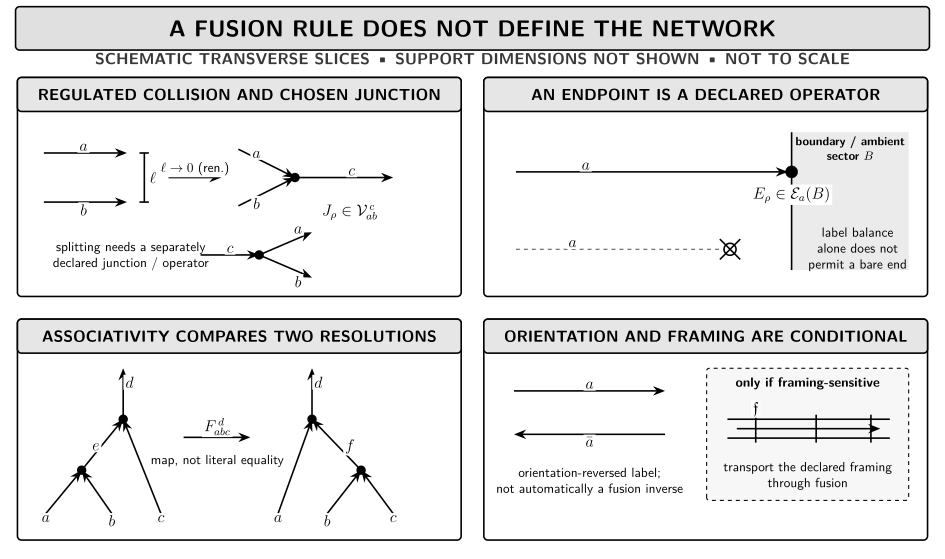
A regulated collision can produce candidate channels, but a chosen junction operator realizes a channel, an endpoint is separate lower-stratum data, and two trivalent resolutions require an associator map. Orientation reversal is not automatically inversion, and framing is carried only when the theory requires it. In panel A, the fusion vertex uses the declared two-in/one-out incidence and the splitting drawing reverses it; arrows in the other panels record their stated endpoint, orientation, or framing roles. Panel A’s displayed is one candidate channel. The direct-sum formula and apply only to the protected semisimple point-junction setting stated in the text. The displayed is the orientation-level comparison map, not a full coherence proof. The symbol denotes the transported framing datum in the conditional inset. The transverse-slice diagram is schematic and not to scale; it does not display the pentagon or higher coherence conditions.
| Datum | Question answered | Required check | Does not imply |
|---|---|---|---|
| Collision limit | What operation brings the supports together? | Common regulator, counterterms, mixing, and a finite limiting domain | A discrete or topological product |
| Channel and multiplicity | Which outputs occur, and how often? | Finite protected sector and a declared decomposition | A basis or normalized junction |
| Junction operator | What realizes the declared two-in/one-out incidence? | Allowed local operator or junction theory, orientation, and renormalization | Existence from label conservation alone |
| Endpoint operator | What absorbs an open defect? | Gauge, flux, anomaly, boundary, and attachment compatibility | That every genuine or screened defect may end |
| Associativity map | How are two trivalent resolutions compared? | An invertible channel map plus higher coherence tests | Literal equality of diagrams or determination by multiplicities |
| Orientation or framing | What geometric data travel through the move? | Consistent reversal, duality, normal structure, and twist convention | An inverse, an adjoint, or framing independence |
Compact U(1) separates label addition from endpoint data
Section titled “Compact U(1) separates label addition from endpoint data”Consider a compact gauge theory on a closed oriented spin four-manifold. Use the faithfully normalized connection , with and . Work at , include a charge- field with , assume that all dynamical electric charges generate , and exclude dynamical magnetic monopoles. On the same oriented closed curve , the bare Abelian holonomies obey
This is charge addition, not by itself a topological fusion theorem. Quantum Wilson lines require a common support regulator and line counterterms. A different finite normalization of each renormalized line changes the numerical junction coefficient while leaving the charge selection rule intact.
At a point junction , take two Wilson segments of charges incoming and one segment of charge outgoing. If a local junction operator has charge , its gauge phase cancels precisely when
For , the neutral channel requires , but this arithmetic still does not choose , its normalization, or its mixing with other neutral local fields. If several independent local fields have the same charge , they give several candidate junction operators in the same charge channel.
An endpoint is the one-leg version of the same test. Let , let the charge- field transform as , and take
Then
is gauge invariant. Removing either endpoint field leaves an uncancelled phase. Thus a Wilson line can end on declared charged matter even though the bare open transporter cannot. Under the declared matter spectrum, electric screening classes are defined modulo . This is an equivalence of screening classes, not an equality of bare Wilson-line formulas and not a choice of endpoint map. The compact normalization, endpoint dressing, and screening relation are reviewed in Bhardwaj et al. 2024, §§ 2.2.2 and 3.2.1, arXiv v2, pp. 20 and 29, eqs. (2.79)–(2.80) and (3.11)–(3.17), Open PDF.
A finite symmetry network exposes surface, line, and point data
Section titled “A finite symmetry network exposes surface, line, and point data”Take an oriented three-dimensional QFT with an exact, non-anomalous, invertible group-like zero-form symmetry . Its cooriented topological symmetry defects are surfaces , , with
Two incoming surfaces and one outgoing surface may meet on an oriented line junction
The congruence is a necessary incidence rule. It does not construct or normalize . A network also needs point operators that compare alternative resolutions of several line junctions. For example, in ,
The left resolution passes through and the right through . Their common final label is only a consistency check; a point-level comparison map is still required. In the minimal example where every relevant junction line has a unique type and the point-comparison space is one-dimensional, one may choose a normalized basis in which that map is multiplication by . Those minimality hypotheses and that normalization are model data, not consequences of the group arithmetic. More general junction data can make the comparison a nontrivial map, while an anomaly can obstruct the topological junction data.
The group law, open-wall endpoint issue, background defect networks, junction phases, and anomaly ceiling are described in Gaiotto, Kapustin, Seiberg, and Willett 2015, § 2, arXiv v2, pp. 6–8, especially eq. (2.2), Open PDF. This finite group-like network is a special class of defects, not a model for every geometric interface or noninvertible fusion rule.
Topological protection is an additional test
Section titled “Topological protection is an additional test”Separation independence is tested in correlators, not inferred from a label law. In a declared topological sector one asks whether
for allowed isotopies that carry orientations, endpoints, junctions, and any framing while avoiding forbidden crossings and physical boundaries. Even if this derivative vanishes for , the collapse at separately requires a finite renormalized limit and an allowed fusion junction.
Stop the topological fusion claim when any of the following occurs:
- collision counterterms or mixing retain scale or scheme dependence;
- a gapless strip or relevant junction coupling drives an RG flow;
- the output does not close in the proposed finite protected sector;
- the isotopy crosses another insertion or changes boundary or attachment data;
- an endpoint or junction operator is missing; or
- the move changes a required framing or tangential structure.
Framing is conditional. The Chern–Simons result below does not imply that every Wilson line carries physical framing; framing is included only when the theory or regulator requires it. In three-dimensional Chern–Simons theory, point splitting introduces a framed push-off and a unit twist can change the quantum phase Witten 1989, § 2.1, pp. 362–365, especially Fig. 3 and eqs. (2.29)–(2.33), Open PDF. The next page develops that geometric information rather than treating it as part of every fusion rule.
Where this reference stops
Section titled “Where this reference stops”The collision, junction, endpoint, and orientation tests above do not classify tensor categories, higher morphisms, Morita equivalence, dualizability, strictification, conformal interface spectra, or bootstrap solutions. The immediate continuation is Linking, Braiding, and Framing, which owns geometric phases, exchange, self-linking, and framing. Non-Invertible Topological Defects and Fusion develops operational non-invertibility and fusion sums. Conformal collision and crossing specialize in Interfaces, Folding, and Fusion and Boundary and Defect Bootstrap.
For theorem-level structures, see Endomorphisms, Intertwiners, and Tensor Products, Higher Morita Categories and Theories as Objects, Strictification, Comparison, and Foundational Limits, Higher-Categorical Targets and Levels of Dualizability, and Defects on Stratified Spacetimes and Higher-Categorical Composition.
Common pitfalls
Section titled “Common pitfalls”Replacing a collision limit by label arithmetic. The equation does not specify the regulator, counterterms, mixing, or domain in which the supports may be collapsed. Check the quantum limit before naming a fusion product.
Treating a multiplicity as a junction operator. A nonzero counts a finite junction space only under the protected semisimple hypotheses above. A basis vector, normalization, and local selection rules still have to be supplied.
Letting a line end because its charge is screened. Screening identifies charge sectors through dynamical endpoints. A particular open line is an operator only after the endpoint fields, boundary condition, and gauge transformation law are included.
Drawing associativity as literal equality. Two fusion trees use different intermediate channels and bases. They require a comparison map and higher coherence, even when their total output label and dimension agree.
Turning a diagram around to obtain an inverse. Orientation reversal, duality, adjunction, splitting, and inversion are distinct properties. Each requires its own evaluation or composition data.
Inferring topological or unframed behavior. Stable labels do not prove shape independence, and topological lines can still depend on framing. Carry the declared normal data through every move.
Check your understanding
Section titled “Check your understanding”1. A compact-Abelian junction
Section titled “1. A compact-Abelian junction”Two Wilson lines of charges and enter a point, and one line of charge leaves. Does gauge invariance determine the junction completely?
Solution
The signed charge is , so a neutral junction is permitted. This is only the selection rule. One must still choose an allowed local neutral operator, its normalization and regulator, and its mixing with any other neutral junction operators.
2. Endpoint covariance
Section titled “2. Endpoint covariance”Verify that is gauge invariant. What fails if either endpoint field is removed?
Solution
The factors transform by , , and , respectively. Their product is one. Removing either endpoint leaves a position-dependent phase, so the remaining expression is not a standalone gauge-invariant operator.
3. Multiplicity is not a basis
Section titled “3. Multiplicity is not a basis”Suppose two independent local fields have the charge needed to terminate the same Wilson line. What does charge conservation establish, and what remains to be chosen?
Solution
Charge conservation permits both fields as candidate endpoint operators and therefore gives at least a two-dimensional candidate space before further relations. It does not choose a basis or normalization, prevent operator mixing, or show that both survive the same renormalized boundary condition.
4. Equal channel counts do not construct an associator
Section titled “4. Equal channel counts do not construct an associator”Assume , both and contain one copy of , and the right-associated resolution also contains two copies of . What follows?
Solution
Both channel spaces have dimension two, so the necessary dimension identity passes. One still needs an invertible comparison matrix between chosen left and right junction bases. Its entries and its compatibility with fourfold fusion are not determined by the dimension count.
5. Reassociate a finite network
Section titled “5. Reassociate a finite network”In , compare with . What does the group law prove, and what does it leave open?
Solution
The first resolution uses intermediate label and the second uses intermediate label ; both finish at label . The group law proves only that the external incidence labels agree. A point operator must still compare the two resolved junction networks, and its phase or matrix is additional coherence data.
References
Section titled “References”-
Bachas, Constantin, and Ilka Brunner. “Fusion of Conformal Interfaces.” Journal of High Energy Physics 2008, no. 2 (2008): 085. DOI. Open PDF, corrected arXiv v3.
-
Bhardwaj, Lakshya, Lea E. Bottini, Ludovic Fraser-Taliente, Liam Gladden, Dewi S. W. Gould, Arthur Platschorre, and Hannah Tillim. “Lectures on Generalized Symmetries.” Physics Reports 1051 (2024): 1–87. DOI. Open PDF, arXiv v2.
-
Bhardwaj, Lakshya, and Yuji Tachikawa. “On Finite Symmetries and Their Gauging in Two Dimensions.” Journal of High Energy Physics 2018, no. 3 (2018): 189. DOI. Open PDF, corrected arXiv v2.
-
Gaiotto, Davide, Anton Kapustin, Nathan Seiberg, and Brian Willett. “Generalized Global Symmetries.” Journal of High Energy Physics 2015, no. 2 (2015): 172. DOI. Open PDF, arXiv v2.
-
Witten, Edward. “Quantum Field Theory and the Jones Polynomial.” Communications in Mathematical Physics 121, no. 3 (1989): 351–399. DOI. Open PDF.
Original QFT.org content:CC BY 4.0, unless an item supplies different terms. Third-party material retains its own terms.