

State Spaces, Cobordisms, and Gluing
A topological field theory assigns a state space to each closed spatial boundary and a linear map to each spacetime bordism. Cutting a spacetime exposes two oppositely oriented copies of the cut, and gluing contracts the corresponding state and costate. In an anomaly-free finite-dimensional theory, this geometric operation is exactly algebraic composition. The cylinder is the identity, closing a bordism gives a trace, and a pair of pants gives multiplication on the circle state space.
The clean statement needs a declared domain. Unless noted otherwise, this page uses absolute, anomaly-free, finite-dimensional TQFTs over on closed oriented manifolds and bordisms. Spin or framed theories require their structures to match across every seam. The path-integral formulas below are operational shorthand; only the finite sums are literal. Gauge fixing, continuous residual modes, determinant factors, and anomalous or relative state spaces require extra data.
Required background. What Is a Topological Field Theory? supplies the unextended functorial definition and separates TQFTs from topological action terms and invertible responses. Helpful background. Homotopy, Degree, Winding, and Covering Spaces explains why the admitted field configurations and identifications must be fixed before sectors can label states.
Boundaries carry states and bordisms carry maps
Section titled “Boundaries carry states and bordisms carry maps”Let be a closed oriented -manifold and let be an oriented -dimensional bordism, so that
An unextended TQFT assigns
The empty boundary receives . Consequently, a bordism prepares a state , a bordism prepares a costate in , and a closed -manifold receives a number. Disjoint union becomes tensor product:
Reversing the orientation reverses the role of incoming and outgoing boundary, giving
This is a bilinear duality statement. It is not, by itself, a positive Hermitian inner product. Positivity or reflection positivity is additional physical structure. Likewise, a spin or framing reversal must use the corresponding structured dual, not merely the underlying oriented manifold.
The two defining gluing checks are
and
These are the cylinder and composition axioms of the Atiyah formulation Atiyah 1988, § 2, printed pp. 178–181, especially axioms (1)–(4c), PDF. A list of closed-manifold numbers that does not admit compatible boundary state spaces, cylinders, and compositions is not yet a local TQFT.
Cutting contracts the shared boundary
Section titled “Cutting contracts the shared boundary”The cylinder can be bent into evaluation and coevaluation bordisms,
Gluing a cup to a cap in either order returns a cylinder. Algebraically these are the snake identities, and they make the boundary pairing nondegenerate. If a closed is cut as , its amplitude is the contraction
In a basis with dual basis this reads
The sum is basis-independent because it inserts the coevaluation tensor . In a functional-integral presentation one often writes the formal analogue
This formula licenses a conclusion only after the boundary fields, polarization, measure, gauge quotient, residual modes, and possible anomaly line have been supplied. For finite gauge theory the integral becomes an exact groupoid-weighted sum; for a continuum gauge theory it may require a BV–BFV pushforward rather than a naive product.
The figure summarizes the finite-dimensional structure. The dashed seam is not an extra operator: it marks the boundary state space being paired and removed.
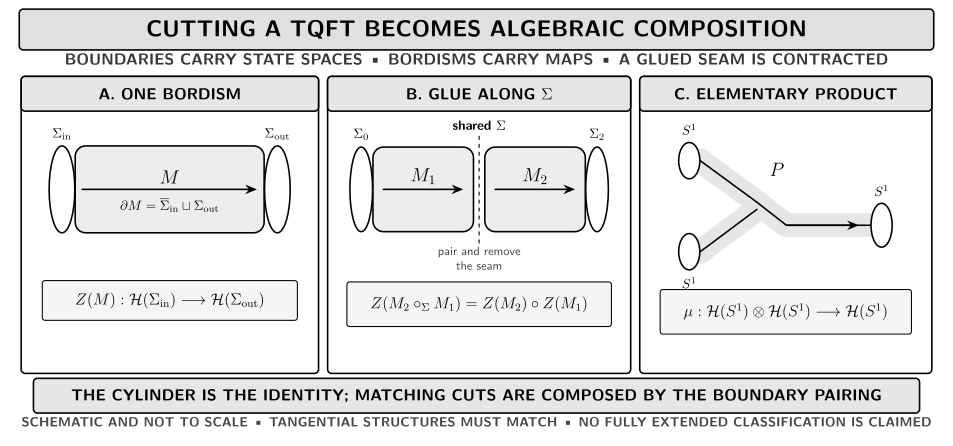
State spaces live on structured boundaries, while bordisms give linear maps. Matching the two copies of the dashed boundary seam produces map composition. In two oriented dimensions, the pair of pants gives the product . The diagram is schematic and does not assert a fully extended classification, a path-integral measure, or the cobordism hypothesis.
Closing the incoming and outgoing copies of in a general bordism gives its trace closure , and the same contraction becomes a trace:
When is the mapping cylinder of a structured diffeomorphism , this closure is the mapping torus and the formula reads .
For the identity cylinder, with the product/glued tangential structure,
In super-valued spin theories the closure can produce a trace or supertrace depending on the spin structure around . A framing anomaly also means that the structured mapping torus, not the unframed manifold alone, is the input. Atiyah states the ordinary vector-space trace relation on printed p. 180 of the source cited above.
Pair-of-pants gluing produces a Frobenius algebra
Section titled “Pair-of-pants gluing produces a Frobenius algebra”Two-dimensional oriented TQFT makes the bordism algebra completely visible. In the bounded unextended category used here, objects are finite disjoint unions of oriented circles. A morphism is a diffeomorphism class, relative to the boundary identifications, of a compact oriented surface whose boundary is split into orientation-reversed incoming circles and outgoing circles. Composition glues matching circles, and the symmetric-monoidal product is disjoint union. This operational description is enough for the following calculation; the construction and universal property of the bordism category remain part of the Mathematical QFT handoff.
Set
The pair of pants with two incoming circles and one outgoing circle gives multiplication, while a disk gives the unit:
Reversing these bordisms gives a coproduct and counit,
The cylinder relations and diffeomorphisms of the relevant surfaces imply
where . The cap–cup cylinder makes nondegenerate. Recutting the same four-holed surface gives the Frobenius identity
Thus is a finite-dimensional commutative Frobenius algebra. Conversely, the generators and relations of oriented two-dimensional bordisms reconstruct an unextended two-dimensional oriented TQFT from such an algebra. The pair-of-pants operations and their gluing relations are developed in Kock 2003, short version, §§ 0.1.7–0.1.10, printed pp. 3–4; § 2.2, pp. 22–23; §§ 2.4.6–2.4.10, pp. 27–28; and Theorem 3.4.14, p. 46, PDF.
A finite gauge control
Section titled “A finite gauge control”For untwisted two-dimensional gauge theory with a finite abelian group , one convenient normalization uses
Then
is nondegenerate, and its adjoint coproduct is
The sphere and torus checks are
More generally,
This is a two-dimensional control. It should not be confused with the three-dimensional surface state spaces below or with fusion of line operators in three-dimensional TQFT.
Two genus-two decompositions give one amplitude
Section titled “Two genus-two decompositions give one amplitude”Choose dual bases and for and define the handle element
One pants decomposition of the closed genus-two surface cuts along a separating circle. Each one-holed torus prepares the state , so gluing them gives
A second decomposition starts from the unit, attaches two handles successively, and then caps:
The Frobenius identity says that is an -bimodule map. Therefore
and hence
The two cuts therefore agree. This calculation checks one separating and one successive-handle decomposition. The full generators-and-relations theorem for all oriented surfaces belongs to the rigorous bordism-category treatment; the example does not prove an arbitrary higher-dimensional decomposition claim.
First application: three-dimensional state spaces pass the same gluing tests
Section titled “First application: three-dimensional state spaces pass the same gluing tests”Now take a closed oriented spatial surface of genus . The models below share the cylinder and trace tests, but they are not identified merely because some dimensions or partition functions agree.
| Model and declared structure | State labels on a genus-g surface | Dimension | Closed-gluing check |
|---|---|---|---|
| Compact U(1) Chern–Simons at nonzero level k | Quantized Abelian holonomies; framing or relative convention retained | Absolute value of k to the power g | The partition function on the surface times a circle equals that dimension |
| Compact BF at positive integer level N | Electric and magnetic ZN holonomies | N to the power 2g | The partition function on the surface times a circle equals that dimension |
| Untwisted finite ZN gauge theory | Flat bundles, equivalently first cohomology with ZN coefficients | N to the power 2g | The groupoid sum on the surface times a circle equals that dimension |
Compact Abelian Chern–Simons surgery
Section titled “Compact Abelian Chern–Simons surgery”Use the standard one-component action
For an ordinary oriented bosonic theory take nonzero even ; integer odd instead defines a spin theory. Quantum amplitudes also retain a framing or equivalent relative gravitational convention. In the matrix normalization used here, the bosonic lattice has even diagonal while a spin lattice may have arbitrary integral diagonal Belov and Moore 2005, §§ 1–2, arXiv v1, printed pp. 3–4 and 7–9, especially eqs. (1.2)–(1.3), PDF. The genus- state-space dimension is
Belov and Moore derive the general Abelian formula Belov and Moore 2005, § 5.3, arXiv v1, printed p. 26, prose after eq. (5.17), PDF.
For the bosonic even- theory, on a basis is labeled by . Up to the sign chosen for orientation and the declared framing phase, the modular transformation exchanging meridian and longitude has matrix
This is the one-component specialization of the discriminant-group Fourier matrix in Belov and Moore 2005, § 5.6.1, arXiv v1, printed p. 35, eq. (5.46a), PDF.
A solid torus prepares the vacuum . Gluing two solid tori by the identity gives and . Gluing after the meridian–longitude exchange gives and
up to the retained framing phase. Witten explains surgery as a state-space pairing in Witten 1989, § 4.2, printed pp. 383–385, and § 4.5, printed pp. 388–390, especially eqs. (4.37)–(4.38), PDF.
Compact BF and finite gauge theory
Section titled “Compact BF and finite gauge theory”For
the Abelian -matrix is
Thus
On the torus, labels give, up to orientation conjugation,
The same general Abelian formula, specialized to the BF pairing, gives this matrix Belov and Moore 2005, § 5.6.1, arXiv v1, printed p. 35, eq. (5.46a), PDF.
The solid-torus gluing test gives . The compact action and its global gauge data are reviewed in Kapustin and Seiberg 2014, § 3, arXiv v2, printed pp. 9–13, eqs. (3.1)–(3.16), PDF.
Untwisted three-dimensional gauge theory assigns the vector space of functions on isomorphism classes of flat bundles:
Therefore
For a connected closed three-manifold, its partition function is the groupoid-weighted sum
It follows that
The second equality is exactly the trace of the identity on . Dijkgraaf and Witten give the finite-group normalization, state spaces, kernels, and sewing formulas in Dijkgraaf and Witten 1990, §§ 6.1–6.3, printed pp. 414–419, eqs. (6.1)–(6.19), PDF. Freed and Quinn formulate the automorphism-weighted measure, boundary inner product, and gluing theorem in Freed and Quinn 1993, § 2, current arXiv v3, internal printed pp. 9–13, especially eqs. (2.1), (2.9)–(2.18) and Theorem 2.13, PDF.
The equality of the BF and untwisted finite-gauge state counts is a nontrivial consistency check. It is not, by itself, a proof that the two theories agree as fully extended TQFTs: operator categories, boundary conditions, normalization, and all global sectors must also match.
A finite residual-mode gluing calculation
Section titled “A finite residual-mode gluing calculation”The compact BF cylinder makes the cut measure explicit without pretending to solve the continuum BV–BFV problem. Let
and use the perfect intersection pairing
The change from the electric -polarization to the complementary magnetic -polarization is the normalized finite Fourier kernel
Reverse orientation conjugates the kernel. Gluing two cylinders along the shared -boundary means summing that residual mode once:
Character orthogonality therefore recovers the identity cylinder: the direct kernel and the two-step composition both give . For three or more cylinders, associativity follows by reordering the finite sums over shared residual labels. Omitting the factor , using incompatible polarizations, or summing one shared zero mode twice leaves a cut-dependent factor. The clean-intersection, measure, determinant, and infinite-dimensional analogues belong to the BV–BFV gluing theorem, not to this finite calculation.
How the circle assignment can extend to points
Section titled “How the circle assignment can extend to points”The following is a bounded application of an imported classification theorem, not a derivation of the cobordism hypothesis. Fix the ordinary Morita 2-category whose objects are finite-dimensional complex algebras, whose 1-morphisms are finite-dimensional bimodules, and whose 2-morphisms are bimodule intertwiners. A fully extended framed two-dimensional theory would refine the unextended circle assignment as follows:
- a positively framed point receives an algebra ;
- an interval between point labels receives a bimodule;
- a surface bordism with corners receives a bimodule intertwiner; and
- a circle receives the Morita trace of , whose degree-zero shadow is .
These target assignments and the circle trace are described in Schommer-Pries 2009 thesis, expanded arXiv v2 (2014), §§ 3.8.4–3.8.5, printed pp. 238–242, PDF. An individual corner is part of the source bordism data; it is not itself assigned an intertwiner.
The framed cobordism hypothesis, imported here rather than proved, identifies such theories with fully dualizable objects of the chosen target Lurie 2010, Theorem 2.4.6 and Remark 2.4.8, author manuscript p. 44; Theorems 2.4.18 and 2.4.26, pp. 46–47, PDF. Lurie’s manuscript is an expository proof sketch, so the precise model of higher category and equivalence must remain part of the theorem-level handoff.
In this ordinary finite-dimensional Morita 2-category, the fully dualizable objects are the finite-dimensional separable algebras. Over they are semisimple. Schommer-Pries gives the target-specific separability test in Schommer-Pries 2009 thesis, expanded arXiv v2 (2014), § 3.8.3, printed pp. 237–238, especially Definitions 3.67 and 3.70, PDF. This statement depends on the target and on framed tangential structure. An oriented refinement needs additional homotopy-fixed, or Calabi–Yau/symmetric-Frobenius, data; bare separability does not classify oriented theories. The corresponding oriented Morita-target classification is stated in Schommer-Pries 2009 thesis, expanded arXiv v2 (2014), Theorem 3.52, printed p. 230; target-specific proof and application in § 3.8.5, pp. 239–244, PDF.
For a concrete passing example, take
With matrix units , the element
satisfies and . Hence
is an -bimodule splitting of multiplication, where carries the usual outer bimodule action. The algebra is separable and passes the full-dualizability gate in this target. Its circle shadow is
consistent with Morita equivalence to .
By contrast,
is finite-dimensional but not separable: it contains a nonzero nilpotent radical, and multiplication does not split as an -bimodule map. It can still participate in algebraic or unextended constructions, but it fails this fully extended framed gate.
The theorem that evaluation at a point gives the classification equivalence, the proof that separability is precisely full dualizability in this target, all higher coherence, and structured refinements belong to Mathematical QFT. The present check only shows how point algebras, interval bimodules, and corner intertwiners refine the circle vector space in one controlled target.
What gluing can fail to prove
Section titled “What gluing can fail to prove”A nondegenerate pairing is indispensable. If the cap–cup pairing has a null vector, inserting coevaluation cannot reproduce the identity cylinder. The supposed gluing assignment then fails before any decomposition theorem is invoked.
A state-space dimension is not a theory. Compact BF and untwisted gauge theory both give states on , but this one equality does not identify their operators, boundary conditions, anomaly data, or fully extended values.
Orientation reversal is not positivity. The identification supplies a bilinear dual. A unitary Hermitian structure and reflection-positive bordisms require separate axioms.
A formal path integral is not a gluing theorem. Continuous gauge theories need a boundary polarization, gauge quotient, residual-field measure, regularization, and anomaly control. Nontransverse constraints or a double-counted zero mode can make two gluing orders disagree.
Unextended data need not extend to points. A consistent vector space on closed -manifolds does not automatically provide point objects, bimodules, adjoints, or full dualizability. The separability test above is a specific two-dimensional framed example, not a universal criterion.
A boundary can make the theory relative. If amplitudes live in an anomaly line rather than in , gluing pairs that line with its inverse. One must not silently replace this structured pairing by ordinary scalar multiplication.
Check your understanding
Section titled “Check your understanding”1. Recover the dimension from a closed cylinder
Section titled “1. Recover the dimension from a closed cylinder”Show that closing the identity cylinder on gives .
Solution
Closing the ends contracts the output and input indices, so the resulting number is
This assumes ordinary finite-dimensional vector spaces and the product/glued tangential structure. A graded spin closure may instead compute a supertrace.
2. Locate the normalization in BF gluing
Section titled “2. Locate the normalization in BF gluing”Replace by the unnormalized character . What does gluing it to its reverse produce?
Solution
Character orthogonality gives
The cylinder is multiplied by instead of being the identity. The factor on each half is therefore fixed by gluing.
3. Compare the two genus-two cuts
Section titled “3. Compare the two genus-two cuts”Use the Frobenius identity to show that the separating-circle and successive-handle decompositions both give .
Solution
Because is an -bimodule map, . Therefore . The successive-handle cut gives . The separating cut pairs the two one-holed-torus states: .
4. Test a false equivalence
Section titled “4. Test a false equivalence”BF theory and untwisted gauge theory have the same state-space dimension. Does that equation alone prove the theories equivalent?
Solution
No. It checks the trace of the identity only. An equivalence must also match the global field sum and normalization, mapping-class action, operators, fusion and braiding, boundary conditions, and every other retained structure. The agreement becomes evidence only as those checks accumulate.
5. Separate framed and oriented extension data
Section titled “5. Separate framed and oriented extension data”Why does separability of not, by itself, classify an oriented fully extended two-dimensional theory?
Solution
Separability supplies full dualizability in the stated framed Morita target. Passing from framed to oriented bordisms requires an homotopy-fixed refinement, concretely extra Calabi–Yau or symmetric-Frobenius trace data in this setting. The tangential structure changes the classification problem.
Continue to models and theorem-level gluing
Section titled “Continue to models and theorem-level gluing”The next physical model page, Abelian Chern–Simons Theory, will develop the compact Abelian state space, mapping-class action, operators, and surgery calculation. BF Theory as a Topological Gauge Theory and Finite Gauge Theory and Dijkgraaf–Witten Twists will develop the other two rows of the comparison.
Mathematical QFT will own the hypotheses and proofs behind Gluing, Reduction, and Composition Theorems, Bordism Categories and Symmetric-Monoidal TQFTs, and Atiyah–Segal Functorial TQFT and Gluing. The point-level seam will continue to Fully Extended TQFTs and Higher Categories and Dualizability and the Cobordism Hypothesis, where the theorem statements, target dependence, and equivalence relations will be established.
References
Section titled “References”- Atiyah, Michael F. “Topological Quantum Field Theory.” Publications Mathématiques de l’IHÉS 68 (1988): 175–186. DOI.
- Belov, Dmitriy M., and Gregory W. Moore. “Classification of Abelian Spin Chern–Simons Theories.” arXiv:hep-th/0505235v1 [hep-th], 2005. Stable record.
- Dijkgraaf, Robbert, and Edward Witten. “Topological Gauge Theories and Group Cohomology.” Communications in Mathematical Physics 129, no. 2 (1990): 393–429. DOI.
- Freed, Daniel S., and Frank Quinn. “Chern–Simons Theory with Finite Gauge Group.” Communications in Mathematical Physics 156, no. 3 (1993): 435–472. DOI. Open PDF, current arXiv v3; v1 and v2 were withdrawn.
- Kapustin, Anton, and Nathan Seiberg. “Coupling a QFT to a TQFT and Duality.” Journal of High Energy Physics 2014, no. 4 (2014): 001. DOI. Open PDF, arXiv v2.
- Kock, Joachim. Frobenius Algebras and 2D Topological Quantum Field Theories. London Mathematical Society Student Texts 59. Cambridge: Cambridge University Press, 2003. DOI. Open PDF, short-version companion.
- Lurie, Jacob. “On the Classification of Topological Field Theories.” In Current Developments in Mathematics 2008, 129–280. Somerville, MA: International Press, 2009. Stable record, arXiv:0905.0465v1. Open PDF, author manuscript dated 26 April 2010.
- Schommer-Pries, Christopher J. The Classification of Two-Dimensional Extended Topological Field Theories. PhD thesis, University of California, Berkeley, 2009; expanded arXiv v2, 2 August 2014. Open PDF, arXiv:1112.1000v2.
- Witten, Edward. “Quantum Field Theory and the Jones Polynomial.” Communications in Mathematical Physics 121, no. 3 (1989): 351–399. DOI.
Original QFT.org content:CC BY 4.0, unless an item supplies different terms. Third-party material retains its own terms.