

Symmetry, Gauge Redundancy, and Duality
A physical symmetry, a gauge redundancy, a duality, and a spurionic covariance can all be written as transformations of fields. They are distinguished by what the transformation acts on and what is held fixed. A global symmetry is a nontrivial automorphism of one physical theory; a gauge transformation relates representatives that are identified as the same physical configuration; a duality is an invertible dictionary between complete descriptions; and a spurion transformation makes a family of theories covariant by transforming nondynamical couplings or sources.
The reliable test is therefore operational, not typographical. One must specify the physical data, parameters, boundary conditions, and domain of validity before asking whether two transformed expressions represent different states, the same state, an equivalent theory, or merely a useful bookkeeping rule.
The discussion concerns ordinary invertible transformations. Detailed gauge-orbit mechanics, BRST cohomology, and dynamical duality evidence are deferred to their dedicated treatments.
Required background. What Is a Symmetry of a QFT? supplies the distinction between an action on complete physical data and an action on a chosen set of field variables. No additional representation theory or gauge quantization is assumed.
Four different kinds of transformation
Section titled “Four different kinds of transformation”Let denote a QFT with parameters and with its operator content, sectors, boundary conditions, and global data specified. The four notions have different mathematical types.
| Notion | What is mapped | Decisive physical test |
|---|---|---|
| Global symmetry | to itself, with fixed | It acts nontrivially on some physical state, operator, or sector while preserving the theory’s relations and dynamics |
| Gauge redundancy | One field representative to another representative in the same gauge orbit | Every physical observable is unchanged after the gauge quotient or constraints are imposed |
| Duality | The complete data of to those of | An invertible dictionary matches all claimed physical data in its stated regime |
| Spurionic covariance | Fields together with nondynamical or sources | After the source is frozen, only transformations that fix it remain exact symmetries of that theory |
The same formula can fall in different rows when the surrounding definition changes. Multiplying a charged scalar by a phase is a global symmetry in an ungauged theory, part of a gauge redundancy after the phase has been gauged, and only a spurionic covariance if a symmetry-breaking source is transformed along with the field.
For the global-symmetry row, the following map shows why no classification can stop at the field formula. Follow both branches to the bottom: the common kernel is computed only after the action on all physical data is known.
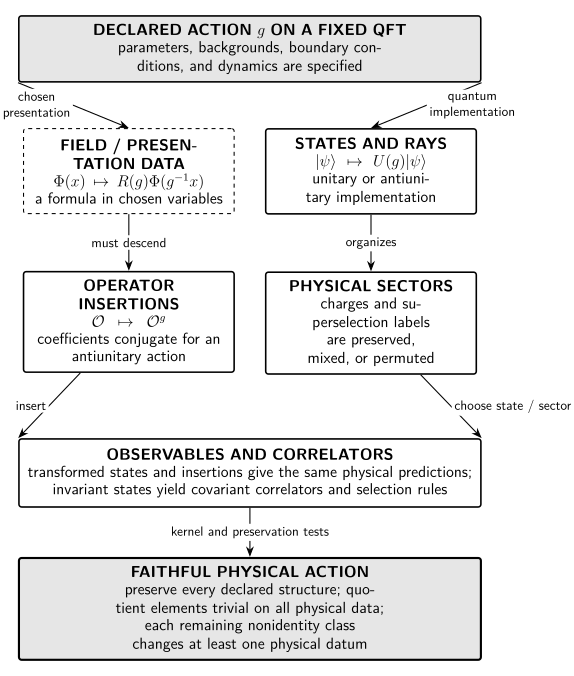
A field substitution is not yet a physical symmetry. A declared action must preserve the fixed theory, act consistently on states or rays and operator insertions, and hence on sectors, observables, and correlators; quotienting the elements trivial on all physical data produces the faithful action. The diagram is schematic and not to scale.
The dashed branch is presentation-dependent: a substitution of fields must descend to well-defined operator insertions. The state branch records the unitary or antiunitary implementation and its action on sectors. Together they determine correlator covariance and physical predictions. A gauge transformation differs at the last step because declared redundant representatives are already identified in the physical state space; a duality instead needs a complete dictionary between the two sets of data.
Global symmetry acts on physical data
Section titled “Global symmetry acts on physical data”For a global symmetry , there is an automorphism
at fixed . It preserves transition probabilities, operator products, locality, the dynamics, and the allowed sector structure, but it is not the identity on all physical data. It may mix symmetry-related states, move an operator within a multiplet, or map one vacuum to another. A common phase on a single state vector is not by itself evidence of a physical action, because the vector and its phase represent the same ray.
The phrase “at fixed ” matters. If the proposed transformation sends to a different value, it acts on a family of theories. It is an exact symmetry of a particular member only when that parameter value is fixed by the transformation.
Gauge redundancy is quotiented
Section titled “Gauge redundancy is quotiented”Gauge variables contain more information than the physical configuration. If is a space of field configurations and is the group of transformations declared redundant, the physical configuration is represented schematically by an orbit in
Thus and for are two representatives of one physical point. A gauge-dependent field may change, while every well-defined physical observable agrees. In canonical language the corresponding transformations are generated by constraints; in a functional integral they require quotienting or gauge fixing. Those constructions come later.
The quotient notation is deliberately schematic. The redundancy subgroup is part of the theory’s definition; it is not determined by the local field formula alone. This page does not classify transformations when boundaries, falloff conditions, or nontrivial topology matter. Gauge Fields, Redundancy, and Observable Content owns that global analysis. Schwartz’s scalar and electromagnetic examples make the local redundancy and degree-of-freedom issue concrete in Schwartz 2014, §§ 8.3–8.6, pp. 120–132.
Duality needs a complete dictionary
Section titled “Duality needs a complete dictionary”A duality is not normally an operation within one displayed set of variables. It is an equivalence map
together with a parameter map . The dictionary must say what happens to the objects relevant to the claim: states and spectra, local and extended operators, correlation functions, partition functions, symmetries, deformations, sectors, boundaries, and global form. An exact duality claims equivalence of the full specified theories; an infrared duality claims equivalence only after an RG limit and therefore need not match microscopic variables.
Matching one protected quantity or a few low-energy observables can support a proposed duality, but it is not the definition of one. The map must also be invertible on the data it claims to preserve. In particular, global symmetries must map consistently even when their actions look different in the two Lagrangians, as emphasized in Gaiotto et al. 2015, § 1, pp. 2–5.
A self-duality has after the parameter map. At a fixed point of that map it may induce a physical symmetry, sometimes one that acts nonlocally on the original variables. Calling it both a duality and a symmetry is then meaningful only after specifying the dictionary and the fixed theory.
Spurions make a family covariant
Section titled “Spurions make a family covariant”Suppose a coupling or source explicitly breaks a transformation of the dynamical fields . At the classical level one can assign a compensating transformation so that
For this covariance to survive quantization, the measure and regulator must transform compatibly and the symmetry must be non-anomalous. Under those hypotheses it is a covariance statement about an enlarged parameter space. For a fixed theory with , the subgroup that preserves the source is the stabilizer
If denotes its action on physical data, the exact faithfully acting group is more precisely
The spurion is not a new dynamical field unless the theory is explicitly enlarged to make it one. Spurionic covariance is nevertheless useful: it organizes allowed counterterms, operator mixing, selection rules with insertions of , and the controlled form of symmetry-breaking Ward identities.
A decision procedure
Section titled “A decision procedure”Given a transformation written in field variables, ask the following questions in order.
- What is the domain? Specify the theory, parameters, sectors, boundary conditions, and physical observables.
- Are nondynamical data transformed? If so, freeze them. Subject to measure, regulator, and anomaly checks, the transformations that still fix them may be exact symmetries; quotient their physical kernel. The rest express only spurionic covariance.
- Are two complete descriptions being compared? If so, demand an invertible dictionary and a regime. That is a duality claim, not merely a symmetry check.
- Are transformed configurations identified before observables are computed? If so, the declared subgroup is gauge redundancy.
- Does the operation act nontrivially on physical data of the same fixed theory? If yes, it is a global symmetry.
A local, patchwise invertible field redefinition usually answers none of these questions by itself. It is a change of coordinates on the same description only when its domain, functional measure and Jacobian, and regulator are transformed consistently. It can be one entry in a duality dictionary, but relabeling variables does not establish a duality.
Worked complex-scalar comparison
Section titled “Worked complex-scalar comparison”Start with a charge-one complex scalar and an integer ,
The four-way test separates transformations that otherwise look deceptively similar.
Global . With no charged source fixed, acts on charged operators and sectors while preserving the theory. It is a physical global symmetry, and its subgroup is a physical symmetry.
Local gauge redundancy. Promote a connection to a dynamical field and use the site convention . Then
leaves covariant. Transformations in the declared redundancy subgroup change the representative , not the physical point. Whether transformations with nontrivial boundary behavior remain redundant is a separate global question.
Spurionic . Add
Assigning makes the classical family covariant. With a -preserving measure and regulator and no anomaly, fixed nonzero has stabilizer . Because the charge-one action is faithful, the exact physical group is then .
Not yet a duality. Rewriting is only a patchwise field redefinition: is periodic, the coordinates are singular at , and the functional measure carries the corresponding Jacobian. Where the map is valid and the measure and regulator are transformed consistently, it has still not produced a second theory, a parameter map, or an operator-and-sector dictionary. Conversely, matching the complex scalar to a genuinely different description would be a duality claim only after those data and its regime were supplied. This negative test prevents a convenient change of variables from being promoted into an unsupported equivalence.
Common confusions
Section titled “Common confusions”Gauge fixing breaks the visible redundancy, not necessarily the gauge theory. A gauge-fixed action need not be invariant under the original local transformation. The physical test is independence of admissible gauge choices after the correct constraints, measure, and quantum identities are included.
A global subgroup of a gauge transformation needs a global specification. Constant-looking transformations cannot be classified from their local formula alone. State the allowed falloff and boundary conditions, then use the criteria developed in Gauge Fields, Redundancy, and Observable Content.
A spurion does not restore a broken charge. It restores covariance of the source-dependent description. The fixed-source theory has only the source stabilizer as an exact symmetry.
Partial matching is not a complete duality. Agreement of anomalies, a partition function, or a protected sector is evidence of a proposed equivalence, not automatically equivalence of the full QFT.
Check your understanding
Section titled “Check your understanding”Classify these four operations in the scalar example: (a) a constant phase at ; (b) a local phase accompanied by the dynamical transformation; (c) a constant phase accompanied by ; and (d) the local change from Cartesian fields to .
Check
(a) is a global symmetry. (b) is gauge redundancy for transformations included in the declared gauge group, subject to boundary qualifications. (c) is spurionic covariance; under the quantum-consistency assumptions above, fixed nonzero leaves the faithful symmetry. (d) is a field redefinition only on its valid patch and after its measure, Jacobian, and regulator are treated consistently; it is not a duality. None of these labels follows from the field formula alone; each uses the surrounding physical definition.
What to carry forward
Section titled “What to carry forward”The shortest robust diagnostic is: symmetries act, redundancies are quotiented, dualities translate, and spurions transform nondynamical data. Every word is conditional on a declared theory, domain, and boundary condition.
The next detailed treatments have separate responsibilities:
- Gauge Fields, Redundancy, and Observable Content constructs the gauge quotient, observables, and local/global qualifications.
- Background Fields versus Dynamical Gauging explains when a source is merely prescribed and when it is integrated over.
- Duality Claims, Dictionaries, Regimes, and Evidence owns developed duality dictionaries and evidence ceilings.
- Internal, Spacetime, Discrete, and Antiunitary Symmetries continues the classification of physical symmetry actions.
References
Section titled “References”Original QFT.org content:CC BY 4.0, unless an item supplies different terms. Third-party material retains its own terms.