

Symmetry, Actions, and Redundancy
Use this chapter when the first difficulty is not calculating a current but deciding what the proposed transformation actually is. The central questions are: What physical data does it act on? What does it preserve? Which elements act trivially? Is the map a global symmetry, a gauge redundancy, a duality, or only a covariance of a family of theories? Once those questions are settled, the chapter classifies ordinary symmetry types, organizes states and operators into multiplets, and explains when the quantum implementation is projective.
The five pages form a diagnostic sequence rather than a compulsory linear course. Everyone should begin with the operational definition. From there, choose the branch matching the problem: redundancy and duality, symmetry type, multiplets and selection rules, or projective implementation. Currents, gauging, spontaneous breaking, anomalies, and generalized symmetry are later developments.
Helpful background. Groups, Actions, Quotients, and Covers supplies the action, kernel, quotient, and cover language used throughout. This mathematical page is required before entering the chapter’s operational-definition leaf.
Parent volume. Symmetry and Gauge Structure
Choose by the question you need to answer
Section titled “Choose by the question you need to answer”| Reader question | Route | Capability at the end |
|---|---|---|
| What must an exact QFT symmetry preserve? | Groups and Actions What Is a Symmetry of a QFT? | Identify the action on states, operators, observables, sectors, and correlators, then remove its physical kernel |
| Is this map a symmetry, gauge transformation, duality, or spurionic covariance? | What Is a Symmetry Symmetry, Gauge Redundancy, and Duality | Classify the transformation by what it relates and whether it acts on physical data |
| Is the symmetry internal or spacetime, continuous or discrete, unitary or antiunitary? | What Is a Symmetry Internal, Spacetime, Discrete, and Antiunitary Symmetries | Keep independent classification axes separate and treat antiunitary conjugation correctly |
| Which states, operators, correlators, or couplings are allowed? | What Is a Symmetry + Representations and Intertwiners Multiplets, Invariants, and Selection Rules | Build invariant tensors and test whether a singlet occurs |
| Does the symmetry act only on rays, or does its algebra have a central term? | What Is a Symmetry + Representations Quantum Implementations, Projective Actions, and Central Extensions | Compute multipliers, rephasing classes, lifts, and central extensions without calling every projective action anomalous |
The sidebar order places the broad taxonomy before the diagnostic page, but their hard prerequisites permit either branch after the operational definition. The projective and multiplet pages additionally require representation theory; they are not introductory substitutes for it.
A transformation is not yet a symmetry
Section titled “A transformation is not yet a symmetry”A proposed map becomes a physical symmetry only after four pieces of data have been supplied:
- the physical states, operators, observables, sectors, and backgrounds on which it acts;
- the dynamics and physical structures it preserves;
- the kernel of elements acting trivially on every physical datum;
- the quantum implementation, including whether it is unitary, antiunitary, or projective.
The map below follows those declarations from a field formula and a state-space implementation to the physical data that can detect the action. The dashed box is intentionally only a presentation: inspect how it must descend to operator insertions before the final faithfulness test is made.
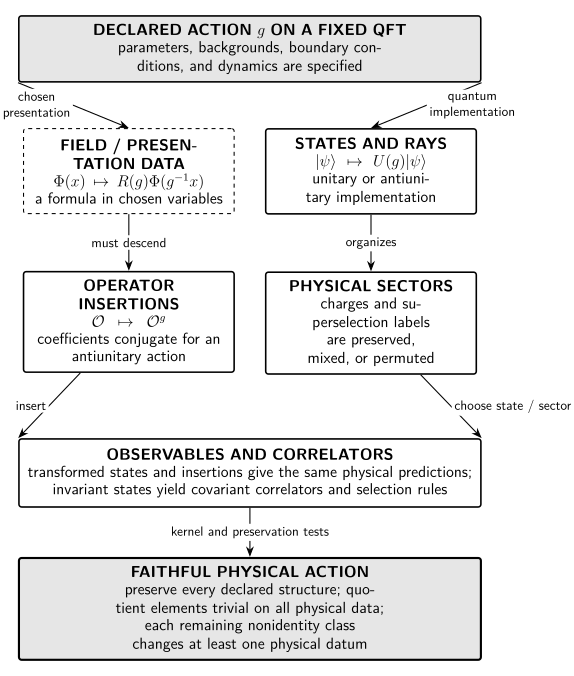
A field substitution is not yet a physical symmetry. A declared action must preserve the fixed theory, act consistently on states or rays and operator insertions, and hence on sectors, observables, and correlators; quotienting the elements trivial on all physical data produces the faithful action. The diagram is schematic and not to scale.
The left branch starts with chosen field variables and reaches physical operator insertions only when the transformation is well defined on the theory. The right branch records the unitary or antiunitary action on rays and the resulting permutation or mixing of sectors. Their joint consequence is covariance of correlators and invariance of physical predictions. An element belongs to the kernel only when every physical branch is trivial, not merely because one displayed field or one state ray is unchanged.
Preservation of a displayed Lagrangian is useful evidence, but it is neither necessary nor sufficient by itself. Field redefinitions can obscure an exact symmetry, regulator or measure effects can spoil a classical one, and a transformation of fixed couplings can relate different theories rather than preserve one theory. The transition-probability starting point and quantum implementation are developed in Weinberg 1995, § 2.2, pp. 50–55; the operator and topological-defect formulation is summarized in Gaiotto et al. 2015, § 2, pp. 5–7, arXiv PDF.
The quickest classification test is operational:
| Candidate map | What it does | Decisive question |
|---|---|---|
| Global symmetry | Acts nontrivially on physical data while preserving the theory | Which observable, state, or sector detects the action? |
| Gauge redundancy | Changes a representative but not the physical configuration | Are the two representatives identified in the physical state space? |
| Duality | Gives an equivalence with a dictionary between complete descriptions or theories | What maps operators, parameters, sectors, and observables in both directions? |
| Spurionic covariance | Transforms fields together with couplings or sources | Is one fixed theory preserved, or only a family parametrized by transformed data? |
This table diagnoses the role of the transformation; it does not yet establish a conserved current, a gauge path integral, or a nonperturbative duality.
How the five pages fit together
Section titled “How the five pages fit together”Operational action. What Is a Symmetry of a QFT? defines the acted-on physical data and the faithful quotient . It is the required starting point for every other page in the chapter.
Independent classification axes. Internal, Spacetime, Discrete, and Antiunitary Symmetries separates what a symmetry moves from the topology of its group and the linear or antilinear nature of its implementation. “Discrete,” “spacetime,” and “antiunitary” answer different questions.
Physical versus descriptive maps. Symmetry, Gauge Redundancy, and Duality turns the opening definition into a decision procedure. It also explains why transforming a coupling as a spurion does not prove that the fixed-coupling theory has the larger symmetry.
Consequences of a representation. Multiplets, Invariants, and Selection Rules converts the action into testable restrictions. Tensor products must contain a singlet for an invariant correlator or coupling to be allowed; the page supplies both continuous and finite-group checks. This criterion assumes an exact, unbroken unitary internal symmetry and an invariant state. A singlet permits a nonzero structure but does not force one.
Quantum implementation. Quantum Implementations, Projective Actions, and Central Extensions distinguishes a ray representation from an ordinary representation, tracks its two-cocycle under rephasing, and explains the corresponding central extension. It also keeps that datum separate from a QFT anomaly.
One scalar, five diagnostics
Section titled “One scalar, five diagnostics”The complex scalar provides a single thread through the chapter. Its charge-one action
first tests what it means for to act faithfully on physical data. Adding a fixed nonzero interaction
reduces the phase-rotation symmetry to its subgroup, while transforming as a spurion makes a family of theories covariant without restoring the full to that fixed theory. Whether an additional reflection survives depends on the complete action.
The same example then serves four different jobs:
- charge conjugation, parity, and time reversal test the symmetry taxonomy;
- invariant tensor products give charge-selection rules modulo ;
- the symmetry-versus-redundancy page keeps the physical action distinct from a gauge identification or dual description;
- the unitary cyclic subgroup supplies a negative test: its projective multiplier can be removed, so nontrivial projectivity must come from different group or antiunitary data.
Later chapters localize the continuous phase transformation to obtain currents and Ward identities, couple its current to background fields, and study what changes when a subgroup is gauged. Those operations should not be read backward into the opening definition.
Boundaries and canonical exits
Section titled “Boundaries and canonical exits”This chapter treats the ordinary action and its immediate representation consequences. It intentionally stops at the following boundaries:
- For infinitesimal generators, currents, charges, and contact terms, continue to Currents, Charges, and Quantum Ward Identities.
- For gauge orbits, Gauss constraints, global form, and observable dressings, continue to Gauge Fields, Redundancy, and Observable Content.
- To distinguish a fixed background probe from construction of a new gauge theory, use Background Fields versus Dynamical Gauging.
- For the criterion that prevents gauging or preserving a classical symmetry, use What Is an Anomaly?.
- For a developed duality claim with explicit dictionaries and regimes, use Duality Claims, Dictionaries, Regimes, and Evidence.
- For conformal generators and their action on local operators, use The Conformal Algebra and Its Generators.
- For theorem-first sector selection and reconstruction, continue to Sector Selection, Localization, and Transportability and then Superselection Sectors and DHR Reconstruction.
Check your preparation
Section titled “Check your preparation”Action and kernel. Given and an action , name the physical data being transformed and compute which elements act trivially. If that cannot be done, begin with What Is a Symmetry of a QFT?.
Role of the map. Given two field configurations or two Lagrangians, state whether the proposed map relates physical states, gauge representatives, complete descriptions, or different coupling values. If the answer depends only on visual invariance of one formula, use Symmetry, Gauge Redundancy, and Duality.
Invariant test. Given representations , determine whether contains a singlet. If not, the corresponding invariant tensor vanishes. Repair with Multiplets, Invariants, and Selection Rules.
Implementation test. Given operators satisfying , check whether a rephasing removes before calling the action intrinsically projective. Repair with Quantum Implementations, Projective Actions, and Central Extensions.
Continue from here
Section titled “Continue from here”For the shortest core route, read What Is a Symmetry of a QFT?, then Symmetry, Gauge Redundancy, and Duality, and continue to Continuous Symmetries, Generators, and Charges. Add the taxonomy, multiplet, or projective branch only when the physical question needs it.
References
Section titled “References”Original QFT.org content:CC BY 4.0, unless an item supplies different terms. Third-party material retains its own terms.