

Wess–Zumino Consistency and Descent
The Wess–Zumino condition is the statement that an anomalous variation must still realize the algebra of the symmetry transformations. For a consistent anomaly—one obtained from a single effective action—this condition is forced by the commutator of two variations. In BRST language it becomes a ghost-number-one cocycle condition. Descent then turns a closed invariant characteristic form in two higher degrees into a local consistent anomaly representative in the physical dimension.
This page develops that local perturbative chain with all form degrees, ghost numbers, and signs explicit. The characteristic polynomial is a universal or formal degree- object, not an ordinary nonzero -form on the physical -manifold. Chern–Simons and descent forms are local representatives; boundaries, nontrivial bundles, large transformations, and torsion require additional data.
Required background. What Is an Anomaly? supplies the counterterm quotient and the distinction between gauge and background anomalies. Differential Forms, Integration, Orientation, and Stokes Theorem supplies graded products, pullbacks, and Stokes’ theorem. de Rham Cohomology, Periods, Duality, and Intersection supplies closed-versus-exact reasoning and the global warning behind local primitives.
Helpful background. BRST Cohomology and Physical Observables supplies kernel-modulo-image reasoning and relative local cohomology. Characteristic Classes and Chern–Weil Theory supplies invariant polynomials and characteristic-form normalization.
Closure of gauge variations is the consistency condition
Section titled “Closure of gauge variations is the consistency condition”Let be a Euclidean effective action for a Hermitian matrix-valued background connection. Absorb couplings and charges into and define
All products of forms below are wedge products. In this convention the commutator of two infinitesimal transformations closes as
Define the integrated consistent anomaly functional by
Applying the commutator to the same functional gives
This is the Wess–Zumino consistency condition. It is an integrability condition: the anomalous Ward identity may fail, but its failure cannot violate the algebra obeyed by the transformations themselves. The original condition appears in Wess and Zumino 1971, pp. 95–97; a direct effective-action derivation with the gauge-algebra signs displayed is given in Bilal 2008, § 9.1, arXiv v1, pp. 70–71, eqs. (9.2)–(9.9), Open PDF.
The equation is necessary, not sufficient. A local expression can satisfy it even when its coefficient vanishes in the actual matter spectrum, and a solution can be removable by an admissible local counterterm. Conversely, the covariant current from the previous page is generally not a functional derivative of one and need not obey the non-Abelian Wess–Zumino condition. For an Abelian group the right-hand side vanishes, but the two variations must still commute. For the gauge-invariant -type densities used below, each variation vanishes separately and the condition is automatic.
BRST turns the algebra into a local cocycle equation
Section titled “BRST turns the algebra into a local cocycle equation”Replace the even parameter by an odd ghost and use a left BRST differential of ghost number one:
On coefficient-valued forms, use the component convention inherited from the BRST prerequisite:
Thus commutes with coordinate derivatives; no unspoken total-degree sign is being used. The ghost rule is precisely what encodes the commutator term in the Wess–Zumino equation. Replacing by turns that equation into
To see the equivalence directly, introduce independent odd numbers and set
The coefficient of in is exactly the Wess–Zumino residual. At the density level that residual can be a total derivative:
The integrated equality follows only when the surface term vanishes or is included in the problem.
An integrated local anomaly on a -manifold has the form
where the superscript is ghost number and the subscript is form degree. At the density level, closure is only required modulo a total derivative:
Two representatives define the same local class when
The term is the variation of a local counterterm; the term integrates away only on a closed manifold or under stated support or boundary conditions. With those hypotheses, genuine local anomaly candidates lie in the relative cohomology
This statement is local: it uses a local algebra of fields, ghosts, and a finite number of derivatives. Its precise cohomological formulation and counterterm equivalence are developed in Barnich, Brandt, and Henneaux 2000, §§ 2.2–2.3, arXiv v3, pp. 7–11, especially eq. (2.23), Open PDF. The simpler BRST conversion of the Wess–Zumino condition appears in Bilal 2008, § 9.2, arXiv v1, pp. 71–73, eqs. (9.10)–(9.15), Open PDF.
Characteristic forms generate a descent staircase
Section titled “Characteristic forms generate a descent staircase”Let be an invariant closed characteristic polynomial of total form degree . On a local trivialization, the Poincaré lemma provides a Chern–Simons primitive . Successive BRST variations produce the descent equations. We choose the sign convention
with . The minus sign in the final displayed equation fixes the otherwise conventional sign of and puts the result directly in the standard relative-cocycle form . The first descendant is the consistent anomaly form; the next equation is its local Wess–Zumino consistency relation.
For an invariant polynomial
a useful local transgression in the present Hermitian convention is
Direct differentiation gives . This construction and the first descendant are derived in Bilal 2008, §§ 8.3.2–8.3.3, arXiv v1, pp. 66–69, eqs. (8.50)–(8.74), Open PDF. The local-contractibility assumption behind a full descent tower is made explicit in Barnich, Brandt, and Henneaux 2000, §§ 9.1–9.2, arXiv v3, pp. 70–72, eqs. (9.1)–(9.4), Open PDF. A primary geometric account, including the local-versus-global qualification, is Zumino 1983/1984, §§ 2–4, LBL-16747, printed pp. 7–29, Open PDF; the higher-dimensional construction is also developed in Zumino, Wu, and Zee 1984, pp. 477–507.
The diagram organizes the case by bidegree. Read downward: each BRST variation is, up to the displayed sign, an exterior derivative of the next descendant. Read the dashed side branch only as the orientation for the next page: a five-dimensional bulk term can cancel the four-dimensional boundary variation only after its global definition, extension, and boundary data have been supplied.
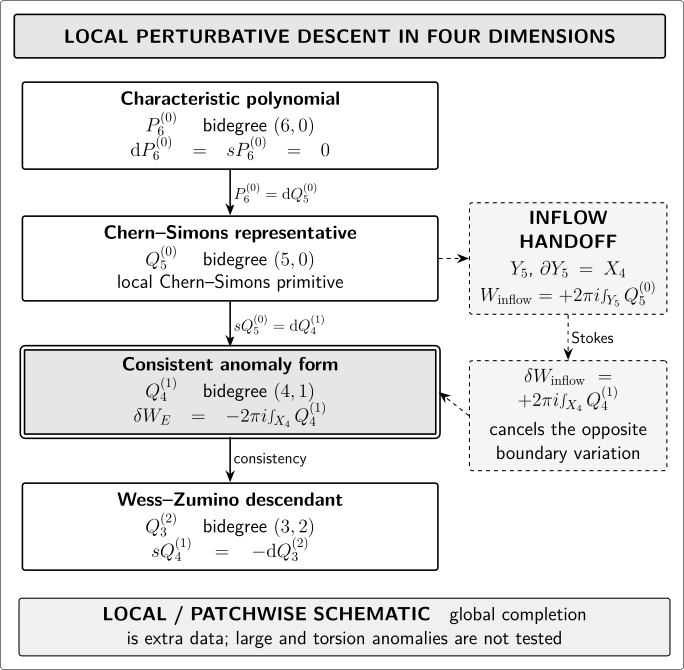
Local descent by form degree and ghost number. Solid relations are the local equations , , and . The dashed inflow branch is schematic: it requires a globally defined bulk or differential-cohomological completion and does not test large or torsion anomalies.
The same relationships remain available without the image:
| Object | Bidegree (form, ghost) | Role | Defining local relation |
|---|---|---|---|
| P₆ | (6, 0) | Invariant universal characteristic polynomial | dP₆ = sP₆ = 0 |
| Q₅⁽⁰⁾ | (5, 0) | Local Chern–Simons representative | P₆ = dQ₅⁽⁰⁾ |
| Q₄⁽¹⁾ | (4, 1) | Consistent anomaly form | sQ₅⁽⁰⁾ = dQ₄⁽¹⁾ |
| Q₃⁽²⁾ | (3, 2) | Wess–Zumino consistency descendant | sQ₄⁽¹⁾ = −dQ₃⁽²⁾ |
The dashed branch has the following exact text equivalent. If a globally admissible completion exists on with induced boundary , the local inflow orientation is
The second line cancels a boundary variation . This is only the local infinitesimal sign check; it does not establish that the exponentiated bulk term is globally defined or extension-independent.
The figure is a local schematic, not a claim that the Chern–Simons form is globally defined. On overlaps of trivializations its representatives differ by further descent data. Differential-cohomological refinement belongs to the mathematical continuation named below.
A four-dimensional Weyl fermion fixes the normalization
Section titled “A four-dimensional Weyl fermion fixes the normalization”Now take a closed oriented Euclidean spin four-manifold and one physical Lorentzian left-handed Weyl fermion. Under the site’s Wick continuation it has negative Euclidean chirality. For a representation , the universal six-form is
Here is a formal characteristic polynomial, equivalently a degree-six class evaluated after pullback to suitable auxiliary or family data. It is not an ordinary nonzero six-form on . The mixed term is written in the representative that preserves diffeomorphism and local-Lorentz covariance and places the mixed violation in the gauge Ward identity.
A local Chern–Simons representative is
Its first descendant can be chosen as
Thus
Multiplying by reproduces exactly the consistent four-form convention on the preceding Consistent and Covariant Anomalies page. The degree-six index normalization and chirality reversal follow from Álvarez-Gaumé and Vázquez-Mozo 2024, §§ 2–3, arXiv v2, pp. 4–8 and 10, eqs. (4)–(11), (17)–(19), and (22), Open PDF. The four-dimensional consistent descendant is worked out in Bilal 2008, §§ 9.3–9.4, arXiv v1, pp. 73–78, eqs. (9.16)–(9.41), Open PDF, after translating from Bilal’s anti-Hermitian connection and opposite chirality naming.
Abelian gauge and gravitational backgrounds
Section titled “Abelian gauge and gravitational backgrounds”For one compact charge , write and let locally. The curvature is global even when the potential is not. Set
On a trivializing patch, introduce an Abelian ghost with and . Then
and one especially transparent descent is
Because the bracketed four-form is closed,
The effective-action variation is therefore
This calculation separates two jobs. The index polynomial fixes the coefficient, including the chirality sign. Descent fixes the consistent local representative and its Wess–Zumino completion. Descent alone cannot predict whether the sum over a particular fermion spectrum vanishes. Opposite chirality flips the entire expression. The term proportional to is a mixed gauge–gravity anomaly; four-dimensional spin- fields have no perturbative pure gravitational anomaly.
Representative shifts, boundaries, and global limits
Section titled “Representative shifts, boundaries, and global limits”The descent representative is not unique. At ghost number one and form degree ,
The first term is generated by the local counterterm
It changes the representative but not a nontrivial class. In particular, if , the opposite counterterm cancels the anomaly on a closed , provided the counterterm is globally defined and admissible. The second term does not change the integrated anomaly on a closed , but on a manifold with boundary
Likewise, the next descent equation gives
Therefore the ordinary integrated Wess–Zumino condition requires a closed manifold, compact support or falloff, boundary conditions that kill the surface term, or an enlarged boundary/inflow system. A transformation that changes the prescribed boundary data is not automatically a gauge redundancy of the same problem; a boundary-nonzero transformation may carry a charge. The support assumption used in the standard local derivation is stated explicitly in Bilal 2008, opening of § 9, arXiv v1, p. 69, eq. (9.1), Open PDF. A Maxwell example in which only boundary-vanishing transformations are quotiented while nonzero boundary values generate charges is given in Harlow and Wu 2020, Introduction and § 3.3, arXiv v4, pp. 1–3 and 26–27, eqs. (3.18)–(3.25), Open PDF.
Three further limits matter:
-
A Chern–Simons form such as is generally only local on a nontrivial bundle. Its patching, periods, and exponentiation require global information.
-
Relative local cohomology detects infinitesimal, perturbative anomaly data. It does not by itself detect large-gauge phases, determinant-line holonomy, torsion, or dependence on the global form of the symmetry group.
-
The descent of an invariant polynomial supplies an important family of cocycles, but a full classification depends on the chosen local complex, spacetime dimension, gauge algebra, Abelian factors, antifields, and regularity hypotheses. It is not a universal replacement for computing .
The first two limits motivate Anomaly Polynomials and Inflow and Global and Torsion Anomalies. The theorem-level classification of relative local classes belongs to Local BRST Cohomology, Consistent Deformations, and Currents, while Local Anomaly Descent and Wess–Zumino Consistency develops the mathematical descent and its hypotheses. Differential- cohomological and globally refined anomaly data are taken up in those mathematical and later physical continuations.
Computational companion. No runnable anomaly-descent calculation is currently available. The bidegrees, signs, and four-dimensional coefficient checks are therefore worked explicitly on this page.
What the condition does and does not prove
Section titled “What the condition does and does not prove”| Established input | Valid conclusion | Not implied |
|---|---|---|
| One effective action and a closing infinitesimal algebra | The consistent anomaly obeys Wess–Zumino consistency | The anomaly coefficient is nonzero or nonremovable |
| Nilpotency s² = 0 and the stated local domain | Ghost-number-one cocycles and coboundaries are defined | Quantum measure invariance or absence of global anomalies |
| Local Poincaré lemma and an invariant polynomial of degree d + 2 | A local Chern–Simons form and descent tower can be constructed | A globally defined primitive on every bundle |
a = s b + d n at ghost number one and top form degree |
The local representative is removable under admissible closed/support assumptions | Its boundary term is physically irrelevant on a bounded region |
| Vanishing local polynomial and trace coefficients | The associated perturbative local anomaly vanishes | Freedom from large, torsion, or other global anomalies |
Common pitfalls
Section titled “Common pitfalls”Treating as an ordinary form on four-dimensional spacetime. It is a universal or auxiliary degree-six characteristic object whose descent produces a four-dimensional anomaly. Three two-forms wedged directly on a four-manifold vanish.
Calling every Wess–Zumino solution a genuine anomaly. Consistency is a cocycle condition. The coefficient may vanish, and an exact representative may be removed by an admissible local counterterm.
Dropping total derivatives in the presence of a boundary. A -exact shift changes a boundary term. Boundary conditions, allowed transformations, edge degrees of freedom, and inflow decide whether that term is removable.
Using the covariant anomaly in descent. Descent generates the consistent effective-action representative. The covariant current is a local Bardeen–Zumino improvement and generally fails the non-Abelian Wess–Zumino condition.
Reading local descent as a global classification. Large transformations, torsion phases, global group form, and determinant-line holonomy require separate tests.
Check your understanding
Section titled “Check your understanding”- Starting from and , show that is locally exact and explain the chosen sign of .
Solution
Apply once more:
Thus is closed. On a contractible local patch, the Poincaré lemma gives . Defining yields . This local step is precisely where topology and boundary qualifications enter.
- For the Abelian example, verify all three equations , , and .
Solution
Let
Because , , , and ,
and .
- Show that a representative shift by is produced by a local counterterm, and identify what fails on a manifold with boundary for the shift.
Solution
Adding to changes its BRST variation by . This is exactly the change of the anomaly representative. By contrast,
so the second shift is invisible only when the boundary term vanishes or is accounted for by allowed boundary data.
- Explain why the Wess–Zumino condition does not distinguish the displayed consistent and covariant Abelian representatives.
Solution
For , , and the displayed curvature-only densities are themselves invariant under Abelian gauge transformations. Thus both sides of the consistency equation vanish. This does not make the condition empty for an arbitrary Abelian candidate; it means that these two particular representatives are not distinguished by it. Their distinction is instead functional integrability: the consistent current is a derivative of one effective action, whereas the covariant current generally has a nonzero functional curl.
- A spectrum has vanishing local cubic and linear anomaly coefficients. What has and has not been established?
Solution
The perturbative local gauge and mixed gauge–gravity anomaly polynomial associated with those coefficients vanishes. Nothing in that calculation tests large transformations, torsion phases, the global form of the group, boundary consistency, or other nonperturbative anomaly data.
References
Section titled “References”-
Álvarez-Gaumé, Luis, and Miguel Á. Vázquez-Mozo. “Anomalies and the Green–Schwarz Mechanism.” In Handbook of Quantum Gravity, edited by Cosimo Bambi, Leonardo Modesto, and Ilya L. Shapiro, 2241–2284. Singapore: Springer, 2024. DOI. Open PDF, arXiv v2.
-
Barnich, Glenn, Friedemann Brandt, and Marc Henneaux. “Local BRST Cohomology in Gauge Theories.” Physics Reports 338, no. 5 (2000): 439–569. DOI. Open PDF, arXiv v3.
-
Bilal, Adel. “Lectures on Anomalies.” LPTENS-08/05, arXiv:0802.0634v1 [hep-th], 2008. Stable record. Open PDF, arXiv v1.
-
Harlow, Daniel, and Jie-qiang Wu. “Covariant Phase Space with Boundaries.” Journal of High Energy Physics 2020, no. 10 (2020): 146. DOI. Open PDF, arXiv v4.
-
Wess, Julius, and Bruno Zumino. “Consequences of Anomalous Ward Identities.” Physics Letters B 37, no. 1 (1971): 95–97. DOI.
-
Zumino, Bruno. “Chiral Anomalies and Differential Geometry.” In Relativity, Groups and Topology II, edited by Bryce S. DeWitt and Raymond Stora, 1291–1322. Amsterdam: North-Holland, 1984. Open report LBL-16747/UCB-PTH-83/16.
-
Zumino, Bruno, Yong-Shi Wu, and Anthony Zee. “Chiral Anomalies, Higher Dimensions, and Differential Geometry.” Nuclear Physics B 239, no. 2 (1984): 477–507. DOI.
Original QFT.org content:CC BY 4.0, unless an item supplies different terms. Third-party material retains its own terms.