

Anomaly and Generalized-Symmetry Constraints on Infrared Phases
An ’t Hooft anomaly is an exact obstruction to gauging a declared global symmetry—or, equivalently, to coupling it to arbitrary background fields while preserving background-gauge invariance—by any choice of allowed local counterterms. Because the obstruction is unchanged along renormalization-group flow, it rules out infrared phases that cannot reproduce it. It does not, by itself, choose among all phases that can. The practical task is therefore to specify the symmetry and its backgrounds precisely, compute the obstruction modulo allowed counterterms, and test every proposed infrared realization against that same data.
Required background. ’t Hooft anomaly matching supplies the obstruction and inflow language, breaking higher-form symmetry and diagnosing phases supplies the extended-operator diagnostics, and theta terms, periodicity, and vacuum sectors supplies the global counterterm data.
Helpful background. Theta dependence, CP, and model-dependent branches gives the branch interpretation used in the Yang–Mills example.
Shared comparison. The sector and periodicity comparison supplies the global-form and theta-period inputs, while the exact and rigorous status comparison separates the exact anomaly obstruction from model-dependent infrared inference and open phase-selection questions.
Background fields expose the obstruction
Section titled “Background fields expose the obstruction”Let denote the full global symmetry, including any higher-form factors, and let denote its background fields. A symmetry transformation can act on the partition function as
The phase is meaningful only modulo the variation of a local -dimensional counterterm. An ’t Hooft anomaly is the equivalence class that remains after every counterterm allowed by locality, quantization, the global form of , and the spacetime structure has been considered. Often it is represented by inflow from a -dimensional invertible action.
Generalized symmetries enlarge both sides of this statement. A -form symmetry couples to a -form background, and its charged observables are extended rather than local. Gaiotto, Kapustin, Seiberg, and Willett formulate these symmetries and their anomalies systematically in Gaiotto et al. 2015, §§ 1, 3, and 7. A current pedagogical treatment of higher-form symmetry, spontaneous breaking, discrete gauging, and the Yang–Mills time-reversal/center anomaly is Brennan and Hong 2023, §§ 2.2–2.5 and 3.3–3.7.
Three specifications are indispensable before drawing an infrared conclusion:
- the faithful symmetry group, including quotients and higher-group extensions;
- the admissible background bundles, defects, and spin or orientation structure;
- the set of quantized local counterterms regarded as changes of scheme.
Changing any of them can change the anomaly question. A Lie algebra or an action on perturbative local fields is not enough.
Matching is an exclusion test
Section titled “Matching is an exclusion test”Renormalization-group flow cannot change the anomaly class, so the infrared generating functional must have the same response:
The brackets are essential: equality is modulo allowed local counterterms. The main infrared mechanisms are:
| Infrared realization | How the anomaly is reproduced | What must be checked |
|---|---|---|
| Spontaneous symmetry breaking | Distinct vacua are permuted; a low-energy order-parameter action or domain-wall inflow carries the response | The broken subgroup, vacuum multiplicity, defects, and residual anomaly |
| Gapless degrees of freedom | Massless fields or a conformal theory have anomalous currents or background dependence | The full anomaly coefficients and faithful symmetry action, not only a matching central charge |
| Topological order or a TQFT | Long-range entanglement and topological operators furnish the anomalous response | Genuine operator spectrum, symmetry fractionalization, and coupling to the same backgrounds |
| Symmetry extension or emergent gauge structure | The obstruction becomes trivial only after enlarging the infrared structure | Whether the extension is dynamical and whether the original symmetry is recovered faithfully |
| Boundary of a higher-dimensional bulk | Bulk inflow cancels the boundary variation | That the proposed system really includes the bulk; this is not a stand-alone -dimensional realization |
A unique, trivially gapped, symmetry-preserving vacuum has no nontrivial long-distance response and therefore cannot match a nonzero anomaly. Excluding that one option is powerful, but the table makes clear why the anomaly rarely selects a unique replacement.
The logic is summarized in the figure. Read it from the declared ultraviolet data to the obstruction, then across the parallel infrared alternatives; the branches are possibilities, not a dynamical decision tree.
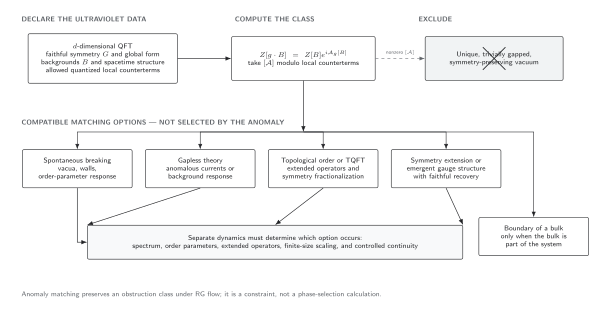
Anomaly matching constrains the infrared without solving it. Every surviving option must reproduce the same counterterm-equivalence class under the stated global-form and spacetime assumptions; the schematic is not a claim that all options occur in one model.
A reusable constraint audit
Section titled “A reusable constraint audit”For a proposed infrared phase, run the following steps in order.
- Name the faithful symmetry. Quotient any subgroup acting trivially and include higher-form factors or higher-group extensions.
- Specify the backgrounds. State the admissible bundles, defects, orientation or spin structure, and boundary conditions.
- List allowed counterterms. Quantization matters; an expression that is local but not globally well defined is not an allowed scheme change.
- Compute the equivalence class. Transform the regulated generating functional and reduce the result modulo those counterterms.
- Test, then select. Reject infrared proposals that cannot reproduce the class. Among the survivors, use spectra, order parameters, extended operators, finite-size scaling, or another controlled dynamical calculation to determine what actually occurs.
Stopping after step 4 gives a constraint. Skipping directly from step 4 to a favored phase mechanism is the characteristic overclaim this page is designed to prevent.
CP and center symmetry at theta equal to pi
Section titled “CP and center symmetry at theta equal to pi”Consider four-dimensional pure Yang–Mills theory with no matter that screens its electric one-form symmetry. Take to be a closed oriented four-manifold without boundary; no spin structure is assumed in the convention that follows. Couple the one-form symmetry to and normalize its Pontryagin square so that is valued modulo . The counterterm contributes the phase
Equivalently, is defined only modulo . Gauge invariance requires to be even: for even , every integral is allowed, while for odd , is restricted to even values. On a spin manifold some counterterms become identified differently, so the quantization must be recomputed rather than silently copied from this general-oriented convention. At , CP first sends to and the return to uses a shift. In the background that shift changes the counterterm, so CP acts by
For even , the fixed-point equation has no solution because its left side is even and its right side is odd. No allowed counterterm preserves both CP and the one-form symmetry at : this is the direct mixed anomaly. For odd , an allowed even fixed point exists at , so there is no such local anomaly there. At , however, CP acts as and the natural fixed choice is ; no single choice preserves CP at both endpoints. This is the weaker but still constraining global inconsistency. The full cochain and continuum derivations are given in Gaiotto et al. 2017, §§ 2.2–2.4.
Under these assumptions, the familiar confining proposal with unbroken center symmetry and a unique trivial gapped CP-invariant vacuum at is excluded. Several outcomes remain:
- CP can break, giving degenerate vacua whose interchange realizes the obstruction;
- the electric symmetry can break, diagnosed by a perimeter rather than area law for genuine center-charged Wilson loops; this abandons the confining, unbroken-center premise and the resulting phase must still match the anomaly;
- the theory can become gapless at the special theta value;
- a nontrivial topological sector can remain in the infrared;
- an intervening transition can invalidate an assumed smooth interpolation, especially in the odd- global-inconsistency case.
The often-drawn two-branch cusp is compatible with the first option, not derived uniquely from the anomaly. If CP breaks, anomaly inflow also constrains the degrees of freedom supported by a wall between the two vacua.
Rebuild the data when the theory changes
Section titled “Rebuild the data when the theory changes”Adding matter can explicitly remove the one-form symmetry by screening Wilson lines. Changing to changes the genuine line operators, background sums, and discrete theta parameters. Working on non-spin manifolds can change counterterm quantization. Massless fermions can make the continuous theta angle redundant through an anomalous chiral rotation.
Any of these changes requires returning to the first step. It is invalid to retain the pure- anomaly conclusion after changing the very backgrounds that defined it.
The same caution applies to numerics and semiclassics. A finite-volume spectrum or a controlled compactification can provide decisive dynamical evidence for one matching option, but agreement with the anomaly is a consistency check, not proof that the same phase persists after every limit is taken.
Common pitfalls
Section titled “Common pitfalls”Naming only the Lie algebra. Anomalies depend on the global symmetry, genuine extended operators, and admissible bundles.
Treating counterterm dependence as arbitrariness. Individual response phases can change by allowed counterterms; the nontrivial equivalence class cannot.
Concluding “therefore symmetry breaking.” Symmetry breaking is one matching mechanism. Gapless or topological infrared physics may also reproduce the obstruction.
Importing the even- statement to odd . The former is a direct anomaly at ; the latter is naturally expressed as an incompatibility between counterterm choices at two theta values.
Exercises
Section titled “Exercises”Suppose a theory has a nontrivial anomaly for an unbroken symmetry . Explain why a unique trivial gapped vacuum cannot match it, and identify the missing premise if one instead proposes two degenerate vacua.
Solution
A unique trivial gapped vacuum has a local infrared generating functional. Its background variation can therefore be removed by a local counterterm, so its anomaly class is zero. This contradicts the nonzero ultraviolet class. Two degenerate vacua can match the anomaly only if acts on the vacuum set and the associated walls or low-energy action reproduce the required background phase; degeneracy by itself is insufficient.
Let be shifted by the variation of an allowed local counterterm . Show that whether the anomaly class is trivial is unchanged.
Solution
After adding , the transformed partition function acquires
Thus and are representatives of the same equivalence class. If one can be removed by an allowed counterterm, so can the other; if neither can, the obstruction remains.
Apply the counterterm map to and . In each case, decide whether has a direct anomaly and compare its CP-preserving counterterm with the one at .
Solution
For , is defined modulo and a fixed point would obey , which has no solution. The theory therefore has the direct mixed CP/center anomaly at .
For , allowed values are even modulo . The fixed-point equation is , and the allowed solution is . Thus CP can be preserved at . At , the fixed choice is , so one regulator choice cannot preserve CP at both points: the obstruction is a global inconsistency rather than a direct anomaly at .
Continue from constraints to phase evidence
Section titled “Continue from constraints to phase evidence”The anomaly calculation ends with a set of allowed infrared responses. The Nonperturbative Gauge Dynamics research field owns dated evidence about which response is realized in a particular theory and regime. For theorem-level formulations of anomaly, superselection, and construction, continue to Mathematical QFT; this page does not upgrade a physics argument into a proof.
References
Section titled “References”- Brennan, T. Daniel, and Sungwoo Hong. “Introduction to Generalized Global Symmetries in QFT and Particle Physics.” arXiv:2306.00912 (2023). arXiv.
- Gaiotto, Davide, Anton Kapustin, Nathan Seiberg, and Brian Willett. “Generalized Global Symmetries.” Journal of High Energy Physics 2015, no. 2 (2015): 172. arXiv. DOI.
- Gaiotto, Davide, Anton Kapustin, Zohar Komargodski, and Nathan Seiberg. “Theta, Time Reversal, and Temperature.” Journal of High Energy Physics 2017, no. 5 (2017): 091. arXiv. DOI.
Original QFT.org content:CC BY 4.0, unless an item supplies different terms. Third-party material retains its own terms.