

Small-Circle Abelianization, Bions, and Adiabatic Continuity
On , a center-symmetric holonomy can separate non-Abelian and Abelian scales so that monopole-instantons and correlated bions become calculable. Which event generates the bosonic dual-photon potential depends on the matter zero modes: fundamental monopoles do so in deformed Yang–Mills, whereas magnetic bions lead in massless QCD(adj). Neutral bions have a different role. Extending either result to large requires a separate continuity argument.
Required background. Fractional events and caloron constituents supplies the holonomy-resolved monopoles and their fractional topological charges. Compact U(1) in 2+1 dimensions supplies the dual-photon and kink mechanism.
Helpful background. Multi-saddle sums and dilute ensembles supplies the correlated-event expansion and its quasi-zero-mode checks.
Shared comparison. The claim–evidence comparison marks the small-circle result as a controlled mechanism under explicit hypotheses.
Center symmetry creates a calculable hierarchy
Section titled “Center symmetry creates a calculable hierarchy”Take on a spatial circle with periodic boundary conditions for adjoint fermions when present. Let
have center-symmetric eigenvalues. Then the adjoint Higgs effect breaks
up to convention-dependent factors for non-nearest roots. At fixed , makes small; more uniformly in , the useful separation is . A center-breaking holonomy destroys this Abelian regime, so “small circle” alone is not enough.
There are fundamental monopole-instantons, associated with the simple and affine roots . At center symmetry each has
and the product of one event of every type has unit instanton charge. These data, including the dilute monopole ensemble and the hierarchy , are derived for center-stabilized Yang–Mills in Ünsal and Yaffe 2008, §§2–3, especially Eqs. (3.11)–(3.23).
Controlled compactification mechanism chain
Section titled “Controlled compactification mechanism chain”The figure separates three superficially similar event chains. Inspect the event inventory and zero-mode test before following an arrow to a bosonic potential.
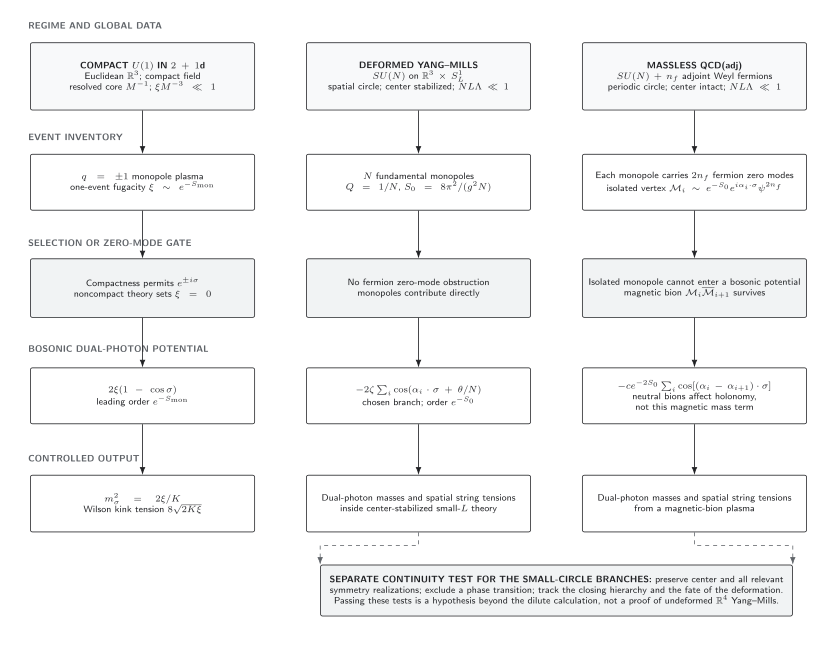
Controlled confinement mechanisms in a compact Abelian theory and in center-symmetric small-circle theories. The chains are schematic but their hypotheses and event orders are explicit; the final continuity test is not part of the semiclassical derivation and does not prove undeformed four-dimensional Yang–Mills confinement.
Deformed Yang–Mills: monopoles contribute directly
Section titled “Deformed Yang–Mills: monopoles contribute directly”In center-stabilized pure Yang–Mills, no fermion zero modes obstruct the fundamental monopole vertices. On one chosen semiclassical branch, the leading dual-photon potential has the affine-Toda form
Away from special destructive-interference points, its Hessian gives masses to the dual photons, and a Wilson loop imposes a weight-lattice discontinuity whose minimum-action interpolation has nonzero string tension; at a special theta value, subleading composite events may be required for a lifted mode. The visible does not give the microscopic theory a period: shifting by relabels the semiclassical branches, and the full branch sum or minimum is -periodic. The mechanism is the locally four-dimensional analogue of the compact- monopole plasma, but it relies on the double-trace deformation maintaining center symmetry Ünsal and Yaffe 2008, §§2.1 and 3.1–3.3.
Massless QCD(adj): zero modes force a composite event
Section titled “Massless QCD(adj): zero modes force a composite event”Now include massless adjoint Weyl fermions with periodic spatial boundary conditions. The index theorem gives fermion zero modes on each fundamental monopole. Schematically,
An isolated monopole therefore cannot appear as a purely bosonic potential term. The leading magnetically charged bosonic object is a magnetic bion, a correlated monopole–anti-monopole pair of different types,
Fermion exchange can bind the magnetically repelling constituents. The resulting operators occur at order and generate
producing a dual-photon mass and spatial string tension. The microscopic binding and bion-plasma mapping are worked through in Anber and Poppitz 2011, §§4.1–4.4.
A neutral bion instead has zero magnetic and topological charge. It affects the holonomy potential and, after a properly defined quasi-zero-mode integral, participates in semiclassical ambiguity cancellation. Because it carries no magnetic charge, it does not directly supply the dual-photon cosine responsible for confinement. Calling both composites simply “bions” erases the physical distinction.
Poppitz gives a convention-complete comparison of deformed Yang–Mills, QCD(adj), and supersymmetric Yang–Mills on the circle in Poppitz 2022, §§3–6.
Continuity is a test, not an arrow in the derivation
Section titled “Continuity is a test, not an arrow in the derivation”The semiclassical calculation is controlled while
As grows toward , the event gas ceases to be parametrically dilute and the Abelian/non-Abelian scale separation closes. To claim adiabatic continuity to a large-circle regime one must separately check:
- the same exact symmetries and anomalies on both sides;
- no intervening center, chiral, or other phase transition;
- no level crossing or new massless sector that changes the infrared realization;
- which deformation or fermion mass is held fixed and whether it is eventually removed.
For deformed Yang–Mills, absence of an order parameter separating small and large within the deformed theory motivates continuity, and large- volume independence adds a distinct statement when center symmetry remains unbroken. Neither statement removes the deformation at finite or constitutes a proof for ordinary Yang–Mills. For QCD(adj), the center may remain intact while chiral symmetry changes, so center symmetry alone cannot establish continuity.
The bounded conclusion is strong but specific: small- center-symmetric theories provide analytic continuum examples of a mass gap and linear confinement generated by identified topological events. The extrapolation beyond the controlled hierarchy is a hypothesis to be tested, not another term in the semiclassical series.
Exercises
Section titled “Exercises”1. Identify the leading event. For massless adjoint Weyl fermions, why can a fundamental monopole not generate a dual-photon mass, and at what exponential order does the magnetic-bion potential appear?
Solution
Each monopole has fermion zero modes, so its vertex contains four fermion fields and is not a bosonic potential. A correlated magnetic bion can saturate the exchanged fermions internally and has action approximately , so its bosonic potential appears at order .
2. Separate the bions. State one observable role of a magnetic bion and one of a neutral bion.
Solution
A magnetic bion carries net magnetic charge and generates a periodic dual-photon potential, hence a dual-photon mass and spatial string tension. A neutral bion carries no magnetic charge; it contributes to the holonomy potential and to the cancellation structure of semiclassical ambiguities, but not directly to the confining dual-photon cosine.
References
Section titled “References”- Anber, Mohamed M., and Erich Poppitz. “Microscopic Structure of Magnetic Bions.” Journal of High Energy Physics 2011, no. 6 (2011): 136. DOI. Open PDF.
- Poppitz, Erich. “Notes on Confinement on : From Yang–Mills, Super-Yang–Mills, and QCD(adj) to QCD(F).” Symmetry 14 (2022): 180. DOI. Open PDF.
- Ünsal, Mithat, and Laurence G. Yaffe. “Center-Stabilized Yang–Mills Theory: Confinement and Large- Volume Independence.” Physical Review D 78 (2008): 065035. DOI. Open PDF.
Original QFT.org content:CC BY 4.0, unless an item supplies different terms. Third-party material retains its own terms.