

Classical and Quantum Conserved Charges
In a massive relativistic theory in dimensions, quantum integrability means more than finding a classically flat connection. The scattering consequence comes from renormalized, mutually commuting conserved charges of nontrivial Lorentz spin that act additively and nontrivially on stable asymptotic particles. When enough such charges survive quantization, their eigenvalues constrain the complete set of incoming and outgoing rapidities, excluding particle production and preparing the factorized-scattering construction. Regularization, composite-operator mixing, boundary terms, and anomalies are therefore part of the claim.
Required background. Quantum currents, improvements, and conservation supplies the operator-level meaning of a conserved charge. The principal chiral model and the integrability bridge supplies the classical Lax example and its quantum qualification. Helpful background. Lie groups, Lie algebras, and the adjoint action supplies Maurer–Cartan forms and monodromy transformations.
Higher-spin charges in a massive theory
Section titled “Higher-spin charges in a massive theory”Let be a renormalized local current whose charge
is time independent on the scattering domain. This requires as an operator statement, sufficient falloff to remove the spatial boundary term, and a common dense domain on which the charge algebra is defined. With the active convention , we use
for a boost of rapidity . On a stable one-particle state,
while a parity-reflected partner has eigenvalue . Translational invariance and locality make the action additive on well-separated asymptotic particles:
Conservation across a scattering process therefore gives
for every surviving , together with the equations from . Energy and momentum are the members; they alone do not forbid production. Charges of further spins provide independent power-sum constraints. The classic argument is developed for massive local theories by Parke 1980, pp. 166–171 and in the factorized-scattering construction of Zamolodchikov and Zamolodchikov 1979, §§ 1–2, pp. 253–259.
For one species, write . If the conserved charges determine all power sums
needed to reconstruct the elementary symmetric polynomials, Newton’s identities determine the monic polynomial
The outgoing roots must then be the same multiset as the incoming roots, including multiplicity. Negative-spin charges supply the corresponding constraints on . With several species, the coefficients must distinguish the relevant species multiplets; otherwise the charge data can leave degeneracies unresolved.
This power-sum argument explains the kinematic mechanism, but a theorem needs less schematic hypotheses. Parke’s sufficient condition uses suitable commuting charges that are spatial integrals of local currents, transform differently from scalar and vector charges and from each other, and do not vanish on any one-particle momentum state. Stable massive asymptotic states and the usual scattering assumptions are essential. Massless left- and right-movers, unstable resonances that are not asymptotic particles, boundaries, and incomplete charge families require separate arguments.
Classical Lax data
Section titled “Classical Lax data”For the principal chiral model, take a group-valued field and right current
The equation of motion and Maurer–Cartan identity are
The spectral-parameter connection
is flat precisely when these two equations hold. On a spatial circle with compatible periodic boundary conditions, the monodromy
evolves by conjugation. Expanding conjugation-invariant functions such as generates classical conserved quantities. This is the first application: the model supplies an infinite classical family in a compact formula.
The conclusion is deliberately classical. The path-ordered exponential contains composite fields at coincident points after quantization. Its expansion can mix operators, require counterterms, or acquire an anomaly. Even if each charge is separately conserved, their mutual commutators and action on the physical asymptotic spectrum must be established. The quantum nonlocal-charge analysis for two-dimensional sigma models is given by Lüscher 1978, §§ 2–4, pp. 4–15; the principal-chiral-field construction adds model-specific algebraic and regularization input Faddeev and Reshetikhin 1986, §§ 2–5, pp. 231–250.
What must survive quantization
Section titled “What must survive quantization”A defensible quantum-integrability statement checks four logically distinct claims.
- Renormalized conservation. There is a regulator and subtraction prescription for which the renormalized current satisfies an operator conservation equation. Contact terms and improvement terms are included.
- No obstructing anomaly. Every operator with the same quantum numbers and dimension that can appear on the right-hand side is classified. If a candidate anomaly is a total derivative, the corresponding improvement is shown explicitly; otherwise the charge is not conserved.
- Compatible charge algebra. The relevant charges commute, or obey the precise algebra required by the model, on the scattering domain. Separate conservation equations do not imply mutual commutativity.
- Nontrivial asymptotic action. The charges have the stated additive eigenvalues on stable one-particle states and separate the channels needed for the scattering argument.
Goldschmidt and Witten’s anomaly-counting method illustrates why the classical inventory and the quantum inventory need not coincide: one compares possible anomaly operators with possible total derivatives rather than declaring every classical current conserved Goldschmidt and Witten 1980, pp. 392–395. Once suitable quantum charges pass these tests, the next page derives the stronger scattering statement under explicit asymptotic hypotheses.
Integrability exact-data chain
Section titled “Integrability exact-data chain”The diagram below separates deductions from additional inputs. Read the main arrows from left to right, then inspect the lower stop conditions: each marks a place where a familiar calculation is insufficient for the next claim.
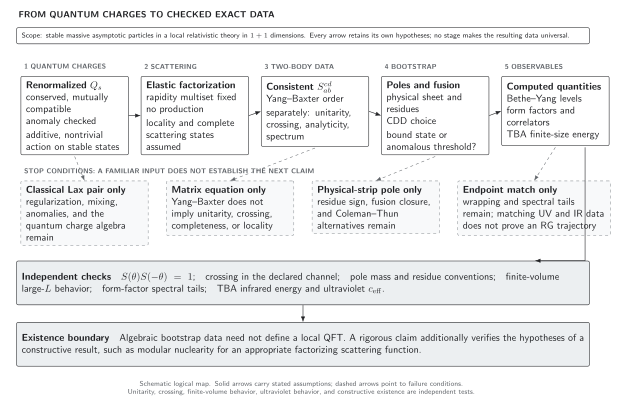
The exact-data chain for stable massive relativistic scattering in dimensions. Solid arrows are deductions only under the conditions printed at each stage; dashed stop conditions identify missing quantum, analytic, spectral, finite-size, or constructive input. The diagram is schematic and assigns no claim of universality beyond the declared model.
Its nonvisual equivalent is:
- establish renormalized quantum charges, absence of an obstructing anomaly, their algebra, and their nontrivial additive action on stable asymptotic particles;
- use suitable higher-spin charges, together with locality and scattering assumptions, to obtain elastic factorized scattering;
- impose Yang–Baxter consistency separately from unitarity, crossing, real analyticity, and a declared particle spectrum;
- solve the two-body bootstrap while recording CDD freedom, physical-sheet poles, residues, fusion closure, and Coleman–Thun alternatives;
- propagate the resulting scattering data to Bethe–Yang levels, form factors, and thermodynamic Bethe ansatz, retaining wrapping corrections and spectral tails; and
- test infrared and ultraviolet limits and, when a rigorous existence claim is intended, verify the hypotheses of an actual local construction.
The exact and rigorous status comparison places “exact S matrix,” “exact observable,” and “constructed local QFT” in separate columns. Exact data within one accepted integrable model are not universal data for nearby nonintegrable theories.
Checks and limits
Section titled “Checks and limits”Three fast checks catch common overstatements.
- Free-theory check. A free massive theory has infinitely many additive momentum moments and purely elastic scattering, but this does not make every local operator or finite-volume observable automatic; statistics and operator normalization still matter.
- Anomaly check. A classical density whose divergence becomes a nonderivative local operator after renormalization fails to define a conserved quantum charge, even if the classical monodromy remains formally writable.
- Boundary check. On an interval, . Vanishing flux or an integrable reflection condition is extra input; the infinite-line scattering argument cannot simply be reused.
Common pitfalls
Section titled “Common pitfalls”Calling a Lax pair a quantum proof. Flatness is an on-shell classical identity. Quantum conservation, anomaly cancellation, charge algebra, and asymptotic action are separate statements.
Using energy–momentum conservation as the infinite family. The spin- charges permit particle production. Additional independent higher-spin constraints do the work.
Applying the massive argument to every excitation. Unstable resonances are poles, not asymptotic particles, and massless scattering has distinct chiral and infrared structure. State the spectrum and scattering framework before invoking factorization.
Exercises
Section titled “Exercises”- For two incoming particles of one species, suppose and are conserved. Reconstruct the unordered pair .
Solution
Newton’s identity gives
The two numbers are the roots of . Thus conserving these two power sums conserves the rapidity multiset for a two-particle process. For an unknown outgoing multiplicity or several species, additional charge and spectrum information is needed.
- Verify the curvature identity
for the displayed principal-chiral-model Lax connection, and identify why it does not establish a quantum operator equation.
Solution
Insert and into , multiply by , and group the constant and linear terms in . The two classical equations set both coefficients to zero. Quantization still requires a definition of the coincident composite products, counterterms, and an anomaly analysis.
References
Section titled “References”- Faddeev, L. D., and N. Yu. Reshetikhin. “Integrability of the Principal Chiral Field Model in (1+1)-Dimension.” Annals of Physics 167 (1986): 227–256. DOI.
- Goldschmidt, Y. Y., and Edward Witten. “Conservation Laws in Some Two-Dimensional Models.” Physics Letters B 91 (1980): 392–396. DOI.
- Lüscher, Martin. “Quantum Nonlocal Charges and Absence of Particle Production in the Two-Dimensional Nonlinear Sigma Model.” Nuclear Physics B 135 (1978): 1–19. DOI.
- Parke, Stephen J. “Absence of Particle Production and Factorization of the S-Matrix in 1+1 Dimensional Models.” Nuclear Physics B 174 (1980): 166–182. DOI.
- Zamolodchikov, Alexander B., and Alexey B. Zamolodchikov. “Factorized S-Matrices in Two Dimensions as the Exact Solutions of Certain Relativistic Quantum Field Models.” Annals of Physics 120 (1979): 253–291. DOI.
Original QFT.org content:CC BY 4.0, unless an item supplies different terms. Third-party material retains its own terms.