

Theta Dependence, CP, and Model-Dependent Branches
Periodic theta dependence can coexist with nonperiodic candidate branches because a shift may permute the branches while leaving their lower envelope invariant. At a branch crossing the vacuum energy can develop a cusp and CP can be spontaneously broken, but neither outcome is universal. Smooth periodic energy, a gapless point, topological order, or other anomaly-compatible behavior may occur, depending on the dimension, matter, global form, and dynamics.
Required background. Theta parameters, theta states, and sector sums fixes the Fourier and periodicity conventions used here.
Helpful background. Discrete and antiunitary symmetries supplies the CP transformation, and ’t Hooft anomaly matching explains why an obstruction constrains rather than solves the infrared dynamics.
Shared comparison. The sector and periodicity comparison records the global-form and spin assumptions that determine which period, or permutation of theories, the branch construction must respect.
Periodic observables from exchanged branches
Section titled “Periodic observables from exchanged branches”Let a family of locally smooth candidate energy densities be
Then
so the physical lower envelope
is periodic even when no individual branch is. A branch is local dynamical data; periodicity belongs to the complete set and its minimization.
A useful model takes
In the fundamental interval , the branch is lowest. At , branches and cross, and
The cusp is a first-order branch switch. This quadratic construction captures the leading large- organization proposed for Yang–Mills theory Witten 1998, §§ 1–2 and reviewed in Mariño 2015, § 7.4, pp. 234–236; it is a model of the branch mechanism, not a universal finite- energy formula.
The chapter’s global relationships are shown below. Follow the solid path from fixed sectors to the theta transform, and then distinguish finite-volume response from the infinite-volume branch envelope.
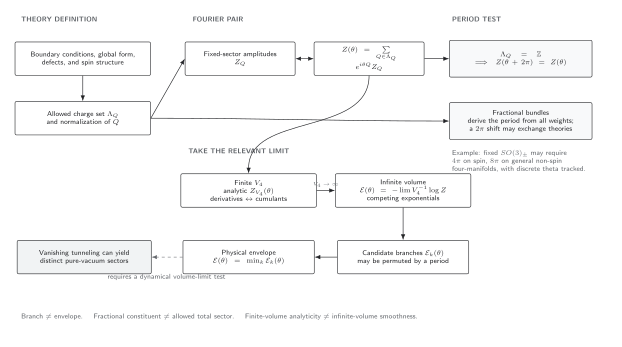
Sector labels, theta weights, energy branches, response derivatives, and superselection are related but distinct. The period shown applies to an integral charge lattice; the global-form input explicitly allows a different period or a permutation of distinct theories.
CP at special theta values
Section titled “CP at special theta values”For a CP-odd topological charge, CP maps
If the complete theory is periodic, and are fixed points of this transformation modulo . That makes CP a possible symmetry of the theory at those values; it does not determine how the vacuum realizes CP.
In the quadratic branch model, CP exchanges the two states at . Choosing one vacuum therefore breaks CP spontaneously, and the order parameter changes sign. A symmetric superposition at finite volume can instead be unique, with a splitting that vanishes in the infinite-volume limit.
The contrast with a dilute independent sector gas is decisive. If positive- and negative-charge events are Poisson distributed with equal density , then
This function is smooth and periodic, with zero first derivative at . Within its controlled regime it has no branch cusp there. The example proves that periodicity alone does not force CP breaking. It does not establish that an ordinary four-dimensional QCD instanton gas is dilute.
What anomalies add—and what they do not
Section titled “What anomalies add—and what they do not”An anomaly can exclude some infrared realizations. In four-dimensional pure Yang–Mills theory, coupling the electric one-form symmetry to a background two-form field exposes a CP/center obstruction at . For even there is a direct mixed anomaly; for odd the closely related statement is a global inconsistency between counterterm choices at and . Gaiotto, Kapustin, Komargodski, and Seiberg derive these distinctions and the resulting phase constraints in Gaiotto et al. 2017, §§ 2–3.
Under the paper’s symmetry and global-form assumptions, a unique, trivially gapped, symmetry-preserving vacuum cannot supply the required response. Viable alternatives include CP breaking with degenerate vacua, gapless degrees of freedom, or nontrivial topological infrared physics. The anomaly does not select one of them. Additional dynamical input is required, as developed on Anomaly and Generalized-Symmetry Constraints on Infrared Phases.
Matter can screen the center symmetry, the global gauge group can change the allowed backgrounds, and massless fermions can change whether theta is physically observable. Therefore the pure- conclusion must not be exported without rebuilding the symmetry and anomaly data.
Branches, metastability, and finite volume
Section titled “Branches, metastability, and finite volume”A locally stable branch need not be the ground state. If but the transition action is large, it can be metastable. In the strict large- limit, lifetimes and branch barriers may scale differently from the expansion, producing a nonuniform limit.
For a spatial box of volume with a Hermitian Hamiltonian and real theta, the positive thermal trace gives an unambiguous finite-volume energy:
The order is part of the claim: first project onto the finite-box ground state, then take the spatial thermodynamic limit. A finite or suitably convergent regulated trace is ordinarily analytic in theta; nonanalyticity emerges only after an accumulation of zeros or a competing-exponential limit. On a generic Euclidean manifold or in complex backgrounds, is instead a generating functional and may be complex. Then should be called an intensive Euclidean response, with a declared logarithm branch, rather than automatically identified with a physical vacuum energy.
The finite-volume smoothing is visible in a two-branch Hamiltonian near a crossing. Let , choose , and write
Its lower energy density is
For every nonzero this is smooth. If as the volume grows, the limit becomes and has a cusp. This calculation does not prove that a given theory has two such branches; it shows exactly how a verified finite-volume mixing matrix can approach a nonanalytic envelope.
Common pitfalls
Section titled “Common pitfalls”Demanding that every branch be periodic. The set of branches and its lower envelope can be periodic while an individual branch is merely relabeled.
Claiming universal CP breaking at . A cusp occurs in important models, and an anomaly can exclude a trivial symmetric gapped state under declared assumptions. Neither fact proves the same realization in every theory with a theta term.
Reading a finite-volume avoided crossing as an infinite-volume analytic crossover. The gap may be exponentially small in spatial volume. Its limit, not its nonzero finite-volume value, decides whether two phases remain distinct.
Exercises
Section titled “Exercises”For , prove periodicity of the lower envelope and locate all cusps.
Solution
Relabeling gives
Adjacent parabolas and cross when , namely at . Hence cusps occur at odd multiples of .
Compare the second and fourth derivatives at for the quadratic-envelope model and the dilute-gas model.
Solution
Near zero the quadratic model is exactly , so and . For , the derivatives are and . Matching the susceptibility by setting does not match the fourth cumulant, so local curvature alone cannot identify the global model.
Diagonalize and show that taking before gives a different derivative from taking at fixed .
Solution
The eigenvalues are . At fixed ,
which vanishes at . If first, the derivative tends to and has unequal one-sided limits. The noncommuting limits separate a smooth avoided crossing from a first-order branch switch.
Continue from allowed patterns to measurements
Section titled “Continue from allowed patterns to measurements”Use Topological Susceptibility and Vacuum Response to derive what local theta derivatives measure. Use Anomaly and Generalized-Symmetry Constraints on Infrared Phases to test which branch or smooth realization patterns are inconsistent with declared background-field data.
References
Section titled “References”- Gaiotto, Davide, Anton Kapustin, Zohar Komargodski, and Nathan Seiberg. “Theta, Time Reversal, and Temperature.” Journal of High Energy Physics 2017, no. 5 (2017): 091. arXiv. DOI.
- Mariño, Marcos. Instantons and Large N: An Introduction to Non-Perturbative Methods in Quantum Field Theory. Cambridge University Press, 2015, § 7.4, pp. 234–236. DOI.
- Witten, Edward. “Theta Dependence in the Large N Limit of Four-Dimensional Gauge Theories.” Physical Review Letters 81 (1998): 2862–2865. arXiv. DOI.
Original QFT.org content:CC BY 4.0, unless an item supplies different terms. Third-party material retains its own terms.