

Boulware, Hartle–Hawking, and Unruh States
Boulware, Hartle–Hawking, and Unruh are state boundary conditions, not emission formulas. They specify which incoming and horizon-originating mode sectors are empty or thermal and where the two-point function is regular. Greybody transmission and luminosity remain independent radial-scattering data.
Required background. Horizon taxonomy fixes the eternal horizon components, ground and KMS state selection gives the stationary criteria, and the Hadamard parametrix controls local regularity.
Helpful background. Thermal propagators supplies occupation factors, and Euclidean/KMS horizon thermality explains the equilibrium state.
Mode sectors and horizon regularity
Section titled “Mode sectors and horizon regularity”On an eternal nonrotating asymptotically flat black hole, a scalar mode basis can be organized into “in” modes arriving from and “up” modes emerging from the past horizon . Their complex conjugates and scattering complete the free solution space. The three standard quasifree states differ in the populations assigned to these sectors.
| State | In modes from | Up modes from | Horizon regularity | Asymptotic interpretation |
|---|---|---|---|---|
| Boulware | Empty in Killing frequency | Empty in Killing frequency | Singular on future and past horizons | Vacuum for static observers at infinity; no thermal bath |
| Hartle–Hawking | Thermal at | Thermal at | Regular on both horizons for the static bifurcate setting | Equilibrium bath; no net flux after incoming and outgoing sectors are combined |
| Unruh | Empty incoming sector | Thermal/affine-vacuum relation giving outgoing Hawking quanta | Regular on the future horizon, singular on the past horizon of the eternal extension | Collapse-like state with outgoing flux and no incoming thermal bath |
Each state is locally Hadamard in the region where it is used, but the Boulware stress diverges as the horizon is approached. The Unruh state’s past-horizon singularity is not encountered in the physical collapse spacetime, which has no white-hole past horizon. The Hartle–Hawking–Israel state is tied to a static bifurcate horizon and its existence is a theorem only under additional geometric and field hypotheses (Kay and Wald 1991, §§ 5–7).
The structure map puts state choice before near-horizon thermality. A state label selects boundary populations; it does not solve the potential between the horizon and infinity.

Position of black-hole state selection in the Hawking construction. The diagram is schematic and not to scale; regularity and occupation data do not determine transmission coefficients.
The failure map applies when a state name is used as a luminosity. Missing greybody data force the claim back to horizon/asymptotic populations and regularity only.
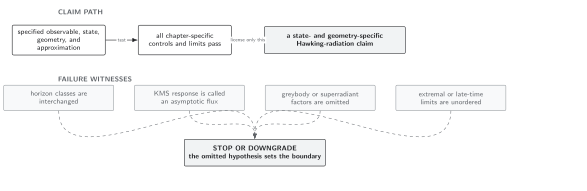
Failure boundary for state labels. This schematic, not-to-scale map licenses the state’s regularity and mode occupations while withholding any uncomputed asymptotic flux.
Application: the three states on Schwarzschild
Section titled “Application: the three states on Schwarzschild”Use the asymptotically normalized Killing frequency and . In the Hartle–Hawking state, both independent sectors have
At infinity, scattering redistributes incoming and outgoing components, but equilibrium detailed balance makes the total stationary radial energy current vanish.
In the Unruh state, the incoming “in” sector is empty while the horizon-originating sector has the Hawking population. A transmitted partial wave therefore contributes
The state supplies the denominator; the radial equation supplies . In the Boulware state there is no such thermal population at infinity, but its renormalized stress contains vacuum polarization and diverges in a freely falling frame at the horizon. Fulling identified the inequivalent static vacuum behavior underlying this distinction (Fulling 1977, §§ II–III); Unruh’s state provides the collapse-like future regularity (Unruh 1976, §§ II–III).
Changing a state label changes incoming populations and horizon regularity; changing a greybody factor changes propagation. These operations cannot compensate each other. A thermal source with zero transmission produces no flux at infinity, while a transparent barrier cannot create occupation in an empty state.
Domain and failure conditions
Section titled “Domain and failure conditions”The chapter domain and failure-conditions table gives the canonical comparison. This taxonomy assumes an eternal, static, nonrotating exterior and specified in/up mode normalizations. It licenses the table’s regularity and occupation statements. Collapse uses the Unruh state only as a future-exterior representation, not as evidence for a physical past horizon. Rotation or multiple horizons changes state existence. Without and stress renormalization, any luminosity claim must be downgraded to state population data.
Exercise
Section titled “Exercise”Why is the Hartle–Hawking state not the state of an isolated evaporating black hole?
Solution
It contains an incoming thermal bath from past infinity as well as outgoing thermal radiation. The two sectors maintain equilibrium and zero net stationary flux. An isolated collapse black hole has no incoming thermal bath; its future exterior is modeled instead by the Unruh state, subject to slow backreaction.
Handoff
Section titled “Handoff”With state populations fixed, the next page solves the radial wave equation, checks its conserved Wronskian, and folds the resulting greybody coefficient into number and energy fluxes.
References
Section titled “References”- Fulling, Stephen A. “Alternative Vacuum States in Static Space-Times with Horizons.” Physical Review D 15 (1977): 2411–2414. doi:10.1103/PhysRevD.15.2411.
- Hartle, James B., and Stephen W. Hawking. “Path-Integral Derivation of Black-Hole Radiance.” Physical Review D 13 (1976): 2188–2203. doi:10.1103/PhysRevD.13.2188.
- Kay, Bernard S., and Robert M. Wald. “Theorems on the Uniqueness and Thermal Properties of Stationary, Nonsingular, Quasifree States on Spacetimes with a Bifurcate Killing Horizon.” Physics Reports 207 (1991): 49–136. doi:10.1016/0370-1573(91)90015-E.
- Unruh, William G. “Notes on Black-Hole Evaporation.” Physical Review D 14 (1976): 870–892. doi:10.1103/PhysRevD.14.870.
Original QFT.org content:CC BY 4.0, unless an item supplies different terms. Third-party material retains its own terms.