

Large-N, Loop, and ℏ Approximation Hierarchies
Large-N, loop, and expansions organize different approximations. With independent matter species, the mean stress grows as and the root-mean-square connected fluctuation grows as , so the relative fluctuation falls as . Holding fixed yields a controlled mean-metric saddle in ordinary regimes, but it does not make every matter loop small, remove stochastic corrections, or remain uniform near critical and secular growth.
Required background. The semiclassical Einstein equation fixes the mean saddle; one-loop matter effective actions fixes what “matter loop” means; and large-N normalizations supplies the species scaling.
Helpful background. Loops, renormalization, and EFT separates loop from derivative order, and nonuniform large-N limits supplies the failure diagnostics.
Species scaling of the mean equation
Section titled “Species scaling of the mean equation”Let , , be identical independent fields in the same state. Their matter functional and stress satisfy
Take
with and the renormalized curvature couplings in the effective action scaled consistently. The mean equation becomes
which is . Both the gravitational action and the total matter effective action scale as , so the mean metric is their leading saddle.
For independent species,
where . The induced metric two-point function carries two powers of and therefore scales as
Thus mean geometry is leading, while connected metric fluctuations are subleading in this scaling. They are not absent and are not determined by the mean equation. Hu and Verdaguer give the large-N relation between semiclassical and stochastic descriptions with this hierarchy made explicit (Hu and Verdaguer 2020, §§ 4.2 and 8.1).
Loop counting is separate. Integrating free fields exactly resums their one-loop determinants at leading ; it does not truncate the determinant to one derivative order. Metric loops are suppressed by the gravitational saddle scaling, whereas matter self-interaction loops depend on their own coupling normalization. Restoring , a vacuum matter loop carries , but a large coherent occupation can make effectively classical. Every calculation should state all three counts rather than calling them collectively “semiclassical order.”
The structure map places this bookkeeping before self-consistency and stability, because a missing nominally same-order term cannot be repaired by later convergence.

Large-N organization of mean backreaction. The diagram is schematic and not to scale; causal response and constraints are imposed at every order, and the leading mean does not include all connected fluctuations.
The failure map tests uniformity. If a retarded response eigenvalue becomes small, a formally correction can be amplified into an order-one effect.
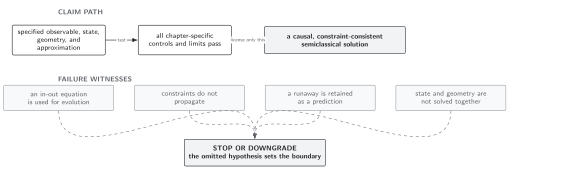
Nonuniform-limit witness for large-N backreaction. This schematic, not-to-scale map requires response eigenvalues, observation time, and state occupation to remain within the regime where the counting is uniform.
Application: classify the leading and subleading terms
Section titled “Application: classify the leading and subleading terms”For free scalars with identical Hadamard state, write the CTP effective action as
The stationary point supplies:
- mean metric ;
- total mean stress ;
- finite backreaction ;
- retarded matter polarization , which contributes at leading order to linear response;
- connected stress and induced metric variance ;
- mean-metric correction from the next saddle order, generically .
This list prevents a frequent mistake: because is a connected two-stress correlator, one might classify it as negligible. In the linearized mean equation it is multiplied by and is leading. The noise-driven metric variance contains a second and is subleading. Response and noise use related correlators but answer different questions.
To reproduce the hierarchy, record whether observables are per species or summed, whether or is fixed, the matter interaction scaling, the state occupation per species, and the time interval. Verify that the mean curvature and every retained response eigenvalue remain finite as changes.
Adversarial test: critical and secular enhancement
Section titled “Adversarial test: critical and secular enhancement”Suppose a physical response mode has inverse propagator
Away from zeros of the first two terms, is small. Near a frequency where
the correction shifts the pole by order one relative to its distance from criticality. Likewise a secular term becomes order one for . Formal counting at fixed frequency and time therefore does not justify the leading saddle in those double-scaling regimes.
The strongest surviving statement is large-N control on compact parameter and time domains separated from critical response poles. Beyond them, one must resum the enhanced sector or downgrade the result.
Domain and failure conditions
Section titled “Domain and failure conditions”See the chapter domain and failure-conditions table. The hierarchy assumes independent or consistently scaled species, finite per-species state data, fixed, and uniform response bounds. It does not establish small stress fluctuations in absolute units, and it says nothing about ultraviolet derivative control unless that expansion is stated separately.
Exercise
Section titled “Exercise”For independent species, compute the relative root-mean-square fluctuation of their summed stress smeared with one fixed test tensor.
Solution
If one species has mean and variance , the sum has mean and variance . Hence
This relative suppression fails when and does not replace a calculation of the induced metric fluctuation.
Handoff
Section titled “Handoff”Self-consistent state–geometry solutions turn the leading mean equation into a fixed-point or coupled evolution problem with residual tests.
References
Section titled “References”- Hu, Bei-Lok, and Enric Verdaguer. Semiclassical and Stochastic Gravity: Quantum Field Effects on Curved Spacetime. Cambridge: Cambridge University Press, 2020. doi:10.1017/9780511667497.
- Roura, Albert, and Enric Verdaguer. “Cosmological Perturbations from Stochastic Gravity.” Physical Review D 78 (2008): 064010. doi:10.1103/PhysRevD.78.064010.
Original QFT.org content:CC BY 4.0, unless an item supplies different terms. Third-party material retains its own terms.