

The Quantum Focusing Conjecture: Dimension, EFT, Smearing, and Status
Quantum focusing replaces area expansion by the functional derivative of generalized entropy. The original QFC proposed a pointwise nonincrease under every forward null deformation. That statement remains a conjecture and has explicit counterexamples in controlled higher-curvature and two-dimensional regimes. Restricted QFC imposes a weaker sign only when the quantum expansion vanishes; it has proofs in particular brane and JT-plus-QFT model classes, not in general semiclassical gravity.
Required background. QNEC on curved backgrounds supplies the nongravitational local limit, and generalized-entropy renormalization supplies the finite entropy functional.
Helpful background. Quantum extremal surfaces use , while the generalized second law is a horizon statement with a distinct domain.
Original and restricted quantum focusing
Section titled “Original and restricted quantum focusing”For a cut of a null hypersurface, define
where is area divided by plus the entropy functionals required by higher-curvature couplings and counterterms. With transverse metric determinant ,
The original QFC asserts, schematically,
for forward deformations, including its distributional diagonal. Bousso et al. formulate the conjecture and derive QNEC and a quantum covariant entropy bound in its intended regime (Bousso et al. 2016, §§ 3–5).
Restricted quantum focusing asks only
This is logically weaker. Shahbazi-Moghaddam proves it, subject to stated technical assumptions, for brane-world semiclassical gravity holographically dual to higher-dimensional Einstein gravity (Shahbazi-Moghaddam 2023, § III). That proof does not establish the original QFC or arbitrary higher-curvature gravity.
The structure map branches at the exact focusing statement. The consequence must retain whether its input was original, restricted, smeared, or model specific.

Variants of quantum focusing. The map is schematic and not to scale; no implication may erase the dimension, gravitational action, state, cut, hierarchy, smearing scale, or whether the input is a conjecture or a proved model theorem.
Higher-curvature pointwise challenge
Section titled “Higher-curvature pointwise challenge”In Einstein–Gauss–Bonnet gravity for , the gravitational entropy contains a curvature term. At a cut with vanishing classical expansion and shear, the diagonal focusing quantity includes
Fu, Koeller, and Marolf construct weakly curved configurations for which for either sign of the Gauss–Bonnet coupling, violating the original pointwise QFC (Fu, Koeller, and Marolf 2017, §§ 2–3). The calculation is not dismissed by taking curvature small; it is an EFT higher-derivative effect with a definite dimensional domain.
Leichenauer argues that this particular violation probes transverse structure below the EFT cutoff and disappears after smearing over a cutoff-sized region (Leichenauer 2017, §§ 2–3). That is evidence for a smeared reformulation, not proof of the original pointwise statement. A smeared proposal must report its kernel, transverse scale, higher-curvature coefficients, and hierarchy to all omitted operators.
Two-dimensional JT-plus-QFT test
Section titled “Two-dimensional JT-plus-QFT test”In JT gravity, transverse area is replaced by a dilaton contribution. A representative generalized entropy is
and quantum expansion is proportional to its affine derivative along the cut. The ratio of matter quantum effects to the total dilaton controls which terms dominate.
As of August 2026, Franken et al. prove restricted QFC in a specified class of JT-plus-QFT toy models and construct counterexamples to the original and stronger focusing statements when matter effects are comparable to the total dilaton (Franken et al. 2026, abstract and §§ 3–4). Therefore:
- restricted QFC in that model class: theorem under the paper’s assumptions;
- original/stronger QFC in the exhibited regime: false;
- restricted QFC in generic dilaton gravity: not established by that result;
- original QFC in Gauss–Bonnet EFT: explicitly challenged pointwise; and
- smeared higher-dimensional focusing: a separate proposal or controlled calculation.
The adversarial test must reproduce both counterexample classes without merging them. The result depends on higher-curvature transverse structure; the result depends on a JT-plus-QFT hierarchy. Neither determines the status of the other.
The failure map is especially important here: saying only “QFC holds” or “QFC fails” omits the variant that carries the truth value.
Status boundaries among focusing variants. The diagram is schematic and not to scale; Gauss–Bonnet pointwise violation, cutoff-scale smearing, brane restricted focusing, and JT restricted focusing are separate results.
Domain and failure conditions
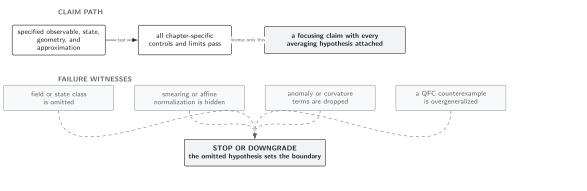
Section titled “Domain and failure conditions”See the chapter domain and failure-conditions table. Every use must specify the exact functional derivative, entropy scheme, cut, dimension, gravitational EFT, matter state, perturbative hierarchy, and smearing. The original QFC is not a universal theorem. Restricted proofs and smearing arguments license only their stated model classes and scales.
Exercise
Section titled “Exercise”Explain why a proof of does not prove when .
Solution
The antecedent restricts the statement to zeros of . It places no sign constraint at points where is positive or negative. Removing that antecedent is a strict strengthening and requires an independent argument.
References
Section titled “References”- Bousso, R., Z. Fisher, S. Leichenauer, and A. C. Wall. “Quantum Focusing Conjecture.” Physical Review D 93 (2016): 064044. DOI.
- Franken, V., S. Kaya, F. Rondeau, A. Shahbazi-Moghaddam, and P. Tran. “Tests of Restricted Quantum Focusing and a New CFT Bound.” Journal of High Energy Physics 2026 (2026): 111. DOI.
- Fu, Z., J. Koeller, and D. Marolf. “Violating the Quantum Focusing Conjecture and Quantum Covariant Entropy Bound in d ≥ 5 Dimensions.” Classical and Quantum Gravity 34 (2017): 175006. DOI.
- Leichenauer, S. “The Quantum Focusing Conjecture Has Not Been Violated.” arXiv preprint arXiv:1705.05469 (2017). arXiv.
- Shahbazi-Moghaddam, A. “Restricted Quantum Focusing.” arXiv preprint arXiv:2212.03881 (2022; revised 2023). arXiv.
Original QFT.org content:CC BY 4.0, unless an item supplies different terms. Third-party material retains its own terms.