

Cosmological and Multiple-Horizon State Obstructions
A static region can be bounded by more than one horizon, and each horizon can demand a different KMS period. Regularity at one boundary then conflicts with regularity at the other. The correct description is generally a nonequilibrium state with flux between sectors, not a single temperature obtained by averaging surface gravities.
Required background. Horizon taxonomy distinguishes cosmological and black-hole horizons, and ground and KMS state selection supplies the global state criteria.
Helpful background. Tolman redshift and local temperature fixes normalization across the static patch, and state-selection failure modes provides adversarial tests.
Two horizons, two regularity conditions
Section titled “Two horizons, two regularity conditions”Consider a static spherical region
between simple zeros , representing black-hole and cosmological horizons. With the same Killing coordinate , define
Euclidean smoothness at each horizon separately requires
One Euclidean time coordinate cannot have both periods unless (after one common generator normalization). A Lorentzian stationary quasifree state that is KMS at one period can therefore fail to be regular at the other horizon. The same obstruction appears in mode populations: incoming data from the two null boundaries carry different thermal weights.
Pure de Sitter has one cosmological horizon for each static observer and an invariant Euclidean/Bunch–Davies state whose restriction to the static patch is thermal. That result does not imply that a Schwarzschild–de Sitter static region with two unequal horizons has one equilibrium temperature. Gibbons and Hawking’s Euclidean analysis makes the horizon-period relation explicit (1977, §§ II–III).
The structure map requires state and geometry to be fixed together. For multiple horizons, the first two boxes contain several generators and boundary sectors, which must be compatible before one KMS relation can be used.

Multiple-horizon state construction. The diagram is schematic and not to scale; each horizon supplies its own regularity and scattering boundary data.
The failure map rejects temperature averaging. A period between and leaves a conical defect—and its Lorentzian regularity counterpart—at both horizons.
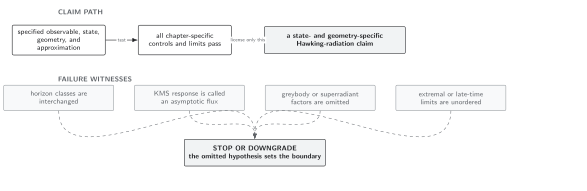
Failure boundary for multiple-horizon equilibrium. This schematic, not-to-scale map licenses a single KMS state only when all horizon periods and other chemical potentials are compatible.
Application: a static patch with unequal surface gravities
Section titled “Application: a static patch with unequal surface gravities”For Schwarzschild–de Sitter,
Generic parameters give . A state chosen regular and thermal at the black-hole future horizon has outgoing occupation at , while independent incoming data from the cosmological horizon must be specified. Choosing them thermal at creates a stationary nonequilibrium configuration rather than one KMS state.
In a two-dimensional conformal approximation with transparent propagation, the net channel flux has the schematic difference
with orientation fixed from the hotter sector to the colder. Four dimensions add separate greybody barriers at both ends and angular modes, so this expression is not a general luminosity formula.
Try an averaged inverse temperature . Near , the Euclidean opening angle is . Smoothness demands for each , which is impossible when . Averaging therefore removes neither defect. Special “lukewarm” families can satisfy equal temperatures, but charge potentials, field boundary conditions, and global Hadamard existence must still be checked rather than inferred from equality of alone.
Domain and failure conditions
Section titled “Domain and failure conditions”See the chapter domain and failure-conditions table. This page assumes a common static Killing normalization and simple horizons bounding one globally hyperbolic static region. Equal periods are necessary for one global KMS equilibrium but not always sufficient. Unequal licenses horizon-specific local temperatures and a nonequilibrium state after both boundary populations are declared. Averaging or testing only one horizon downgrades the claim to that local sector.
Exercise
Section titled “Exercise”Show that no Euclidean period removes both conical singularities when .
Solution
Smoothness at horizon requires . A common would imply , hence . If they are unequal, every choice leaves at least one nonzero deficit angle.
Handoff
Section titled “Handoff”The remaining pages test the Hawking construction outside its standard low-energy stationary domain: first the blueshifted precursor and then controlled modified-dispersion and analogue models.
References
Section titled “References”- Gibbons, G. W., and Stephen W. Hawking. “Cosmological Event Horizons, Thermodynamics, and Particle Creation.” Physical Review D 15 (1977): 2738–2751. doi:10.1103/PhysRevD.15.2738.
- Kay, Bernard S., and Robert M. Wald. “Theorems on the Uniqueness and Thermal Properties of Stationary, Nonsingular, Quasifree States on Spacetimes with a Bifurcate Killing Horizon.” Physics Reports 207 (1991): 49–136. doi:10.1016/0370-1573(91)90015-E.
Original QFT.org content:CC BY 4.0, unless an item supplies different terms. Third-party material retains its own terms.