

Effective-Action Variation, Stress Tensors, and Consistency Checks
Metric variation turns a renormalized matter effective action into a stress tensor and its second variation into a time-ordered or Euclidean response kernel. Conservation, the trace anomaly, and finite curvature shifts must agree with an independent local renormalization prescription. Retarded response does not follow from that Hessian unless a closed-time-path contour is used.
Required background. One-Loop Matter Effective Actions in Curved Space supplies the functional, Renormalized Stress Tensor: Axioms and Curvature Ambiguities supplies its allowed finite shifts, and Relative Cauchy Evolution and Background Response supplies an algebraic response check.
Helpful background. Conservation, Local Covariance, and the Backreaction Source fixes Ward identities, and Trace Anomalies and Convention Translation fixes trace conventions.
First metric variation
Section titled “First metric variation”The site’s Lorentzian sign is
For a determinant,
plus the variation of zero-mode projectors and local counterterms when present. The Euclidean formula must be continued as a complete tensor equation before it is compared with the Lorentzian sign above.
Diffeomorphism invariance gives the Ward identity. Under and with boundary terms controlled,
so
If the regulator violates this identity, the required local restoring terms must be included before the stress is interpreted. Christensen’s point-splitting construction provides an independent local calculation of the massive scalar stress and its divergent geometry Christensen 1976, pp. 2490–2498.
First application: conformally flat stress checks
Section titled “First application: conformally flat stress checks”Let and take a conformal matter field in a state whose additional traceless stress is separately specified. Because , the anomaly-induced part obeys
in the declared Lorentzian anomaly convention. The minus sign follows because for the site’s inverse-metric variation. Integrating the negative of the trace anomaly along the conformal path gives the Lorentzian Wess–Zumino functional in this convention; varying it with respect to the full inverse metric gives a conserved tensor whose trace is .
Now compute the same state with Hadamard point splitting. After the same length scale and finite curvature terms are chosen, the two results must have:
- identical trace;
- vanishing covariant divergence;
- identical state-dependent smooth contribution;
- a difference, if any, equal to the variation of an allowed finite local action.
The point-split trace anomaly and the necessity of conservation-compatible local terms are analyzed in Wald 1978, pp. 1477–1484. Agreement is a method check, not evidence that the anomaly alone selected the state.
Second variation and causal meaning
Section titled “Second variation and causal meaning”The ordinary in–out or Euclidean Hessian,
is symmetric under exchange of and , up to the conventional contact-term organization. That symmetry is incompatible with a generic retarded kernel, which vanishes when lies to the future of but not conversely.
A closed-time-path action instead yields a retarded Hessian after variation and branch identification. With the same factor of four as in the Hessian above and with inverse-metric arguments,
Thus the actual first-order stress response is
The sign is because is a plus source for . For a covariant perturbation , one has , so the response coefficient multiplying is . Stating both the metric variable and the Hessian normalization is therefore essential when comparing formulas that display , , or .
Jordan’s construction proves the reality and causal support of expectation-value equations within its perturbative domain Jordan 1986, §§ II–IV. The imaginary part quadratic in branch difference encodes fluctuations; it is not the mean stress.
Finite-counterterm adversary
Section titled “Finite-counterterm adversary”Add
Then stress and response must shift together:
On a closed four-manifold the Euler and total-derivative integrals do not change bulk equations, while shifts the scheme-dependent trace and supplies a conserved traceless bulk tensor. If a comparison shifts the stress but leaves the response or anomaly convention fixed, it has mixed renormalization schemes.
The structure map closes the chapter by feeding a fully renormalized action into first and second variations. Inspect the separate arrows to conserved in–out stress and retarded in–in response.

Action, stress, anomaly, contact terms, and response must use one finite renormalization convention; causal support comes from the in–in contour. Schematic; not to scale.
Domain and failure conditions
Section titled “Domain and failure conditions”The determinant variation assumes a differentiable family of operator domains and controlled zero modes. Boundaries require boundary stress and varied boundary conditions. The Euclidean/in–out Hessian is not retarded; noise requires a connected stress bi-tensor. See Domain and failure conditions.
The failure map’s final branch tests three identities together: conservation, trace, and correlated finite shifts of stress and response. Passing only one is insufficient.
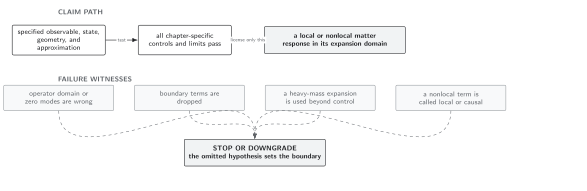
Ward identities, finite-counterterm variations, point-splitting comparison, and contour support independently constrain an effective-action response. Schematic; not to scale.
Handoffs
Section titled “Handoffs”Causal mean evolution continues in In–In Effective Actions and Causal Backreaction. Stress fluctuations continue in Stress Bi-Tensors and Noise-Kernel Input.
References
Section titled “References”- Christensen, Stephen M. “Vacuum Expectation Value of the Stress Tensor in an Arbitrary Curved Background: The Covariant Point-Separation Method.” Physical Review D 14 (1976): 2490–2501. DOI.
- Jordan, Ronald D. “Effective Field Equations for Expectation Values.” Physical Review D 33 (1986): 444–454. DOI.
- Wald, Robert M. “Trace Anomaly of a Conformally Invariant Quantum Field in Curved Spacetime.” Physical Review D 17 (1978): 1477–1484. DOI.
Original QFT.org content:CC BY 4.0, unless an item supplies different terms. Third-party material retains its own terms.