

Rotating and Charged Horizons, Superradiance, and Chemical Potentials
For a rotating or charged horizon, the relevant energy is not the asymptotic frequency alone. Horizon flux and thermal occupation depend on the gauge-covariant Killing energy . Its sign controls bosonic superradiance, and the same shifted frequency exposes why a globally regular Hartle–Hawking state is obstructed on asymptotically flat Kerr.
Required background. Greybody scattering supplies the Wronskian, surface gravity and generator normalization fixes , and gauge fields on curved backgrounds fixes gauge-covariant frequencies.
Helpful background. The KMS condition gives chemical potentials, and black-hole states supplies the nonrotating comparison.
Horizon energy and the Wronskian sign
Section titled “Horizon energy and the Wronskian sign”For a stationary axisymmetric charged black hole, the future-horizon generator is
Choose the gauge potential to vanish at infinity and define
A charged scalar mode
has gauge-covariant horizon energy
For a mode incident from infinity with , radial flux conservation gives
Thus
When , the reflected flux exceeds the incident flux: the horizon absorbs negative Killing energy while the exterior wave is amplified. Define the signed absorption probability
It is negative in the superradiant band. That sign is essential in the emission formula; replacing it by breaks detailed flux accounting. The classical amplification relation for Kerr modes was established by Teukolsky and Press (1974, §§ II–III).
The structure map adds superradiance to the scattering box. The state and near-horizon thermal factor use the same , so flux conservation connects rather than duplicates the two steps.

Rotating/charged modification of the Hawking construction. The diagram is schematic and not to scale; the shifted energy enters both the near-horizon relation and the Wronskian before asymptotic flux is formed.
The failure map tests two linked errors: an unshifted Planck factor violates chemical-potential accounting, and assuming a global bosonic rotating equilibrium state ignores superradiant state-existence obstructions.
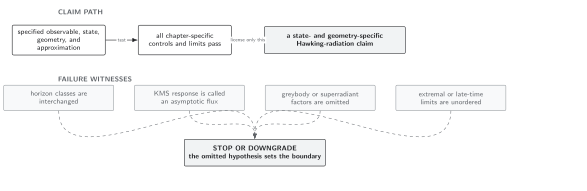
Failure boundary for rotating and charged horizons. This schematic, not-to-scale map requires the chemical potentials, signed transmission, boundary conditions, and actual state domain to pass together.
Application: amplified scalar emission
Section titled “Application: amplified scalar emission”For bosons, the horizon occupation factor is
The asymptotic number spectrum is conventionally written
In the superradiant range, both numerator and denominator are negative, leaving a nonnegative emission rate. The associated energy, angular-momentum, and charge fluxes multiply each quantum by , , and , respectively. This joint sign check is more reliable than forcing every factor to be positive separately.
As a concrete neutral Kerr mode, choose , , and . Then and
Using an unshifted denominator would combine a negative with a positive occupation and predict a negative particle rate. The contradiction exposes the missing chemical potential.
For asymptotically flat Kerr, superradiant bosonic modes obstruct a globally regular, isometry-invariant Hartle–Hawking state of the usual kind; the Kay–Wald analysis gives the relevant state theorem and obstruction (Kay and Wald 1991, §§ 6–7). Frolov–Thorne thermal constructions are useful in restricted regions or mode descriptions, but they should not be advertised as a globally regular state on the entire exterior without additional boundaries or qualifications.
Domain and failure conditions
Section titled “Domain and failure conditions”The chapter domain and failure-conditions table gives the shared claim structure. This page assumes stationary axisymmetry, a fixed gauge at infinity, separable flux-normalized modes, and stable boundary conditions. It licenses the shifted occupation and Wronskian amplification. An unshifted formula fails even locally; a mirror or AdS boundary can turn amplification into an instability and changes the state problem; a formal Frolov–Thorne density does not by itself license a global Hadamard equilibrium state.
Exercise
Section titled “Exercise”Show that the bosonic emission ratio remains nonnegative in the superradiant band.
Solution
For , flux conservation gives . Also . Their ratio is therefore nonnegative. Replacing either signed factor by its nonrotating analogue destroys this consistency.
Handoff
Section titled “Handoff”Multiple horizons create a related state-selection problem: even without rotation, two distinct surface gravities demand incompatible KMS periods unless special parameter relations hold.
References
Section titled “References”- Frolov, Valeri P., and Kip S. Thorne. “Renormalized Stress-Energy Tensor Near the Horizon of a Slowly Evolving, Rotating Black Hole.” Physical Review D 39 (1989): 2125–2154. doi:10.1103/PhysRevD.39.2125.
- Kay, Bernard S., and Robert M. Wald. “Theorems on the Uniqueness and Thermal Properties of Stationary, Nonsingular, Quasifree States on Spacetimes with a Bifurcate Killing Horizon.” Physics Reports 207 (1991): 49–136. doi:10.1016/0370-1573(91)90015-E.
- Teukolsky, Saul A., and William H. Press. “Perturbations of a Rotating Black Hole. III. Interaction of the Hole with Gravitational and Electromagnetic Radiation.” Astrophysical Journal 193 (1974): 443–461. doi:10.1086/153180.
Original QFT.org content:CC BY 4.0, unless an item supplies different terms. Third-party material retains its own terms.