

Semiclassical Black-Hole Information: Scope and Limits
Semiclassical QFT can compute exterior correlators, Hawking flux, local stress, relative entropy, and—under stated hypotheses—generalized-entropy evolution. It does not by itself supply a microscopic factorization of gravitational degrees of freedom, prove unitary evaporation, or select the replica saddles used in island calculations. Hawking’s original nonunitary conclusion made additional global and endpoint assumptions beyond the asymptotic flux calculation Hawking 1976, pp. 2468–2472.
Required background. The generalized second law supplies a proved causal-horizon statement, and quantum extremal surfaces supplies the renormalized stationarity equation. Helpful background. Review recovery and approximate Markovianity, the status of entropy bounds, and continuum factorization failure.
Four levels of an information claim
Section titled “Four levels of an information claim”A defensible evaporation argument separates:
- QFT on a prescribed geometry. The state and exterior algebra determine correlators and a greybody-filtered Hawking flux. This can show approximate thermality of selected observables.
- Semiclassical backreaction. The renormalized sources a mean metric while fluctuations and higher-curvature corrections remain controlled. Generalized entropy can be defined and, in specified causal-horizon domains, obey a GSL.
- A gravitational path-integral or holographic model. One chooses boundaries, topologies, replica saddles, analytic continuation, anchors, homology, and an extremize/select prescription. Island and Page-curve results live here.
- Microscopic quantum gravity. A Hilbert space or observable algebra, unitary dynamics, and an operational decoding map must be supplied. This is stronger than any mean-field entropy curve.
The same symbol can refer to different objects across these levels. In gauge theory and gravity, a radiation “subsystem” is not automatically a tensor factor: gravitational dressing, constraints, asymptotic charges, and edge data affect the accessible algebra.
First application: classify an evaporation argument
Section titled “First application: classify an evaporation argument”Suppose a calculation gives the mean luminosity at future null infinity and the Bondi-mass evolution . It establishes an energy-transfer observable within its state and backreaction approximation. If one also computes a Gaussian outgoing-state covariance matrix on a regulated radiation algebra, one may estimate a coarse or fine entropy for that model.
To claim a Page curve, however, one still needs:
- a precise radiation algebra and its relation to gravitating degrees of freedom;
- a fine-grained entropy rather than a thermodynamic entropy inferred from flux;
- a microscopic unitarity or duality assumption;
- for an island calculation, a gravitational replica path integral, allowed topologies, analytic continuation, and dominance of the relevant saddle;
- a rule selecting among anchored, homologous QES candidates.
Specific two-dimensional gravitating-bath and holographic models realize these additional ingredients and obtain Page-like transitions Almheiri et al. 2019, §§2–5; Penington 2020, §§2–4. Those are major model and gravitational-path-integral results, not consequences of Hawking’s fixed-background calculation for an arbitrary astrophysical black hole.
The structure map organizes the claim by its required input. Inspect where a QFT flux calculation ends and extra gravitational assumptions begin.

Black-hole information claims form a hierarchy: flux and local stress are QFT calculations, whereas island selection and microscopic unitarity require additional gravitational structure. Schematic; not to scale.
Domain and failure conditions
Section titled “Domain and failure conditions”The chapter’s canonical domain table is the comparison source for entropy, GSL, and QES claims. For any new argument, record the algebra, state, entropy type, regulator, gravitational approximation, topology sum, saddle criterion, operational task, and evidence status.
Adversarial test. Infer a Page curve solely from a nearly thermal mean Hawking flux. Many states share the same one-point energy flux while having different higher correlations and fine-grained entropies. The missing radiation factorization, nonperturbative saddles, and microscopic unitarity assumption prevent the inference. The strongest surviving statement is the calculated mean flux and its controlled backreaction.
The failure map shows that horizon restriction is loss of access to an algebra, not proof that information has been destroyed.
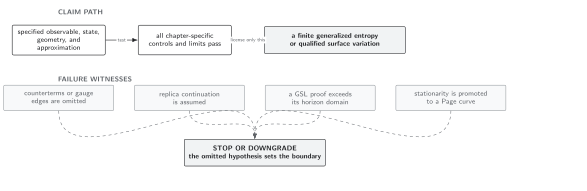
An information-loss conclusion requires specified observables, factorization or algebra, dynamics, and recovery task beyond the existence of a horizon or thermal-looking flux. Schematic; not to scale.
Evidence boundary
Section titled “Evidence boundary”Evidence status was checked through 10 August 2026. The stable conclusions here are the distinction among QFT calculations, semiclassical definitions and theorems, model-dependent gravitational path integrals, and microscopic claims. Whether a given UV-complete theory realizes particular replica saddles or reconstruction maps is a separate, evolving research question.
References
Section titled “References”- Almheiri, A., N. Engelhardt, D. Marolf, and H. Maxfield, “The Entropy of Bulk Quantum Fields and the Entanglement Wedge of an Evaporating Black Hole,” Journal of High Energy Physics 2019, 063 (2019), doi:10.1007/JHEP12(2019)063.
- Hawking, S. W., “Breakdown of Predictability in Gravitational Collapse,” Physical Review D 14, 2460–2473 (1976), doi:10.1103/PhysRevD.14.2460.
- Penington, G., “Entanglement Wedge Reconstruction and the Information Paradox,” Journal of High Energy Physics 2020, 002 (2020), doi:10.1007/JHEP09(2020)002.
Original QFT.org content:CC BY 4.0, unless an item supplies different terms. Third-party material retains its own terms.