

Gauge, BRST, and BV Interfaces on Curved Backgrounds
Interacting gauge theory on a curved background requires more than a covariant gauge-fixing term. Renormalized products must respect the BRST/BV master identity so that gauge-fixed fields descend to a physical cohomology. A violation that is local and BRST exact can be removed by a finite counterterm; a nontrivial ghost-number-one class is an anomaly and obstructs the claimed gauge symmetry.
Required background. Gauge fields, gauge fixing, and ghosts on curved backgrounds supplies the hyperbolic free problem, local covariant renormalization controls ultraviolet extensions, and the BRST differential supplies the cochain complex.
Helpful background. The BV master equation organizes fields and antifields, while Slavnov–Taylor and Zinn–Justin identities give equivalent source-level tests.
The curved-background BV complex
Section titled “The curved-background BV complex”Let be a compact semisimple gauge group and a connection on a fixed globally hyperbolic . For a standard nonminimal gauge-fixed complex, the fields are
| Field | Statistics | Ghost number | BRST transformation |
|---|---|---|---|
| even | |||
| odd | |||
| odd | |||
| even |
Each field has an antifield of opposite parity and ghost number . The BV antibracket is
Before gauge fixing, a minimal BV action contains
and obeys the classical master equation . A gauge-fixing fermion selects a Lagrangian submanifold and gives a normally hyperbolic gauge-fixed operator for the vector–ghost system, subject to the global and zero-mode qualifications of the free gauge page.
The classical identity implies . Quantum mechanically, time-ordered products must satisfy its renormalized counterpart. It is safer in curved-space causal perturbation theory to state this as the anomalous master Ward identity
with the factors of absorbed into the chosen Lorentzian definition of and . The anomaly functional is local, covariant, supported where the interaction is supported, and has ghost number one. Consistency gives at the first nonvanishing order. If for an allowed local ghost-number-zero , the finite counterterm removes it. If its cohomology class is nonzero, the physical gauge theory is anomalous.
Hollands constructs perturbative Yang–Mills theory on arbitrary globally hyperbolic curved spacetimes by imposing a hierarchy of Ward identities that makes the interacting BRST current conserved and its charge nilpotent; physical fields are the resulting cohomology (Hollands 2008, §§ 3–4 and 5.3).
The construction map shows that the BV identity is not a final cosmetic check. It constrains time-ordered products and curvature counterterms before gauge-invariant interacting observables can occupy the last box.

BRST/BV constraints across the controlled construction. The map is schematic and not to scale; physical cohomology is licensed only after the renormalized master identities constrain every intermediate stage.
The failure map should be read cohomologically on this page. A regulator can be covariant yet leave a ghost-number-one breaking; until that breaking is removed or shown absent, the claim stops before gauge independence.
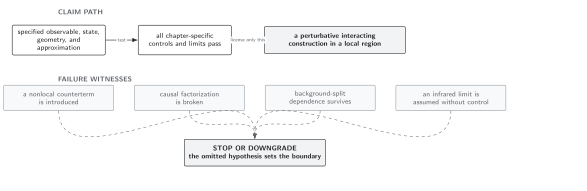
Failure path for a curved-background gauge construction. This schematic, not-to-scale map distinguishes a removable local breaking from a nontrivial anomaly that blocks the physical observable algebra.
Application: compactly supported Yang–Mills interaction
Section titled “Application: compactly supported Yang–Mills interaction”Choose a relatively compact globally hyperbolic region and a switching function that equals one on a smaller region . Split the gauge-fixed action into a hyperbolic quadratic part and
All terms dictated by the same BV action must carry compatible switching; otherwise derivatives of appear in the master identity. They are legitimate edge terms supported where , not bulk gauge anomalies in .
A complete perturbative check through loop order has five parts:
- Hyperbolicity: the gauge-fixed vector and ghost propagators exist on with Hadamard wavefront form.
- Classical master equation: the cubic, quartic, ghost, and antifield vertices satisfy , including curvature-dependent covariant derivatives.
- Causal renormalization: time-ordered products are extended locally and covariantly with counterterms restricted by dimension, tensor type, ghost number, and Lie-algebra invariance.
- Quantum identity: the breaking is computed as a local ghost-number-one insertion and tested in local BRST cohomology. A trivial breaking is canceled before proceeding.
- Physical observable: a candidate satisfies and is considered modulo . Its interacting representative is independent of the gauge-fixing fermion only after the quantum identity holds.
For pure Yang–Mills with an anomaly-free matter representation, this procedure can normalize the Ward identities consistently. It remains a formal power-series construction, and it does not by itself solve confinement, select a global physical state, or remove topological zero modes.
Adversarial test: covariance without the master identity
Section titled “Adversarial test: covariance without the master identity”Consider a regulator built from the background Laplacian. It can be manifestly coordinate covariant yet treat longitudinal vector, ghost, and antifield sectors differently. Suppose the one-loop effective action then has
where is a local covariant polynomial. Coordinate covariance only guarantees that is a scalar density; it does not make the expression vanish.
First test the Wess–Zumino consistency condition . Next classify the term in local BRST cohomology. If it equals modulo a divergence, add the correlated finite counterterm and recheck all identities. If it represents a nontrivial class—such as the familiar chiral gauge anomaly for an anomalous fermion representation—no local counterterm restores gauge independence. Declaring an observable physical before this test confuses spacetime covariance with gauge invariance.
Domain and failure conditions
Section titled “Domain and failure conditions”The chapter’s domain and failure-conditions table supplies the common controls. This page additionally assumes a globally hyperbolic gauge-fixed free complex, compactly supported BV interaction, anomaly-free field representation, and a declared local BRST cohomology problem. Those data license physical observables only as ghost-number-zero cohomology classes of a renormalized nilpotent charge. The decisive check is the anomalous master identity and consistency condition. A BRST-exact breaking is handed back to finite counterterm choice; a nontrivial class downgrades the construction to a gauge-fixed formal theory and blocks any gauge-independence claim.
Checks and limitations
Section titled “Checks and limitations”- Keep the switching derivatives until restricting to the interior region where .
- Check ghost number, parity, form degree, dimension, and covariance of every possible breaking.
- Nilpotence of the free BRST differential is not sufficient; the interacting renormalized charge must be nilpotent.
- Gauge-parameter independence holds for BRST cohomology classes under the stated anomaly and state assumptions, not for arbitrary gauge-variant correlators.
- Boundaries, nontrivial bundles, reducible symmetries, and gravitational gauge fields require enlarged complexes and boundary/global cohomology data.
Exercise
Section titled “Exercise”Let the first nonzero master-identity breaking be . Show how a finite counterterm removes it to that order.
Solution
Replace by . To first order in ,
Thus a BRST-exact breaking is a removable scheme choice. A nontrivial cohomology class cannot be canceled this way.
Handoff
Section titled “Handoff”Once local products and symmetry identities are fixed, their short-distance content can be reorganized into state-independent OPE coefficients. The next page shows how curvature enters those coefficients and how state dependence enters only after taking expectation values.
References
Section titled “References”- Hollands, Stefan. “Renormalized Quantum Yang–Mills Fields in Curved Spacetime.” Reviews in Mathematical Physics 20 (2008): 1033–1172. doi:10.1142/S0129055X08003420.
- Rejzner, Katarzyna. Perturbative Algebraic Quantum Field Theory: An Introduction for Mathematicians. Cham: Springer, 2016. doi:10.1007/978-3-319-25901-7.
Original QFT.org content:CC BY 4.0, unless an item supplies different terms. Third-party material retains its own terms.