

Moving Mirrors and the Dynamical Casimir Effect
A moving boundary can mix positive and negative frequencies and radiate real stress-energy. In the ideal -dimensional moving-mirror model, a ray-tracing map determines both Bogoliubov coefficients and the renormalized outgoing flux. Agreement between particle energy and boundary work requires inertial asymptotic segments and controlled ultraviolet behavior; an eternal or perfectly reflecting idealization can make total number or energy diverge.
Required background. Particle Creation in Time-Dependent Backgrounds supplies in/out mixing; Green Operators, Causal Propagators, and State-Dependent Two-Point Functions supplies boundary-dependent propagation.
Helpful background. In–Out versus In–In Expectation Values separates amplitudes from flux; WKB and Eikonal Methods and Turning-Point Matching supplies asymptotic estimates.
Ray tracing and outgoing flux
Section titled “Ray tracing and outgoing flux”In Minkowski spacetime, use null coordinates
A timelike mirror trajectory can be encoded by
with Dirichlet condition . An incoming right-moving ray labeled by is reflected into an outgoing ray labeled by . Nonlinear mixes frequencies.
For a massless conformal scalar in the in-vacuum, the renormalized outgoing flux is
where
is the Schwarzian derivative. A linear ray map has zero Schwarzian and no flux. Fulling and Davies derive this conformal-anomaly result and its particle interpretation Fulling and Davies 1976, pp. 393–414.
The Bogoliubov coefficient is obtained by the Klein–Gordon overlap of an incoming mode and the reflected outgoing mode. Its modulus squared gives out occupation only when approaches linear functions in both asymptotic regions.
First application: a finite acceleration pulse
Section titled “First application: a finite acceleration pulse”Choose a smooth such that
with , and interpolate with over a finite interval. Then in and out frequencies exist, the Schwarzian flux has compact or rapidly decaying support, and both particle production and total radiated energy can be computed.
When at both ends,
This follows by integrating the Schwarzian by parts. It is an independent check on the energy obtained by summing with wavepacket or continuum normalization. The mirror’s prescribed motion is an external source; its driving agent supplies the radiated energy.
The dynamical Casimir interpretation in a physical cavity adds finite reflectivity, dispersion, two boundaries, and device dynamics. The ideal mirror is a benchmark, not an ultraviolet-complete material model.
Adversarial noninertial future
Section titled “Adversarial noninertial future”Let approach a constant exponentially, producing an effective horizon and an eternal late-time flux. The future ray map is not asymptotically linear, so ordinary global out plane waves and finite total energy need not exist. A late-time wavepacket spectrum may be meaningful, but “total particles emitted over all future time” can diverge.
Alternatively retain a perfectly reflecting boundary at arbitrarily high frequency. Rapid acceleration then probes modes outside any material model. A cutoff-dependent total energy is a failure of the ideal boundary’s ultraviolet domain, not evidence for unlimited extractable radiation.
Construction and failure maps
Section titled “Construction and failure maps”The structure map places boundary trajectory and asymptotics before both Bogoliubov counting and local flux.

Particle count and outgoing flux are cross-checked for a specified trajectory with inertial asymptotic segments; the map is schematic and not to scale.
The failure map targets absent future asymptotics and uncontrolled perfect-reflector ultraviolet behavior.
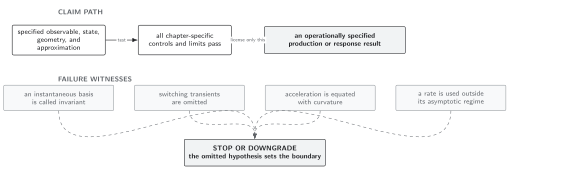
A finite-pulse trajectory licenses in/out number and total flux; horizon-like or ultraviolet idealizations require narrower wavepacket or cutoff-qualified claims. Schematic and not to scale.
Use the flux and in/out rows in Domain and failure conditions. Check , timelikeness, asymptotic slopes, wavepacket normalization, Schwarzian sign, integrated flux, boundary work, reflectivity scale, and the order of long-time and cutoff limits.
Check your understanding
Section titled “Check your understanding”Why is the total energy nonnegative for an asymptotically inertial ray map even though the instantaneous flux can be negative?
Solution
After integrating the Schwarzian and using at both ends,
The integrand is nonnegative. Local negative-flux intervals can occur, but positive intervals compensate them in this complete finite-pulse setting.
Chapter 6 owns collapse and gravitational horizons; Chapter 7 owns general stress renormalization; specialist resources own device-level dynamical Casimir modeling.
References
Section titled “References”- P. C. W. Davies and S. A. Fulling, “Radiation from Moving Mirrors and from Black Holes,” Proceedings of the Royal Society A 356 (1977), 237–257, DOI.
- S. A. Fulling and P. C. W. Davies, “Radiation from a Moving Mirror in Two Dimensional Space-Time: Conformal Anomaly,” Proceedings of the Royal Society A 348 (1976), 393–414, DOI.
Original QFT.org content:CC BY 4.0, unless an item supplies different terms. Third-party material retains its own terms.