

Validity, Unitarity, and Breakdown
Gravity EFT is valid only where every expansion used by a declared observable is controlled. Soft external momentum is insufficient: background curvature, enhanced species loops, large Wilson coefficients, thresholds, secular duration, or an unstable response can fail first. Breakdown ends the low-energy claim but does not by itself identify the ultraviolet theory that replaces it.
Required background. Applying EFT Power Counting to Gravity supplies expansion parameters; One-Loop Graviton EFT supplies loop structure; and EFT Truncation Errors and Breakdown Diagnostics supplies remainder estimates.
Helpful background. Hilbert Positivity and Unitary Evolution supplies the unitarity condition, while Linear Response and Semiclassical Stability supplies background stability tests.
A validity envelope for one observable
Section titled “A validity envelope for one observable”For a process of characteristic invariant energy on a background sampled by an apparatus-frame curvature scale , define
Here is the largest relevant tidal or curvature eigenvalue rather than a coordinate component, denotes the declared graviton–ghost channel, and is a -derivative operator in the chosen basis. If the observable lasts for time , add an observable-specific secular parameter such as
where may be a logarithm, a power, or a resonant response derived from the calculation. There is no universal secular function. A compact stopping statistic is
where tests occupation, fluctuations, or proximity to an instability when relevant. Control requires not merely but also inclusion of every contribution at the claimed order. Burgess derives gravitational power counting tied to amplitudes and backgrounds in Burgess 2004, §§2.2–2.4 and 3.1.
The structure map collects these independent tests only after the observable and active modes have been fixed.

The applicable cutoff is the first scale at which any expansion controlling the declared observable fails; different experiments can therefore have different practical limits. The map is schematic and not to scale.
First application: a weak-background scattering response
Section titled “First application: a weak-background scattering response”Consider a graviton-mediated matter amplitude at energy measured in a weakly curved stationary region for a duration . Suppose the calculation retains tree-level Einstein exchange, one-loop terms from light species plus the metric–ghost sector, and one six-derivative coefficient . Its relative correction has the schematic organization
The curvature term is an expansion around the flat amplitude only when both and are controlled; if is exceptionally small, a background-adapted calculation may be required instead. Taking removes an artificial large renormalization logarithm, while a physical logarithm of separated scales remains and may require renormalization-group resummation.
A reproducible claim reports the numerical values or bounds for every applicable , varies the matching scale, and estimates the first omitted complete order. For example, if all retained corrections are and the basis is closed there, the residual should scale as . An accidental cancellation among the displayed coefficients does not justify replacing that estimate by the small net answer.
Now perform the adversarial test: keep while increasing toward unity. The derivative expansion fails even though every external momentum is soft. Alternatively, keep and small but let a retarded response grow until ; fixed-order late-time perturbation theory then fails without any high-energy scattering.
Partial-wave unitarity
Section titled “Partial-wave unitarity”For a short-range amplitude with convention
unitarity gives
in the elastic normalization. A tree amplitude approaching this boundary indicates that loops or new dynamics must enter before the extrapolation is trusted. Gravity adds an important qualification: massless -channel exchange is forward singular, so a naive partial-wave integral is infrared divergent. One must define an infrared-safe observable, remove the universal long-range phase, impose a physical angular resolution, or use an impact-parameter description before interpreting a bound.
Order-by-order unitarity below the cutoff is compatible with the nonrenormalizability of the Einstein action. Nonanalytic one-loop discontinuities must match products of lower-order amplitudes; local counterterms affect only analytic pieces, as illustrated in Donoghue 1994, §§III–IV, pp. 3878–3884. A formal above-cutoff pole of a higher-derivative truncation is not an extra unitarity channel within the EFT.
What each failure means
Section titled “What each failure means”When or reaches unity, omitted local operators compete. When reaches unity, fixed-loop perturbation theory fails. When reaches unity, the weak-curvature derivative expansion fails. When reaches unity, the selected time expansion fails. A threshold crossing may instead demand a new active-field EFT even while all these parameters remain small.
These diagnoses do not select strings, asymptotic safety, extra particles, or any other completion. They state which assumption stopped licensing the calculation. Multiple descriptions may be possible beyond that boundary, and discriminating among them requires additional observables or microscopic input.
Domain and failure conditions
Section titled “Domain and failure conditions”The chapter comparison table requires the observable, kinematics, apparatus-frame curvature, active spectrum, coefficients, regulator, duration, state, desired error, and cutoff definition. The partial-wave statement additionally requires an infrared prescription appropriate to massless gravity.
The failure map makes a low momentum pass only one branch of a multi-parameter decision.
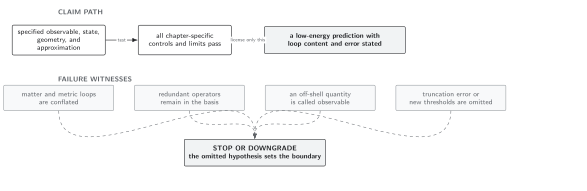
Validity is observable specific and ends at the earliest failed expansion; identifying that boundary is a controlled result, whereas naming a UV completion requires new evidence. The map is schematic and not to scale.
References
Section titled “References”- Burgess, C. P. “Quantum Gravity in Everyday Life: General Relativity as an Effective Field Theory.” Living Reviews in Relativity 7, 5 (2004). doi:10.12942/lrr-2004-5. Open PDF
- Donoghue, J. F. “General Relativity as an Effective Field Theory: The Leading Quantum Corrections.” Physical Review D 50, 3874–3888 (1994). doi:10.1103/PhysRevD.50.3874. Open PDF
Original QFT.org content:CC BY 4.0, unless an item supplies different terms. Third-party material retains its own terms.