

Causal Support, Signaling, and Global Geometry
Global geometry determines where a field-mediated channel can have causal gain. Null propagation produces the familiar light-cone signal; curvature, mass, dimension, boundary conditions, or topology can also produce retarded tails inside the cone. Such timelike signaling respects causality. Correlated outcomes outside direct null support establish neither a signal nor superluminality until the smeared commutator is tested.
Required background. Curved Spacetimes, Cauchy Surfaces, and Global Hyperbolicity supplies causal diamonds and well-posed evolution. From Propagators and Response Functions to Channel Maps identifies causal gain. Signaling, No-Signaling, and Causal Composition supplies the operational criterion.
Helpful background. Correlation Extraction versus Causal Exchange separates state correlations from response. Local Field Algebras, Causality, and the Time-Slice Property gives the algebraic locality statement. Joint Measurements and Spacelike Composition treats compatible spacelike interventions.
Support of the causal propagator
Section titled “Support of the causal propagator”For on a globally hyperbolic spacetime, the advanced and retarded Green operators obey
Thus vanishes between causally disjoint supports and
there. This is microcausality. It forbids a sender operation in from changing outcome probabilities of a receiver operation in a causally disjoint , provided the interventions themselves are localized and compose causally.
Inside a convex normal neighborhood, a four-dimensional retarded Green function has the Hadamard form
up to the normalization convention for Synge’s world function . The term propagates on the null cone. The term is a tail inside it. Strong Huygens propagation means the relevant tail vanishes; it is exceptional, not generic. Massless conformally coupled propagation in a conformally flat four-dimensional region inherits the null-cone behavior of Minkowski space, whereas a mass, nonconformal coupling, or generic curvature can produce .
Signaling is a change under an intervention
Section titled “Signaling is a change under an intervention”Let the sender choose and the receiver measure a POVM element . An operational signaling estimator is
At leading order in local detector couplings, the sender-dependent part is proportional to a smeared commutator,
The proportionality factor depends on the preparations and receiver observable. The field anticommutator can affect the baseline variance and joint correlations but cannot replace this intervention-dependent term. Consequently, a tail permits communication between timelike-separated laboratories after the direct null pulse has passed, while a Wightman correlation between spacelike regions does not.
Matched Huygens and tail fixtures
Section titled “Matched Huygens and tail fixtures”Consider two compact detector switchings in spatially flat four-dimensional FLRW spacetime,
Keep the same conformal-coordinate supports, detector gaps measured in proper time, spatial smearings, coupling amplitudes, and field state prescription.
- Huygens fixture: use a massless conformally coupled field. In the site convention . After the conformal rescaling, the commutator has only null-cone support. If every pair of points in the two compact supports is strictly timelike and no null pair occurs, the leading signal integral vanishes.
- Tail fixture: use a massless minimally coupled field, , on an expanding background for which the retarded solution has an interior term. The same strictly timelike supports can now give and hence a nonzero signal.
This comparison holds the state and local protocol choices fixed as far as the two field theories permit, while changing the propagation law. Explicit cosmological detector calculations exhibit timelike information transmission from violation of the strong Huygens principle Blasco et al. 2015, pp. 141103-1–141103-5. The result is a model calculation: it demonstrates a causal tail channel for the stated field and FLRW backgrounds, not a universal enhancement by expansion.
Horizons and topology require the same discipline. If , no retarded channel connects them in that deployment. A reflecting boundary or nontrivial topology may create additional causal paths or image contributions, but every path remains within the causal structure of the full initial-boundary-value problem. An event horizon restricts which receiver regions can be reached; it does not by itself define a noisy trace or prove information destruction.
Correlation outside direct null support
Section titled “Correlation outside direct null support”Suppose the detectors become correlated although their switching regions have no direct null connection. Three cases must be separated:
- If the regions are causally disjoint, ; the correlation can come from the state, common causes, or apparatus, but not sender-to-receiver signaling.
- If they are timelike related and only through , the protocol has a causal tail channel.
- If a boundary or topology supplies another null or timelike path, “outside direct support” was only a statement about one geodesic, not the full propagator.
The adversarial test is therefore decisive: compute or bound the retarded commutator before attaching either a superluminal or geometry-induced channel interpretation.
Domain, limits, and maps
Section titled “Domain, limits, and maps”The canonical comparison appears at Domain and failure conditions. The support theorem assumes global hyperbolicity or a well-posed declared boundary problem. Caustics can change the local form of singularities, and tails can interfere, but neither enlarges support beyond . Perturbative detector estimators additionally require controlled switching, smearing, and coupling order.
The structure map locates the support calculation in the propagation stage. Inspect the commutator checkpoint: it decides whether the receiver gain is causally available before state noise is considered.

Null-cone and tail contributions both remain causal; the smeared commutator, not visual proximity or correlation, determines signaling support. Schematic; not to scale.
The failure map stops the claim when a correlation is presented without a response test. Tail support can repair that claim only when the retarded kernel is explicitly nonzero.
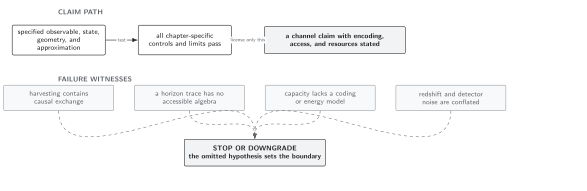
Outside direct null support, the claim is downgraded to correlation unless an allowed tail or alternate causal path gives nonzero response. Schematic; not to scale.
Handoffs
Section titled “Handoffs”Correlation Extraction versus Causal Exchange on Curved Backgrounds decomposes detector correlations. Horizon-Restricted Local Operations and Distillability identifies accessible algebras when horizons matter. Green-function existence and support remain with Green Operators, Causal Propagators, and State-Dependent Two-Point Functions.
References
Section titled “References”- Blasco, Ana, Luis J. Garay, Mercedes Martín-Benito, and Eduardo Martín-Martínez. “Violation of the Strong Huygen’s Principle and Timelike Signals from the Early Universe.” Physical Review Letters 114 (2015): 141103. DOI. Open PDF.
- Fewster, Christopher J., and Rainer Verch. “Quantum Fields and Local Measurements.” Communications in Mathematical Physics 378 (2020): 851–889. DOI. Open PDF.
Original QFT.org content:CC BY 4.0, unless an item supplies different terms. Third-party material retains its own terms.