

Curved-Spacetime Channel Deployment Contract
A curved-field communication claim becomes meaningful only after every map between preparation and readout has been fixed. The minimal specification names the spacetime and field state, sender and receiver worldlines, localized couplings, clocks, encoding, accessible output algebra, decoding, resource constraint, and performance metric. Omitting any one of these can turn a numerical “fidelity” into a comparison between undefined tasks.
Required background. Completely Positive Maps and Causal Quantum Channels supplies the channel axioms. Algebraic Quantum Channels and Localized Operations identifies operations by spacetime support, and Localized Probe and Detector Models supplies the probe–field interaction.
Helpful background. Detector Response Along Curved and Accelerated Worldlines fixes proper-time response. Switching, Smearing, and Detector Regularization controls ultraviolet and switching effects. Operational Locality and Local Measurement Instruments explain supported interventions and readout.
The deployment data
Section titled “The deployment data”Take a globally hyperbolic spacetime and a real field satisfying
In four dimensions the site’s signed conformal coupling is . A localized probe may couple through
where is compactly supported, is a normalized spatial smearing in a specified detector frame, and is a probe observable. The support region , not a coordinate interval alone, determines causal relations. The corresponding local scattering morphism or unitary is meaningful only within the chosen interaction model; pointlike or sudden-switching limits require separate distributional control. A local-measurement construction that respects causal factorization is developed by Fewster and Verch 2020, §§ 3–5.
A reproducible deployment record contains:
- Background: , boundary conditions if any, field equation, and a state on the relevant algebra.
- Laboratories: worldlines or worldtubes, tetrads, proper-time origins, and clock synchronization rule.
- Interventions: interaction density, coupling strengths, switching, smearing, perturbative or exact regime, and ordering of supports.
- Code: input system, message ensemble, map , and any reference system used to test entanglement fidelity.
- Access: a receiver algebra or an explicitly normalized set of decoded modes; inaccessible modes must be identified rather than inferred from a drawing.
- Task and resources: decoder , number of uses, assistance, error criterion, energy Hamiltonian, bandwidth, interaction time, and backreaction tolerance.
The channel is then a map on a declared input state space,
The restriction symbol is deliberately algebraic. It may be represented by a partial trace only after a subsystem factorization or split construction has been supplied.
Static two-probe application
Section titled “Static two-probe application”Let
be static, with probes held at and . Their proper times satisfy . Choose smooth compact switchings with to the causal future of , and use a finite-width wavepacket code supported by the sender coupling. For a binary coherent code, prepares or with equal prior probability. The receiver couples to a mode defined in its local tetrad and measures a declared quadrature POVM.
At weak coupling, the receiver mean shifts linearly,
where is an integral of switching, smearing, detector response, and the retarded kernel. The receiver variance contains its preparation noise and the state-dependent field covariance. These are separate reported quantities: is causal gain, while the covariance determines added noise.
For an energy constraint, choose the sender’s local Hamiltonian and require . A Killing-energy convention instead weights local frequency by ; the two conventions may be translated, but not silently exchanged. State the decoding error, for example the Helstrom error for the two receiver outputs,
This completes the first application: every factor entering the result can be changed independently and reproduced.
The undefined-task test
Section titled “The undefined-task test”Now retain the same number labeled “fidelity” but delete . There is no longer a specified output system on which either the decoded state or the comparison state lives. Alternatively, delete the energy constraint and optimize a bosonic code over arbitrarily energetic inputs; the optimization no longer describes the original finite-resource protocol. In the first case no channel task survives. In the second, fixed-code one-shot performance may survive, but an optimized rate does not.
Domain, limits, and maps
Section titled “Domain, limits, and maps”The chapter-wide comparison is Domain and failure conditions. This page licenses a channel statement only for the declared geometry, state, supported interactions, receiver algebra, code, resource set, and approximation order. It does not establish that an idealized detector is an available instrument, that perturbation theory controls strong coupling, or that ignoring backreaction remains valid at arbitrary energy.
The structure map shows where each deployment datum enters. Inspect the path from the localized sender coupling to the receiver algebra: field propagation alone is not yet the task-specific channel.

Geometry, state, localized couplings, access, decoding, and resources jointly define the deployed channel; none is supplied by the word “curved.” Schematic; not to scale.
The failure map makes the adversarial deletion explicit. A performance number without an output algebra or resource model must stop before the channel claim.
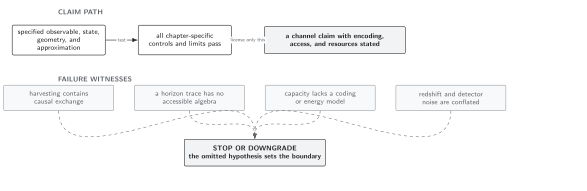
The claimed fidelity or rate is licensed only after the accessible algebra, encoding, decoding, and resource constraint are specified. Schematic; not to scale.
Handoffs
Section titled “Handoffs”From Propagators and Response Functions to Channel Maps derives the gain and covariance. Causal Channels and Relativistic Communication owns the abstract coding theory, while Energy-Constrained Capacity Under Redshift and Acceleration adds asymptotic rates.
References
Section titled “References”- Fewster, Christopher J., and Rainer Verch. “Quantum Fields and Local Measurements.” Communications in Mathematical Physics 378 (2020): 851–889. DOI. Open PDF.
- Martín-Martínez, Eduardo, Miguel Montero, and Marco del Rey. “Wavepacket Detection with the Unruh–DeWitt Model.” Physical Review D 87 (2013): 064038. DOI. Open PDF.
Original QFT.org content:CC BY 4.0, unless an item supplies different terms. Third-party material retains its own terms.