

Ray Tracing and the Hawking Bogoliubov Map
The ray-tracing function contains the kinematic content of a collapse Hawking calculation. Its leading exponential fixes the thermal ratio; its subleading terms determine transients and finite-time corrections. Wavepackets are essential because continuum frequency eigenmodes have infinite duration and hide when the late-time approximation becomes valid.
Required background. Hawking radiation from collapse supplies the physical state and geometry, while in/out modes and number operators fixes Bogoliubov normalization.
Helpful background. WKB and turning-point matching supports the ray approximation, and moving mirrors gives an exactly tractable two-dimensional analogue.
Fourier transform of the exponential map
Section titled “Fourier transform of the exponential map”Take
With Klein–Gordon-normalized right-moving modes, one common phase convention gives a kernel proportional to
Set . Apart from an irrelevant phase and the normalization fixed by the full Cauchy surface,
The corresponding coefficient has in place of the negative exponential, so
Overall phases and a possible exchange of factors depend on whether the transform is written on null infinity or a complete Cauchy surface; the ratio and packet normalization are the invariant checks. Hawking’s calculation uses precisely this branch structure (Hawking 1975, § 2).
Define packets of bandwidth by
They are centered near retarded time and frequency . A useful thermal statement requires to resolve the spectrum while the packet duration remains short compared with background evolution. These inequalities compete in an evaporating geometry.
The structure map places this explicit transform in the near-horizon box. It determines a mode relation; the greybody barrier and renormalized energy flux are not contained in the Gamma function.

Ray tracing inside the controlled Hawking construction. The diagram is schematic and not to scale; wavepacket Bogoliubov coefficients establish thermality only at their stated late-time resolution.
The failure map focuses attention on changing . A subleading perturbation can alter transients without invalidating the asymptotic temperature, whereas a change of the leading peeling law can alter the spectrum itself.
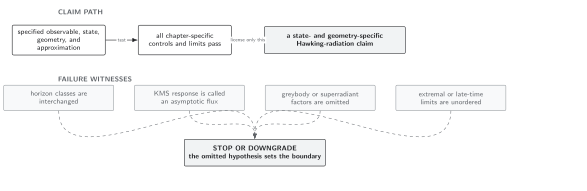
Validity boundary for the Bogoliubov map. This schematic, not-to-scale map requires the leading exponential, packet resolution, and normalization to be tested before exact thermality is claimed.
Application: packets and finite-time thermality
Section titled “Application: packets and finite-time thermality”For the pure exponential map, packet integration removes the continuum and gives
after the late-time packet lies within the exponential regime. For narrow bins this equals the Planck factor at plus binning corrections. Early packets sample the nonexponential part of the collapse map and are transient, not thermal.
Now perturb
Expanding the Fourier phase shows relative corrections for a packet centered at . The leading Planck ratio survives at late time. However, the integrated transient energy can change, and a two-dimensional stress flux depends on derivatives of the full map through its Schwarzian derivative. Exact thermality at all times therefore does not follow from asymptotic thermality.
If instead has a time-dependent peeling rate
then a local thermal approximation requires over the packet. If becomes power law, oscillatory, or terminates, the Gamma-function derivation and its Planck ratio need not survive.
Domain and failure conditions
Section titled “Domain and failure conditions”The chapter domain and failure-conditions table supplies the surrounding distinctions. This page assumes normalized in/out modes, an affine , a monotone ray map, a leading exponential over the packet support, and compatible frequency/time resolution. These inputs license the displayed Bogoliubov ratio and its late packet occupation. Subleading decaying terms license the same temperature with transient errors; a changed leading map or failed packet hierarchy requires a nonthermal spectrum. No result here licenses unit greybody transmission or a four-dimensional luminosity.
Exercise
Section titled “Exercise”Use to expose the Planck denominator in .
Solution
The modulus of the displayed coefficient contains
with . The remaining normalization and factor encode continuum mode density; packetization makes the number finite.
Handoff
Section titled “Handoff”The number spectrum is one observable. A renormalized stress tensor provides an independent energy-flux calculation and exposes exactly what a two-dimensional reduction can and cannot predict in four dimensions.
References
Section titled “References”- Hawking, Stephen W. “Particle Creation by Black Holes.” Communications in Mathematical Physics 43 (1975): 199–220. doi:10.1007/BF02345020.
- Unruh, William G. “Notes on Black-Hole Evaporation.” Physical Review D 14 (1976): 870–892. doi:10.1103/PhysRevD.14.870.
Original QFT.org content:CC BY 4.0, unless an item supplies different terms. Third-party material retains its own terms.