

Gravitational Production of Massive Relics
Expansion can create a population of massive quanta even when the field has no direct coupling to a thermal bath. A relic prediction begins only after a late-time particle basis exists and then requires spin and statistics, the full transition history, dilution, entropy production, subsequent interactions, and backreaction to be specified.
Required background. FLRW mode quantization fixes canonical normalization; adiabatic particle number fixes the late-time projection and its error; and time-dependent particle creation supplies the Bogoliubov interpretation. Helpful background. Review spinor and gauge fields and mass thresholds and decoupling.
From mode mixing to a comoving abundance
Section titled “From mode mixing to a comoving abundance”For a massive conformally coupled scalar, the site value removes the curvature potential and the canonical mode equation is
Suppose the geometry has adiabatic early and late regimes. Relative to normalized in and out modes,
After subtracting the out-vacuum contribution, the distribution is . For degeneracy its physical number and energy densities are
The factors of distinguish a conserved comoving number from physical density. Once the population is nonrelativistic, . A yield remains constant only through epochs in which the entropy current is conserved and number-changing interactions are negligible. Those assumptions are additional cosmology, not consequences of the mode equation.
Bosonic and fermionic mode equations, normalization relations, degeneracies, and high-momentum tails differ. Pauli blocking gives for each fermion helicity, whereas bosonic amplification has no analogous one-mode ceiling. A scalar result therefore cannot be transferred to another spin by merely changing .
First application: inflation-to-radiation production
Section titled “First application: inflation-to-radiation production”Choose a scale factor that approaches quasi-de Sitter expansion and then radiation domination over a physical duration . Initialize fourth-order adiabatic in modes, evolve the exact equation through the transition, and project onto second- and fourth-order out bases only after is uniformly small over the contributing band. Integrate to obtain and report separate uncertainties from time stepping, momentum truncation, WKB order, and the background interpolation.
The classic superheavy-relic calculation shows explicitly how the result depends on , the end-of-inflation transition, and the subsequent expansion history Chung, Kolb, and Riotto 1998, §§II–IV, pp. 023501-2–023501-10. A current community review likewise treats gravitational production as one conditional mechanism among several, not a universal abundance theorem Carney et al. 2023, §2.2, pp. 9–12. The evidence class here is a model calculation. It predicts a population for the declared smooth history; identifying that population with all dark matter additionally requires stability, an entropy history, interaction bounds, and phenomenological tests.
The structure map shows where a late particle spectrum becomes an abundance only after dilution and consistency checks. Inspect the separation between mode production and relic transfer.

Bogoliubov production supplies ; spin, degeneracy, expansion, entropy, stability, and interactions determine whether it becomes a surviving massive relic. Schematic; not to scale.
Domain and failure conditions
Section titled “Domain and failure conditions”The chapter’s canonical domain table records the required late basis and smooth-history control. The calculation assumes a free spectator field during production, an adiabatic out region, convergent momentum integrals, and whenever the background is treated as fixed.
Adversarial test. Replace a sharp transition by a family of smooth scale factors with durations , raise the initial and final adiabatic orders, and refine the momentum grid. Reject any abundance whose dominant modes move with the numerical cutoff, whose value fails to approach a smooth-transition limit, or whose backreaction becomes order unity. A genuine rapid-transition prediction may depend on the physical ; it must not depend on an unresolved discontinuity used in place of it.
The validity map separates controlled production from artificial junction excitations. A surviving abundance may be handed to a Boltzmann or structure-formation calculation only with its phase-space distribution, entropy history, stability assumptions, and uncertainty envelope attached.
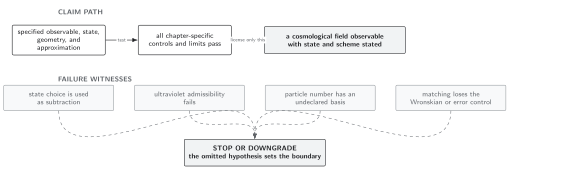
Smooth-transition convergence, late-basis stability, finite density, and small source stress are necessary before a mode calculation supports a relic claim. Schematic; not to scale.
References
Section titled “References”- Carney, D., et al., “Snowmass2021 Cosmic Frontier White Paper: Ultraheavy Particle Dark Matter,” SciPost Physics Core 6, 075 (2023), doi:10.21468/SciPostPhysCore.6.4.075.
- Chung, D. J. H., E. W. Kolb, and A. Riotto, “Superheavy Dark Matter,” Physical Review D 59, 023501 (1998), doi:10.1103/PhysRevD.59.023501.
Original QFT.org content:CC BY 4.0, unless an item supplies different terms. Third-party material retains its own terms.