

Modified Dispersion, Analogue Horizons, and Universality
Dispersive horizon models replace the arbitrarily short relativistic precursor by explicit high-wavenumber dynamics. They show, in a calculation rather than by analogy alone, how positive- and negative-norm branches convert near a blocking point. Their strongest durable conclusion is conditional robustness of a mode-conversion mechanism; they do not identify the ultraviolet theory of gravity or establish an astrophysical Hawking flux.
Required background. Trans-Planckian sensitivity defines the question being tested; adiabaticity and Stokes phenomena supplies the branch-conversion analysis; and controlled EFT expansions explains scale separation and matching.
Helpful background. Evidence limits for analogue and astrophysical claims separates model evidence from target-system evidence, and the Schwinger–gravitational production comparison provides a second example of mode conversion with distinct physical dynamics.
Dispersive branches at a stationary horizon
Section titled “Dispersive branches at a stationary horizon”Work in one spatial dimension with a stationary medium velocity and preferred-frame dispersion
Here is conserved laboratory frequency, is comoving frequency, and the sign of fixes the norm sign for the usual dispersive scalar products. Near a right-moving horizon choose
Two ultraviolet laws with the same low-energy light cone are
is superluminal at large ; is subluminal and saturating. Both obey near the origin, but they have different high- roots and turning points. A comparison is meaningful only if it holds fixed , , , the low- normalization, the incoming state, the asymptotic boundary conditions, and the observable.
The number of real roots of
can change with . The rays follow Hamilton equations and ; at a turning point two WKB roots join and must be connected rather than discarded. Norm conservation then has the schematic form
for one unit-norm incoming branch. This signed relation, not an ordinary probability sum over roots, is the first numerical check.
The structure map places analogue calculations at the near-horizon mode step. The model can also supply its own scattering channels, but those are the medium’s channels rather than the Regge–Wheeler potential of an astrophysical black hole.

Dispersive horizon workflow. This diagram is schematic and not to scale; matching surface gravity and a low-frequency spectrum does not match gravitational dynamics, exterior greybody propagation, or backreaction.
The failure map is an inference test. Its endpoint changes from “gravitational Hawking flux” to “quasiparticle spectrum in the specified medium” unless geometry, state, scattering, and observables are independently related to the gravitational target.
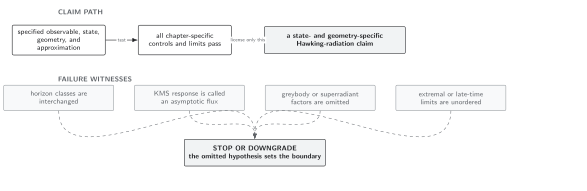
Evidentiary boundary of an analogue result. The map is schematic and not to scale; omitted gravitational field equations, global state preparation, greybody factors, and metric backreaction prevent promotion to an astrophysical flux claim.
Application: the same low-energy spectrum from two laws
Section titled “Application: the same low-energy spectrum from two laws”The leading connection coefficient can be computed in momentum space without pretending that the two ultraviolet theories are identical. On the outgoing positive-comoving-frequency branch,
Using the linear velocity profile gives
For either or , the second term is analytic at after a branch is fixed, whereas the first has residue . Continuing the WKB phase around the origin above or below its branch cut produces an imaginary action . Hence the norm ratio is
at leading near-horizon order for both laws. The calculation explains why the Hawking exponent can survive very different high- rays: it is controlled by the low- pole and analyticity of the continuation, not by equality of every root.
This result is not the complete spectrum. To compute the comparison reproducibly:
- choose a smooth that becomes constant on both sides and record ;
- set a hierarchy such as and a packet window ;
- enumerate all asymptotic roots of , label group velocity and norm sign, and prepare the same adiabatic incoming vacuum for both and ;
- integrate a flux-conserving stationary mode equation or match uniform WKB solutions across every turning point;
- extract the full scattering matrix and verify its indefinite-unitarity relation;
- report , , correlations between partner branches, and convergence under domain size, resolution, profile width, and .
The contour result predicts the common limit of . Deviations in the absolute occupation can arise from extra branches, finite profile width, state preparation, or remote boundaries. Corley and Jacobson’s explicit dispersive calculations exhibit both near-thermal spectra and model-dependent features (1996, §§ II–VI); Unruh and Schützhold identify sufficient hypotheses and counterexamples (2005, §§ III–V).
What analogue evidence establishes
Section titled “What analogue evidence establishes”Unruh’s acoustic construction shows that linear perturbations of a fluid can propagate in an effective Lorentzian geometry with a sonic horizon (1981, pp. 1351–1353). In a particular medium, measurements or simulations can test the effective wave equation, dispersion, blocking point, branch populations, stimulated or spontaneous emission, and partner correlations. Those are substantive tests of horizon mode conversion and of the medium’s quantum or classical fluctuation theory.
They leave unmatched, unless separately demonstrated:
- the Einstein dynamics that creates an astrophysical geometry;
- the gravitational field’s ultraviolet degrees of freedom and symmetries;
- the global Hadamard state produced by gravitational collapse;
- four-dimensional angular barriers and physical greybody factors;
- the renormalized stress tensor at null infinity; and
- self-consistent metric backreaction and energy loss.
The 2026 Living Reviews in Relativity synthesis surveys modern analogue systems while preserving the distinction between effective kinematics and the dynamics of the underlying medium (Barceló, Liberati, and Visser 2026, §§ 2, 4, and 6). Thus an analogue spectrum can support a universality class of effective mode equations. It cannot, by itself, confirm a quantum-gravity mechanism or the luminosity of a real black hole.
Adversarial test: promote the model, then remove the excess claim
Section titled “Adversarial test: promote the model, then remove the excess claim”Suppose the two laws yield the same and a laboratory system measures the corresponding partner correlation. The overstrong conclusion is “Hawking radiation is universal and ultraviolet gravity has been tested.” Now list the unmatched items above. None is supplied by the spectral agreement.
The strongest surviving conclusion is narrower and still valuable: within the prepared medium and within errors, horizon mode conversion is insensitive to the tested change of dispersion over the stated window. If the calculation alone was performed, this is controlled-model evidence. If a quantitative laboratory spectrum and correlations were measured with systematic controls, it is empirical evidence for that analogue system. The gravitational ultraviolet inference remains open.
Domain and failure conditions
Section titled “Domain and failure conditions”See the chapter domain and failure-conditions table. The leading contour result assumes stationarity, a simple linear horizon, analytic dispersion near , an adiabatic incoming state, separated scales, and complete root accounting. Strong dissipation, nonanalytic response, unstable extra branches, an excited incoming state, or remote boundary feedback can invalidate it. Evidence was checked through 10 August 2026; experiments and platform-specific claims are intentionally left to dated research coverage.
Exercise
Section titled “Exercise”Expand the two dispersion laws at and identify the sign of the first correction.
Solution
For the superluminal law,
For the saturating law,
Their group-velocity corrections have opposite signs even though the residue of at is the same. This is why a common leading thermal exponent does not imply identical ray trajectories or subleading spectra.
Handoff
Section titled “Handoff”Slowly evaporating backgrounds replaces stationary by a time-dependent peeling rate and asks whether a wavepacket can resolve a locally thermal interval.
References
Section titled “References”- Barceló, Carlos, Stefano Liberati, and Matt Visser. “Analogue Gravity.” Living Reviews in Relativity 29 (2026): 2. doi:10.1007/s41114-026-00064-9.
- Corley, Steven, and Ted Jacobson. “Hawking Spectrum and High Frequency Dispersion.” Physical Review D 54 (1996): 1568–1586. doi:10.1103/PhysRevD.54.1568.
- Unruh, William G. “Experimental Black-Hole Evaporation?” Physical Review Letters 46 (1981): 1351–1353. doi:10.1103/PhysRevLett.46.1351.
- Unruh, William G. “Sonic Analogue of Black Holes and the Effects of High Frequencies on Black Hole Evaporation.” Physical Review D 51 (1995): 2827–2838. doi:10.1103/PhysRevD.51.2827.
- Unruh, William G., and Ralf Schützhold. “Universality of the Hawking Effect.” Physical Review D 71 (2005): 024028. doi:10.1103/PhysRevD.71.024028.
Original QFT.org content:CC BY 4.0, unless an item supplies different terms. Third-party material retains its own terms.