

Coleman–De Luccia Bounces
A Coleman–De Luccia (CDL) bounce is a regular, inhomogeneous Euclidean solution of the coupled scalar–gravity equations. It supplies a semiclassical action difference and, after a separately justified continuation, initial data for a Lorentzian bubble. It does not by itself supply the fluctuation prefactor, the contour, or a cosmological completion history.
Required background. Euclidean gravitational saddles and boundary terms fixes the action, pole regularity, and matched subtraction used below. Bounce existence and symmetry supplies the flat-space shooting logic, and thin-wall control supplies the wall-profile expansion.
Helpful background. False-vacuum decay with gravity distinguishes an invariant proper-volume rate from a foliation-dependent survival probability.
The regular O(4) boundary-value problem
Section titled “The regular O(4) boundary-value problem”Write and absorb the Euclidean cosmological constant into
For an -invariant saddle,
the field equation, scale-factor equation, and Hamiltonian constraint are
A compact bounce has two regular poles. At the first,
and at it obeys , , and . The unknown shooting datum is . The constraint is not an extra evolution equation: it is a stringent numerical residual. Coleman and De Luccia derive this coupled boundary-value problem and its continuation (Coleman and De Luccia 1980, Eqs. (3.1)–(3.11)).
Near a regular pole, direct division by is ill conditioned. A stable integration starts from a series at ,
One varies , integrates the two second-order equations, and demands regular arrival at the second pole. Overshoot/undershoot language remains useful, but gravity can change the topology of the shooting branches. A solver should therefore continue branches in a potential parameter rather than assume that the first root is unique.
Thin-wall radius and exponent
Section titled “Thin-wall radius and exponent”Suppose the false and true vacua have , define , and let be the wall tension computed from a parametrically thin microscopic wall. On the ordinary cap branch, with
the thin-wall action difference as a function of the junction radius is
where each term is understood by continuity. Extremizing gives
For other embeddings, each square root carries a cap-orientation sign fixed by the outward normal; changing that sign without changing the glued geometry is not another convention for the same solution. Parke gives the analytic thin-wall classification and branch structure (Parke 1983, Eqs. (10)–(17)).
The weak-gravity limit is a decisive normalization check:
Expanding the gravitational expression at fixed and reproduces
and hence and . A claimed thin-wall computation that misses this limit has mismatched caps, subtraction, or signs.
The analytic benchmark is controlled only if the wall thickness satisfies and , the field is exponentially close to each vacuum outside the wall, and the numerical solution lies on the same cap branch. The comparison should use both and the matched , not merely a similar-looking profile.
Gravitational quenching as an adversarial test
Section titled “Gravitational quenching as an adversarial test”For Minkowski or anti-de Sitter false vacua, increasing the tension can remove the finite-radius decay bounce. In the thin-wall regime with , the critical bound is
At equality the radius diverges and the limiting configuration is a planar static wall. Above it, continuing the algebraic expression onto an unrelated square-root branch does not establish decay. The full thick-wall problem can have a more intricate branch diagram, so the scientific test is to track the regular numerical saddle as crosses the thin-wall boundary. Masoumi, Paban, and Weinberg derive the bound and analyze its relation to positive-energy conditions (Masoumi, Paban, and Weinberg 2018, Eq. (1) and §§ II, V).
Lorentzian bubble data
Section titled “Lorentzian bubble data”Analytic continuation through a reflection-symmetric surface gives a real Lorentzian solution only when the continued fields and extrinsic data are real. Continuing the regular interior pole yields an open-FLRW region,
with regular-origin data , , , and inherited from the Euclidean pole. These are initial data for classical evolution inside one idealized bubble. They do not determine bubble collisions, plasma friction, reheating, or the probability that the bubble was produced.
The structure map makes this handoff visible. Inspect the separation between the Euclidean boundary-value problem, its Lorentzian continuation, and the later expansion-history calculation.

The CDL handoff from a regular Euclidean saddle to an open-FLRW bubble interior. The diagram is schematic and not to scale; the action difference, fluctuation rate, and subsequent cosmological history are distinct outputs.
The failure map identifies the branch tests. In particular, it blocks the inference from a formal thin-wall root to a physical bounce when regularity, cap orientation, or the negative-mode interpretation has failed.
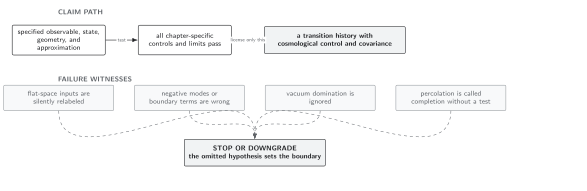
Checks on a CDL saddle and its continuation. The diagram is schematic and not to scale; branch disappearance downgrades the result to a statement about the limiting saddle, not a decay rate beyond the boundary.
Page-local assumptions and failure modes refine the chapter-wide domain and failure conditions. The determinant and contour question is taken up in negative modes, determinants, and prefactors, while expansion history and completion begins only after a rate and wall history have been supplied.
Exercise
Section titled “Exercise”Expand the thin-wall through order and recover the flat-space critical radius and exponent.
Solution
Using ,
The terms linear in cancel between the two vacua. Since ,
Thus gives . Substitution yields .
References
Section titled “References”- Coleman, S., and F. De Luccia. “Gravitational Effects on and of Vacuum Decay.” Physical Review D 21 (1980): 3305–3315. DOI.
- Masoumi, A., S. Paban, and E. J. Weinberg. “Tunneling from a Minkowski Vacuum to an AdS Vacuum: A New Thin-Wall Regime.” Physical Review D 97 (2018): 045016. DOI. Open PDF.
- Parke, S. “Gravity, the Decay of the False Vacuum and the New Inflationary Universe Scenario.” Physics Letters B 121 (1983): 313–315. DOI.
Original QFT.org content:CC BY 4.0, unless an item supplies different terms. Third-party material retains its own terms.