

Constructing Hadamard States by Deformation and Gluing
Hadamard states exist far beyond stationary spacetimes. The central construction is to obtain a positive reference state where spectral methods are available, transport it through a well-posed Cauchy problem, and use propagation of singularities to retain its ultraviolet form. Deformation and gluing refer to controlled changes of geometry or Cauchy data; multiplying two-point functions by an arbitrary partition of unity is not enough.
Required background. Propagation of the Hadamard Property supplies the local-to-global theorem. Local Covariance, Isometric Embeddings, and Boundaries supplies the causal embeddings and time-slice maps used in the transfer.
Helpful background. Operator Algebras and Positive Functionals explains why star isomorphisms preserve positivity. Quasifree States and Two-Point Functions supplies the covariance tests.
Deform to a reference geometry
Section titled “Deform to a reference geometry”Let be a smooth globally hyperbolic spacetime for a normally hyperbolic scalar operator. Choose a Cauchy temporal function and a second globally hyperbolic metric that is ultrastatic in a neighborhood of a Cauchy surface . Arrange an interpolating spacetime whose metric agrees with in an early Cauchy neighborhood and with in a later Cauchy neighborhood. The cone relations must be chosen so that the embeddings and Cauchy evolutions remain causal and well posed.
On the ultrastatic region, a positive self-adjoint spatial operator with no untreated zero-mode obstruction gives a ground-state covariance through . Its two-point function is Hadamard. The time-slice property then induces star isomorphisms along the chain of Cauchy regions,
Pulling the reference state through these isomorphisms preserves normalization and positivity. Near the transported Cauchy surface its two-point function has Hadamard form, and the propagation theorem extends that property globally. This is the deformation strategy behind the general existence result of Fulling, Narcowich, and Wald Fulling, Narcowich, and Wald 1981, pp. 243–272.
Cauchy-data form of the construction
Section titled “Cauchy-data form of the construction”Equivalently, encode a quasifree state by a positive covariance matrix on Cauchy data,
subject to the CCR antisymmetric part. Let map a spacetime solution to its field and future-normal derivative on . The spacetime two-point function is reconstructed by composing the Cauchy evolution with . A pseudodifferential construction chooses the principal symbols of these operators to be the positive-frequency projectors; lower-order smoothing corrections can then enforce exact positivity and the field equation.
This formulation makes the division of labor clear. Principal symbols control the wavefront orientation, exact operator identities control the CCR and constraints, and positive covariance controls statehood. A modern pseudodifferential realization of this program is given by Gérard and Wrochna 2014, §§ 6–7.
First application: ultrastatic reference to a target spacetime
Section titled “First application: ultrastatic reference to a target spacetime”A reproducible scalar construction proceeds as follows:
- declare the target , the Cauchy surface, and all boundary or zero-mode assumptions;
- choose an ultrastatic reference with positive spatial operator and construct its ground covariance;
- specify a smooth globally hyperbolic interpolation and verify the cone and Cauchy properties;
- transport the state through the time-slice isomorphisms;
- check the canonical antisymmetric part and positivity after transport;
- invoke Hadamard propagation only after the local wavefront condition is established.
The output is an existence construction, not a preferred vacuum. Different reference metrics or interpolations can produce different states whose two-point functions differ smoothly.
Why naive gluing fails
Section titled “Why naive gluing fails”Let and be Hadamard two-point functions and let . The pointwise splice
still has no worse local wavefront directions, but differentiating the cutoffs produces terms such as and . It is generally not a bisolution, its antisymmetric part is not , and cross terms needed for positivity are absent. Preserving the wavefront set is therefore not enough.
A valid gluing method works with Cauchy data or algebra morphisms and checks positivity after the correction. If only the microlocal test survives, the strongest remaining description is a Hadamard-shaped kernel, not a state.
Domain and failure conditions
Section titled “Domain and failure conditions”Deformation and Cauchy-data methods realize the construction-and-propagation box in the map. A positive reference state is transported through time-slice isomorphisms, while the Hadamard checkpoint controls its singularities; different reference geometries can lead to different admissible outputs.

Controlled deformation preserves algebraic statehood and propagates Hadamard form, but it does not turn the constructed state into a unique vacuum. Schematic; not to scale.
Naive partition-of-unity splicing illustrates the first failure witness: its wavefront directions may remain acceptable while the bisolution, CCR, or positivity conditions fail. The construction must stop until those exact conditions are restored.
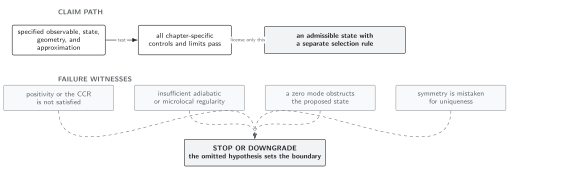
Microlocal regularity alone does not license a glued state; exact dynamics and positivity remain required controls. Schematic; not to scale.
The chapter-wide construction and selection distinctions appear in Domain and failure conditions.
Handoffs
Section titled “Handoffs”Ground, KMS, and Symmetry-Selected States supplies common reference states when a suitable time flow exists. Adiabatic States, WKB Order, and Regularity gives a constructive homogeneous approximation. Proofs of the deformation theorem, gluing, and modern pseudodifferential constructions continue in Existence, Deformation, and Gluing of Hadamard States.
References
Section titled “References”- Fulling, Stephen A., Frank J. Narcowich, and Robert M. Wald. “Singularity Structure of the Two-Point Function in Quantum Field Theory in Curved Spacetime, II.” Annals of Physics 136 (1981): 243–272. DOI.
- Gérard, Christian, and Michał Wrochna. “Construction of Hadamard States by Pseudodifferential Calculus.” Communications in Mathematical Physics 325 (2014): 713–755. DOI.
Original QFT.org content:CC BY 4.0, unless an item supplies different terms. Third-party material retains its own terms.