

Vacuum Energy and the Cosmological Constant
Vacuum energy is a relevant gravitational coupling, not an additive constant that can be discarded after gravity becomes dynamical. A heavy field contributes a local term of order when it is integrated out. Renormalization makes the measured curvature finite and scale independent, but it does not explain why the resulting cosmological scale is extraordinarily small compared with known particle thresholds.
Required background. Renormalization of Gravitational Couplings by Matter Loops supplies the local divergences; Applying EFT Power Counting to Gravity supplies relevant-operator counting; and Renormalized Stress Tensor: Axioms and Curvature Ambiguities supplies finite local freedom.
Helpful background. Decoupling Theorems and Threshold Corrections supplies heavy-field matching, while EFT Truncation Errors and Breakdown Diagnostics separates uncertainty from naturalness.
The site sign dictionary
Section titled “The site sign dictionary”Use
Write a state-independent vacuum term in the matter effective action as
Then , and the total zero-derivative action density is
The vacuum equation may therefore be written
The minus sign is specific to the site action, stress, and Riemann conventions as a package. For a spatially flat de Sitter solution in these conventions, , hence . With bare , a positive gives , the invariant physical check.
The structure map sends vacuum and Einstein terms through the same threshold match before any observed curvature is inferred.

Only the convention-consistent combination of the gravitational cosmological term and matter vacuum energy enters the mean curvature equation; neither term is separately observable. The map is schematic and not to scale.
First application: integrating out one heavy scalar
Section titled “First application: integrating out one heavy scalar”For a real scalar of mass in the standard normalization, the flat-space one-loop effective potential contributes
Curved-space matching also produces an threshold and curvature-squared logarithms; this calculation isolates the zero-derivative term. Above the threshold, is active and its loop is explicit. Below it, equality of the constant effective-action density gives
in the definitions above. The low-energy theory must not also include the same scalar vacuum bubble. Its physical cosmological combination is unchanged:
Choosing keeps the matching logarithm small. Differentiating the threshold term gives
which is cancelled by the running of the renormalized cosmological coupling in the full observable. The measured low-energy curvature is an independent renormalization condition; the formula does not predict it from alone.
Decoupling does not remove a relevant threshold
Section titled “Decoupling does not remove a relevant threshold”At external momenta , nonlocal heavy-field effects admit an expansion in . This is ordinary decoupling. The coefficients of relevant operators are nevertheless shifted by positive powers of : for vacuum energy and for the Einstein term. Appelquist–Carazzone decoupling never says that such matching corrections vanish; it says their low-energy effects can be absorbed into renormalized parameters plus suppressed operators Appelquist and Carazzone 1975, §III, pp. 2862–2866.
A hard momentum cutoff may display a contribution proportional to , whereas dimensional regularization contains no scaleless quartic integral. That regulator difference concerns how local bare and renormalized terms are partitioned. The finite physical threshold proportional to an actual mass remains after matching in either scheme.
Naturalness claim ceiling
Section titled “Naturalness claim ceiling”Renormalization answers how to make finite and independent of . It does not explain why the measured combination remains small after each known or hypothetical heavy threshold shifts its constituents by . Holding the small value fixed can require repeated adjustment of the renormalized cosmological coupling unless a further symmetry or dynamical mechanism correlates the terms.
This is a naturalness diagnosis, not a mathematical inconsistency and not an EFT breakdown: the low-energy theory remains predictive once is measured. Weinberg reviews the radiative-stability problem and the limits of adjustment mechanisms in Weinberg 1989, §§I–III, pp. 2–23. No generally accepted mechanism within ordinary low-energy gravity EFT determines the observed value.
State-dependent stress, phase-transition energy differences, and dynamical dark-energy models are separate inputs. A term may be absorbed into only if its stress is the local conserved form over the domain considered; a time-dependent or nonlocal source cannot be renamed a cosmological constant.
Domain and failure conditions
Section titled “Domain and failure conditions”The chapter comparison table requires the action and stress signs, regulator, subtraction scheme, active fields, matching scale, state, and measured cosmological parameter. The scalar formula assumes a stable real field and perturbative one-loop matching; phase transitions and nonequilibrium states require additional data.
The failure map distinguishes finite renormalization from a claimed solution of radiative instability.
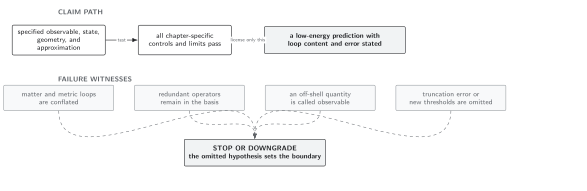
Threshold matching preserves the measured cosmological combination across EFT descriptions; treating that bookkeeping identity as a naturalness solution exceeds what the calculation establishes. The map is schematic and not to scale.
References
Section titled “References”- Appelquist, T., and J. Carazzone. “Infrared Singularities and Massive Fields.” Physical Review D 11, 2856–2861 (1975). doi:10.1103/PhysRevD.11.2856
- Weinberg, S. “The Cosmological Constant Problem.” Reviews of Modern Physics 61, 1–23 (1989). doi:10.1103/RevModPhys.61.1
Original QFT.org content:CC BY 4.0, unless an item supplies different terms. Third-party material retains its own terms.