

Energy-Constrained Capacity Under Redshift and Acceleration
A capacity is a rate for a specified coding task in a limit of many controlled channel uses. In a bosonic curved-field link, the statement is incomplete until the input and output Hamiltonians, local clock used to quote the rate, energy and bandwidth constraints, assistance, error criterion, and time dependence are declared. Redshift translates local energies and rates; it does not license switching among these conventions without an explicit map.
Required background. Redshift, Restricted Access, and Effective Channel Noise supplies the reduced channel. Energy-Constrained Capacities and Coding Tasks defines the asymptotic tasks. Infinite-Dimensional and Energy-Constrained Channel Distances supplies the appropriate topology and error control.
Helpful background. Operational Preparation Cost and Energy-Constrained Bounds interprets the code budget. Tolman Redshift, KMS Structure, and Local Temperature translates equilibrium noise. Energy Cost of Localization and Measurement adds laboratory costs.
Capacity needs a Hamiltonian and a task
Section titled “Capacity needs a Hamiltonian and a task”For an input reference Hamiltonian , the mean-energy-constrained state set is
For uses, the code must state whether the constraint is an average
or a maximum bound on every codeword. Classical capacity, quantum capacity, private capacity, and entanglement-assisted capacity optimize different codes and are not interchangeable. The rate can be bits per use, qubits per use, or divided by the sender’s or receiver’s proper duration.
An infinite-dimensional channel should also be energy limited. A useful Heisenberg-picture condition is
which bounds the output energy of every input in . The equivalence of standard energy-limitedness formulations and their role in energy-constrained norms are given by van Luijk 2025, § 1.1 and Lemma A.
Pure-loss bosonic benchmark
Section titled “Pure-loss bosonic benchmark”For a stationary single-mode pure-loss channel
let and . Define
The energy-constrained classical capacity is
bits per use. For the degradable pure-loss channel, the energy-constrained unassisted quantum capacity is
qubits per use; it is zero for . These are benchmark theorems for the memoryless pure-loss model, not formulas for arbitrary curved propagation. The Gaussian-channel capacity framework is developed by Holevo and Werner 2001, §§ IV–V, and degradability yields the pure-loss quantum expression Wolf, Pérez-García, and Giedke 2007, pp. 130501-1–130501-4.
A thermal-loss channel with environment occupation has added noise. Coherent-state encoding gives the achievable classical rate
but one must not promote this lower bound to the unrestricted capacity without the applicable optimality theorem. Likewise, a single-letter coherent-information value need not equal quantum capacity for a nondegradable or memory channel.
Separate sender and receiver energy constraints
Section titled “Separate sender and receiver energy constraints”For static laboratories, with . Suppose the deployed wavepacket channel has transmissivity and thermal occupation . The mean received energy, excluding the zero point, is
Impose independently
and, if the receiver hardware accepts mean energy no greater than ,
The permitted signal occupation is therefore
Insert into the pure-loss formulas only when ; otherwise use justified bounds for the thermal channel. This completes the first application: the redshift affects both the frequency in the energy Hamiltonian and any rate per local time, while and describe distinct loss and noise.
If one channel use occupies Killing-time interval , then and . The same bits-per-use capacity corresponds to
These are different local rates for the same sequence of uses, not competing capacity values.
Acceleration and nonstationary uses
Section titled “Acceleration and nonstationary uses”An accelerated or time-dependent protocol may produce a sequence with changing gain, noise, and proper-time separation. A memoryless stationary capacity formula is licensed only after showing that the uses are identical and independent, or after coding in blocks over which a controlled approximation holds. Otherwise the object is a capacity of a channel sequence, compound channel, or memory channel with its own coding theorem.
Finite switching and detector reset energy also matter. A detector gap sets one energy scale, the field wavepacket another, and external acceleration does work. A complete resource comparison states which costs are charged to the sender, receiver, and trajectory-control apparatus.
The unconstrained-rate adversarial test
Section titled “The unconstrained-rate adversarial test”First remove and optimize classical signaling over a bosonic pure-loss mode. Since grows without bound as , the per-use rate diverges; this is not the finite-resource protocol. Next retain a numerical but reinterpret it once as local sender energy and once as conserved Killing energy. Because for a static narrow mode, the allowed changes unless the bound is translated.
The surviving conclusion is either a capacity function with its Hamiltonian explicitly named or a rate for a fixed code. A bare number without coding limit, assistance, time unit, and energy convention is not meaningful.
Domain, limits, and maps
Section titled “Domain, limits, and maps”See Domain and failure conditions. The displayed capacity equalities apply to a memoryless pure-loss single mode. Real curved links can have multimode scattering, thermal or non-Gaussian noise, fading, detector saturation, clock drift, and backreaction. Current energy-limited channel theory controls finite-energy continuity; it does not make a physically changing channel stationary.
The structure map places the resource constraint at the task stage after the physical channel has been reconstructed. Inspect the energy and frame checkpoint before comparing rates between observers.

Transmissivity and noise define the physical channel; sender and receiver Hamiltonians, energy bounds, assistance, and time convention define the capacity task. Schematic; not to scale.
The failure map identifies a capacity without a code or energy model. Translating the local energy convention is the decisive repair.
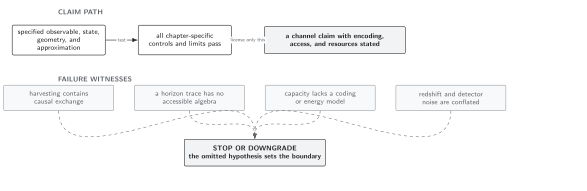
A capacity number is licensed only for a named channel sequence, coding task, error limit, reference Hamiltonian, and finite resource bound. Schematic; not to scale.
Handoffs
Section titled “Handoffs”Relativistic Protocols, Clocks, Encoding, and Channel Tomography estimates the deployed and noise. Abstract coding theorems belong to Energy-Constrained Capacities and Coding Tasks. Laboratory localization costs belong to Energy Cost of Localization and Measurement.
References
Section titled “References”- Holevo, Alexander S., and Reinhard F. Werner. “Evaluating Capacities of Bosonic Gaussian Channels.” Physical Review A 63 (2001): 032312. DOI. Open PDF.
- van Luijk, Lauritz. “Energy-Limited Quantum Dynamics.” Communications in Mathematical Physics 406 (2025): 120. DOI. Open access.
- Wolf, Michael M., David Pérez-García, and Géza Giedke. “Quantum Capacities of Bosonic Channels.” Physical Review Letters 98 (2007): 130501. DOI. Open PDF.
Original QFT.org content:CC BY 4.0, unless an item supplies different terms. Third-party material retains its own terms.