

Locally Covariant QFT and Dynamical Locality
Locally covariant QFT assigns one coherent theory to an entire category of spacetimes, not a separate algebra to each background. The source arrows preserve causal geometry; the target arrows preserve observables. Time-slice then makes Cauchy embeddings invertible, relative Cauchy evolution measures response to compact background changes, and dynamical locality tests whether that response recovers ordinary regional localization.
Helpful background. Local Covariance, Isometries, and Boundaries previews covariance across backgrounds. Relative Cauchy Evolution and Background Response supplies the physical response problem. Local Field Algebras, Causality, and the Time-Slice Property supplies the fixed-spacetime algebraic setting.
Enter this chapter
Section titled “Enter this chapter”The basic source object is an oriented, time-oriented globally hyperbolic spacetime with the site-wide convention. A standard Loc morphism is a causally convex, orientation- and time-orientation-preserving isometric embedding. The target Phys used for the central examples consists of unital -algebras and injective unit-preserving -homomorphisms. Other targets are possible, but every theorem below depends on which limits, equalizers, and unions of subobjects the target actually has.
A theory is a functor . Einstein causality constrains the images of two causally disjoint embeddings. The time-slice axiom says that is an isomorphism when contains a target Cauchy surface. A natural field is a transformation from test-function spaces to , while a theory embedding is a natural transformation between two such functors. These structures are related but none substitutes for another.
The chapter’s main implication chain is shown below. Read it from left to right, then follow the lower branch: time-slice licenses relative Cauchy evolution; exterior perturbations define the dynamical net; equality with the kinematic net licenses the same-physics theorem. The stress-tensor and natural-state results each require their own representation and regularity hypotheses.
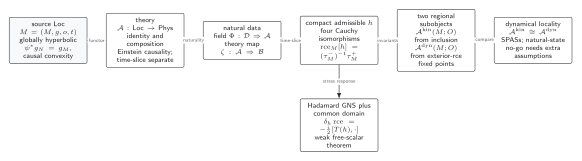
Loc objects and admissible embeddings provide the typed domain for the functor and natural fields. Cauchy morphisms plus time-slice—not causality alone—construct relative Cauchy evolution. Its differentiable free-field response is generated by stress–energy, while its exterior fixed subobjects define the dynamical net. Kinematic–dynamic equality supports the same-physics theorem; the natural-state obstruction additionally needs faithfulness, Reeh–Schlieder, noncompact Cauchy surfaces, and extended locality. Enriched boundaries and gauge backgrounds form a separate restricted branch. The diagram is schematic and not to scale. Structured description and source data (JSON)
The functorial framework originates in Brunetti, Fredenhagen, and Verch 2003, §§ 2.2, 2.5, and 4, pp. 5–13 and 21–29. Dynamical localization and its same-physics and natural-state theorems are stated with their categorical hypotheses in Fewster and Verch 2012, §§ 5–6, pp. 29–43.
The chapter sequence
Section titled “The chapter sequence”Read the pages in this order.
- Globally hyperbolic spacetimes and the Loc categories defines the source objects, causally convex embeddings, and Cauchy morphisms.
- Locally covariant QFT as a functor types the algebra assignment and separates functoriality, Einstein causality, and time-slice.
- Natural transformations, fields, and subtheory embeddings makes field covariance and comparisons between theories into commuting squares.
- Time-slice axiom and relative Cauchy evolution composes four Cauchy isomorphisms around a compact metric perturbation.
- Stress–energy response and background variation states when the weak derivative of that automorphism is a stress-tensor commutator.
- Dynamical locality and kinematic–dynamic nets compares regional embeddings with invariance under exterior perturbations.
- The same-physics-in-all-spacetimes principle shows how dynamical locality excludes diagonal species-changing counterexamples.
- No-natural-state results and covariant state spaces distinguishes a natural state from a covariant class of admissible states.
- Local covariance with boundaries and background structures enriches objects and arrows for sources, bundles, gauge topology, and fixed boundary data.
- LCQFT, nets, fields, and factorization: typed comparisons records the valid directional constructions and conditional converses.
This order keeps geometry ahead of algebra transport and finite background comparison ahead of differentiation. It also keeps a theorem about dynamically local theories separate from the definition of an LCQFT.
Hypotheses and licensed conclusions
Section titled “Hypotheses and licensed conclusions”| Object and domain | Required hypotheses | Licensed conclusion | Excluded converse or upgrade | Adversarial check |
|---|---|---|---|---|
| Embedding between oriented, time-oriented globally hyperbolic spacetimes | Same dimension; isometric; orientation- and time-orientation-preserving; causally convex open image | A Loc morphism that preserves causal propagation and composes with other admissible embeddings | An arbitrary isometric open embedding is not admissible, and a Loc morphism need not be Cauchy | Let a target causal curve leave and re-enter the image and test Green-operator intertwining |
| Functor $\mathcal A:\mathsf{Loc}\to\mathsf{Phys}$ | Identity and composition; injective $*$-maps; Einstein causality and time-slice imposed separately | Coherent observable transport, spacelike commutation, and isomorphisms for Cauchy morphisms | Functoriality alone supplies neither causality nor time-slice, and no preferred state follows | Use a non-causally-convex embedding and compare the transported Klein–Gordon commutator |
| Field or theory transformation | A component on every object and a commuting naturality square for every Loc morphism | A locally covariant field, subtheory embedding, or natural equivalence with a fixed direction | Objectwise formulas or one component isomorphism do not form a natural transformation or equivalence | Choose curvature-renormalization constants independently on embedded spacetimes |
| Compact metric perturbation and its represented derivative | Both metrics globally hyperbolic; four Cauchy maps; time-slice; for the derivative, a Hadamard representation, common domain, and differentiability | A relative-Cauchy automorphism; in the free scalar theorem, weak generation by the smeared renormalized stress tensor | Finite rce does not imply a norm derivative or an abstract inner derivation | Pass through a nonglobally hyperbolic metric, or add a nonconserved curvature term and test a compact diffeomorphism |
| Kinematic and dynamical regional subobjects | Time-slice, admissible exterior metric perturbations, and target equalizers/unions; model-specific support theorem | Equality for the massive scalar and stated reduced gauge theories; regional localization is recovered dynamically | Exterior invariance alone does not prove kinematic localization | Retain a locally constant massless mode or a universal Maxwell flux observable |
| Natural transformation between dynamically local theories | Dynamical locality for both theories and one component isomorphism; categorical subobject hypotheses | The transformation is a natural isomorphism on all spacetimes | One-spacetime agreement between unrestricted LCQFTs does not imply same physics everywhere | Construct a diagonal theory whose species number changes with the spacetime class |
| Natural state or boundary-enriched theory | For the no-go theorem: dynamical locality, faithful Reeh–Schlieder GNS on a noncompact-Cauchy spacetime, and extended locality; for boundaries: fixed well-posed boundary data preserved by arrows | The natural state forces trivial rce and, with the full hypotheses, a trivial theory; a fixed-boundary propagator may define a restricted functor | No-natural-state does not mean no Hadamard states, and a fixed Robin construction is not generic boundary covariance | Confuse a covariant state space with one natural section, or change the Robin parameter while keeping the same propagator map |
Structured table data (JSON) preserves the caption, scoped headers, rows, and reading order.
The rows expose where the most tempting shortcuts break. Causal convexity is necessary before propagators can be transported; time-slice is necessary before relative Cauchy evolution can be formed; differentiability and a controlled domain are necessary before a stress tensor can generate its variation; and dynamical locality is necessary before a one-spacetime isomorphism can propagate through the theory class.
The failure map gathers these obstructions by the first unavailable inference. Inspect the surviving lower statement in each branch: the massless scalar remains a functor but not dynamically local in its unreduced form, and a covariant Hadamard state space survives even when no preferred natural state does.
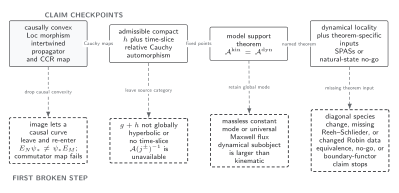
Each dashed branch removes one named hypothesis. Non-causal convexity destroys the Green-operator square; a nonglobally hyperbolic perturbation removes the four Cauchy maps; locally constant scalar modes and universal Maxwell fluxes remain exterior-invariant without being kinematically local; a diagonal theory defeats one-component equivalence; and the no-natural-state conclusion stops if faithfulness, Reeh–Schlieder, dynamical locality, noncompact Cauchy surfaces, or extended locality is unavailable. Boundary-changing arrows fail for a different reason: they do not preserve the operator domain. The diagram is schematic and not to scale. Structured description and source data (JSON)
Scope boundaries
Section titled “Scope boundaries”The chapter develops the categorical and theorem-level structure. Physical calculations of particle creation, curved-spacetime expectation values, and semiclassical backreaction remain in the curved-spacetime volume. Category-theory foundations are assumed rather than rebuilt here. A locally covariant functor is not automatically a Wightman theory, a net on one fixed spacetime, or a factorization algebra; the final page states only the constructions supported by explicit hypotheses.
Boundaries and gauge topology are correspondingly restricted. The Poincaré-AdS scalar example fixes an admissible boundary condition and uses a proved propagator construction. It does not authorize arbitrary changes of boundary data or a functor on all asymptotically AdS spacetimes. The reduced Maxwell theory restores injective covariance and dynamical locality by discarding topological observables, so the recovery has a stated cost.
Review the chapter
Section titled “Review the chapter”For a proposed locally covariant model, answer these questions in order.
- What data are carried by each source object, and what exactly must a morphism preserve?
- Is every image causally convex, and which morphisms contain a target Cauchy surface?
- What is the target category, and does it possess the subobjects, equalizers, and unions used later?
- Does the algebra assignment preserve identities, composition, field equations, involution, and commutators?
- Where are Einstein causality and time-slice proved rather than assumed?
- For relative Cauchy evolution, do both metrics remain objects and do all four Cauchy isomorphisms exist?
- In a response claim, what topology, representation, common domain, and renormalized generator are used?
- Do kinematic and dynamical subobjects agree, and have zero-mode and topological sectors been tested?
- Is a same-physics or state-selection conclusion using every hypothesis of its theorem?
- Does a comparison preserve cross-spacetime maps, or only data on one Lorentzian manifold?
Synthesis exercise
Section titled “Synthesis exercise”A free field theory is functorial and obeys Einstein causality. Its algebras agree with another theory on Minkowski spacetime, and each curved spacetime admits Hadamard states. May one conclude that the two theories are naturally equivalent, that relative Cauchy evolution exists, or that there is a preferred natural Hadamard state?
Solution
No. Agreement on one object is insufficient without a natural transformation and a theorem such as the dynamically local SPASs result. Relative Cauchy evolution additionally requires the time-slice axiom and admissible compact background perturbations. A covariant nonempty class of Hadamard states is not one natural section; the no-natural-state theorem explains why a nontrivial dynamically local theory generally cannot make such a preferred choice under its full representation and locality assumptions.
References
Section titled “References”- Benini, Marco, Marco Perin, and Alexander Schenkel. “Model-Independent Comparison Between Factorization Algebras and Algebraic Quantum Field Theory on Lorentzian Manifolds.” Communications in Mathematical Physics 377 (2020): 971–997. DOI; Open PDF.
- Brunetti, Romeo, Klaus Fredenhagen, and Rainer Verch. “The Generally Covariant Locality Principle—A New Paradigm for Local Quantum Physics.” Communications in Mathematical Physics 237 (2003): 31–68. DOI; Open PDF.
- Fewster, Christopher J., and Benjamin Lang. “Dynamical Locality of the Free Maxwell Field.” Annales Henri Poincaré 17 (2016): 401–436. DOI; Open PDF.
- Fewster, Christopher J., and Rainer Verch. “Dynamical Locality and Covariance: What Makes a Physical Theory the Same in All Spacetimes?” Annales Henri Poincaré 13 (2012): 1613–1674. DOI; Open PDF.
Original QFT.org content:CC BY 4.0, unless an item supplies different terms. Third-party material retains its own terms.